


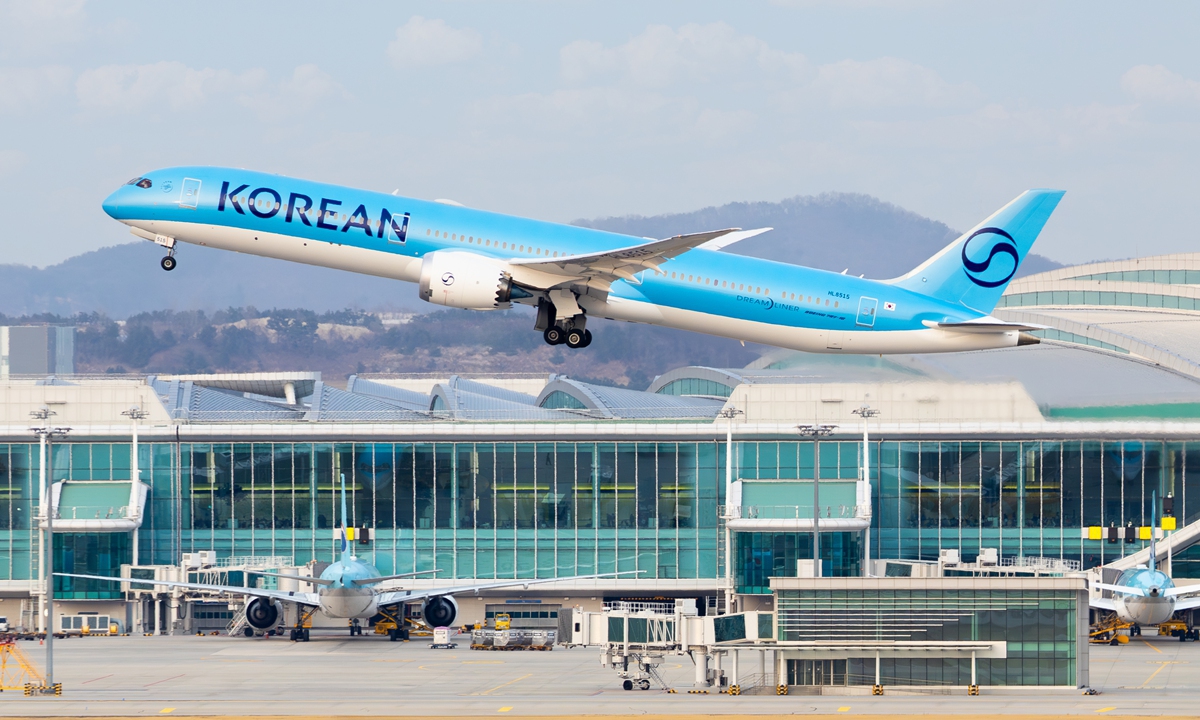
Photo: Courtesy of Korean Air
South Korea and China have agreed to expand weekly flight rights between the countries for the first time in seven years, Reuters reported on Thursday, citing Seoul's transport ministry.
A Chinese expert said this move reflects improved bilateral relations, alongside growing demand including tourism and business. The move benefits both sides and sets a positive example for travel and cooperation in Northeast Asia and beyond, the expert said.
The agreement, reached at bilateral aviation talks held in Seoul on May 27 and 28, will increase passenger flight rights by 56 weekly flights to 664 from 608, and cargo rights by 14 weekly flights to 68 from 54, the Ministry of Land, Infrastructure and Transport was quoted in Reuters report.
The ministry said that the deal would make it easier to add flights on high-demand routes such as Incheon to Shanghai and Incheon to Guangzhou, where existing rights had been fully used by both sides.
It will also expand routes from South Korea's regional airports, including Busan and Cheongju, to 10 Chinese cities such as Guangzhou, Chengdu, Shenzhen, Chongqing and Xi'an, the ministry said in the report.
Korean Air told the Global Times on Thursday that the specific results of the flight rights allocation may still take some time to emerge.
This expansion of flight rights between China and South Korea reflects both the improvement in bilateral relations, as well as the growing demand for tourism, business, investment, and people-to-people exchanges, Da Zhigang, a researcher at the Institute of Northeast Asian Studies at the Heilongjiang Provincial Academy of Social Sciences, told the Global Times on Thursday.
He said that visa-free policies and travel facilitation measures by both China and South Korea, driven by tourism as a key link for exchanges and trade, have laid the groundwork for expanding flight rights.
Data from industry information provider VariFlight sent to the Global Times on Thursday showed that from May 21 to June 3, the number of flights between the Chinese mainland and South Korea reached 4,706, an increase of 2.3 percent compared with the period from May 7 to May 20, indicating that the scale of operations on the China-South Korea route had maintained a slight upward trend.
Compared with the same period in 2025, the number of flights increased by 290, a year-on-year increase of 6.6 percent, indicating that the market for this route had recovered and expanded to some extent, VariFlight said.
From January to April, the average passenger load factor on Korean Air's routes to China stood at 88 percent, an increase of 11 percentage points year-on-year, Korean Air previously told the Global Times.
The Yonhap News Agency reported on Thursday that the number of passengers traveling to China from South Korea had rebounded to surpass the level seen before the COVID-19 pandemic, with nearly 4.4 million using the route in the first quarter of this year, citing ministry data.
With the growing cooperation potential in areas such as artificial intelligence, green energy, and advanced manufacturing, bilateral economic and trade ties are gradually shifting from the past vertical division of labor toward higher-level industrial collaboration, Da added.
Xiong Jijun, vice MIIT minister, met with Park Sung-taek, president of SK China, in Beijing on Thursday.
Xiong said that it is hoped that SK Group will take an active part in China's new industrialization drive, further deepen its presence and investment in the Chinese market, build steady and predictable supply-demand partnerships with more domestic Chinese companies, and elevate bilateral industrial cooperation to new heights.
Park said that SK Group holds full confidence in China's economic outlook and business environment. The conglomerate stands ready to press ahead with investment and its business layout in China to facilitate high-quality coordinated industrial development between the two countries.
South Korea's exports surged 53.2 percent year-on-year to a new monthly high of $87.8 billion in May, the Yonhap News Agency reported on Monday, citing data from the country's Ministry of Trade, Industry and Resources. By destination, exports to China rose 80.9 percent year-on-year to $18.9 billion in May, far outpacing the country's overall export growth rate.