


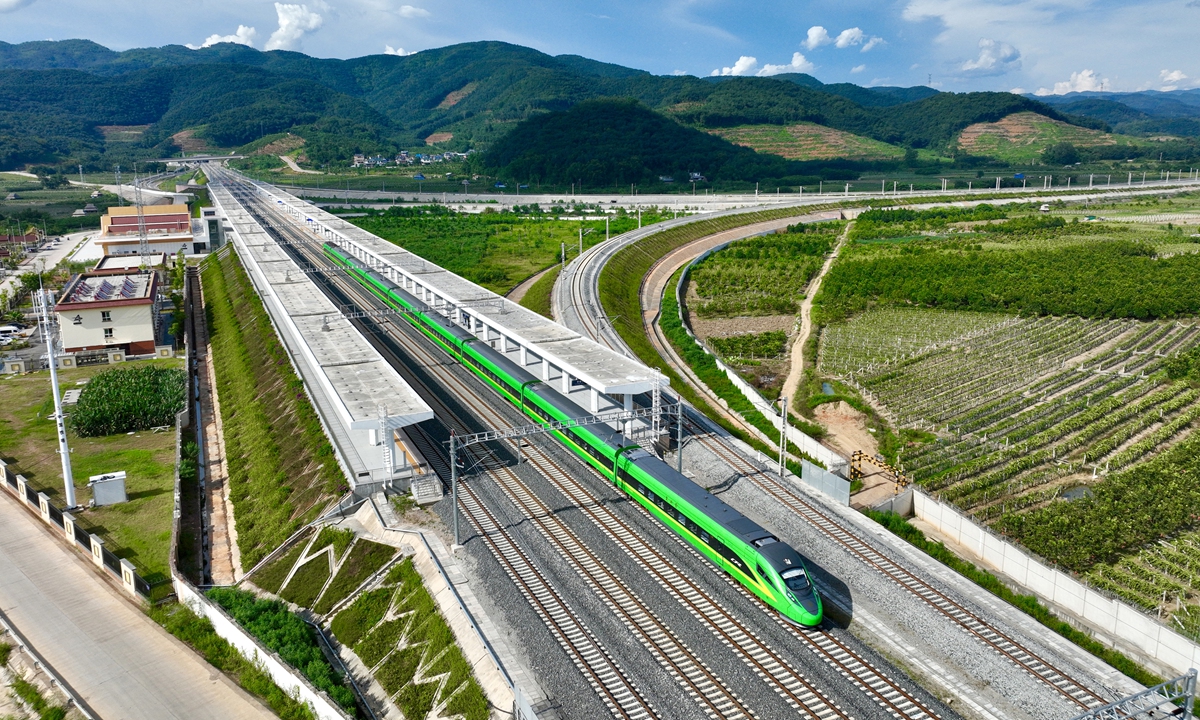
A bullet train runs along the China-Laos Railway. (File photo: VCG)
The global economic landscape is undergoing profound adjustment. According to forecasts by the International Monetary Fund (IMF), despite uncertainties such as energy market fluctuations, Asia continues to demonstrate strong economic resilience.
The IMF projected in April that Asia's economy will grow by 4.4 percent in 2026, remaining the main driver of global growth. Against this backdrop, the traditional factor-driven growth model is giving way to one powered by technological innovation, with artificial intelligence (AI) ushering in a new growth cycle across Asia.
Based on current growth trends, Asia is well positioned to become the world's fastest and most extensive adopter of AI technology. On the one hand, the region is home to the world's most concentrated manufacturing clusters. On the other, it boasts a vast internet user base and a rich array of mobile internet consumption scenarios.
According to the 57th Statistical Report on Internet Development in China released by the China Internet Network Information Center (CNNIC), as of December 2025, the number of generative AI users in China had reached 602 million, with a penetration rate of 42.8 percent.
These advantages provide favorable conditions for AI research and development and its commercialization. Whether in consumer-facing applications or industrial AI solutions, Asian markets are capable of rapidly translating technological innovations into daily use.
China's AI innovations are increasingly integrating with the real economy. In manufacturing, AI is deeply embedded in production processes, enhancing product quality and energy efficiency while accelerating the development of smarter factories.
China had built more than 35,000 basic-level, more than 8,200 advanced-level, over 500 excellence-level smart factories nationwide by the end of 2025, which make it the world's largest intelligent manufacturing base, according to the Ministry of Industry and Information Technology (MIIT). In e-commerce and foreign trade, the widespread adoption of AI technology and intelligent supply chain management tools has significantly reduced the cost of cross-border business operations.
As industrial integration and trade ties deepen across Asia, the application of Chinese AI innovations is expected to further promote regional economic and trade cooperation.
In supply chain management, AI can enhance the efficiency of logistics, warehousing and production coordination, helping businesses optimize resource allocation. In cross-border trade, intelligent translation and digital marketing tools help lower barriers for small and medium-sized enterprises to participate in international markets, enabling them to integrate into global trade networks.
Meanwhile, China's smart manufacturing technology is helping some Asian economies move into making higher value-added manufactured products. In recent years, multiple Chinese cities have begun exploring cross-border computing power cooperation projects.
Led by the China-ASEAN Free Trade Area (FTA) 3.0 version, cooperation between China and ASEAN in digital infrastructure, AI application, and digital governance are gaining pace.
On the one hand, both sides can strengthen collaboration in computing power, cloud services, and cross-border digital connectivity to promote regional digital cooperation. On the other hand, coordination on cross-border data flow, cyber-security, and digital governance will provide a solid foundation for the secure development of the regional digital ecosystem.

Li Tianguo (Photo: Courtesy of Li Tianguo)
Asia's AI industrial chain is increasingly comprehensive, covering key segments such as semiconductors, computing infrastructure, robotics, and intelligent terminals. As a major manufacturing and innovation hub in the region, China is playing an important role as both a technological enabler of Asia's digital economy and a co-builder of regional standards and governance.
China has developed a massive industrial ecosystem encompassing computing power and telecommunications infrastructure. The country possesses strong capabilities in data center construction, server manufacturing, and AI chip designing, enabling large-scale deployment of computing resources.
In the field of making intelligent devices, China's manufacturing supply chain facilitates the rapid commercialization of smart robots and vehicles. At the same time, China has accumulated extensive industrial data and practical experience, supporting AI adoption across manufacturing, logistics, retail, and other sectors.
AI is now reshaping the way Asia's economies grow and develop. Leveraging its strength in digital infrastructure, industrial application and innovation, China is expected to play an even greater role in advancing regional digital economic cooperation. As industrial collaboration continues to expand, AI will not only drive China's economic transformation and upgrading but also create new opportunities for high-quality development across Asia.