


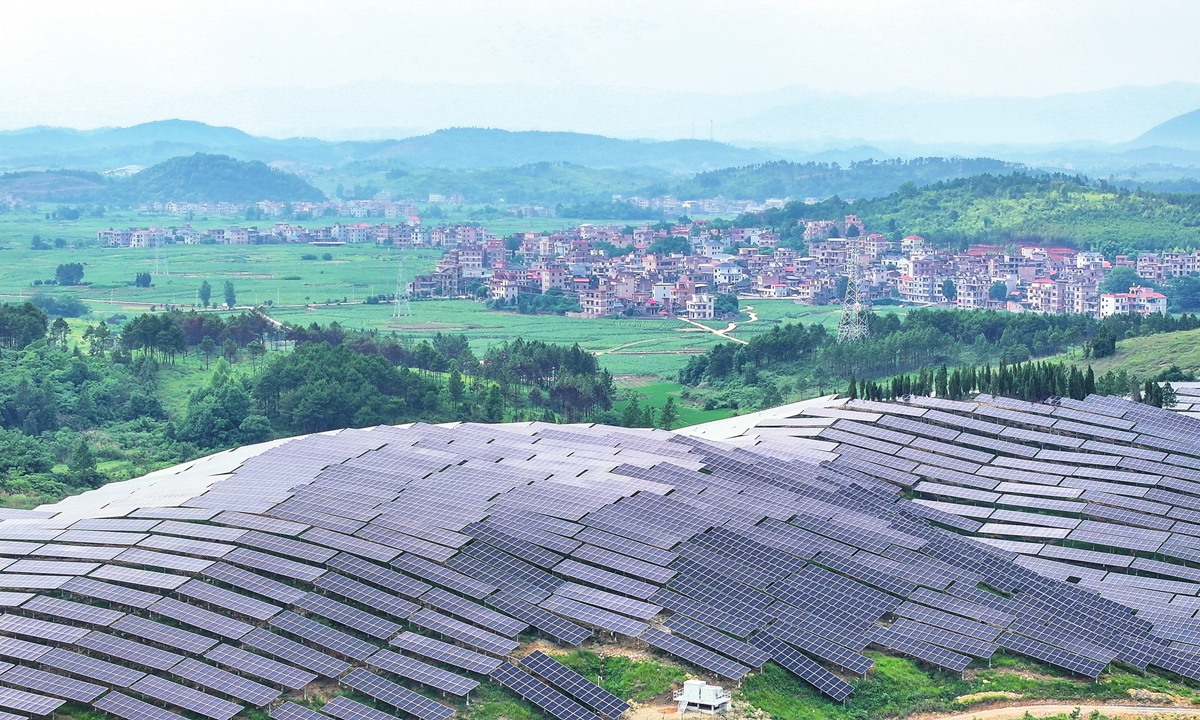
A view of a photovoltaic farm in a village in Yongzhou, Central China's Hunan Province, on June 1, 2026 (Photo: VCG)
The number of low-carbon industrial projects that have secured funding over the last six months has more than doubled year-on-year to 19, worth $43 billion, with the bulk of them in China, Reuters reported, citing a report by a research institute.
Some 13 of the projects that reached a final investment decision from November to April were in China, ranging from methanol to aluminum, per a report by the Mission Possible Partnership (MPP), a US-based non-profit group seeking to boost the growth of low-emission industries and supported by the Bezos Earth Fund and the World Economic Forum.
The report is one of the latest by a Western research institute acknowledging China's progress in green development and rising global role.
Amid the growing importance the Chinese government placing on making its vast industrial sector greener and less polluting, a Chinese analyst said the findings of the MPP report are not surprising, as China holds significant advantages in the development of green industries and plays a major leading role in advancing global climate governance and the green transition.
According to the MPP report, only eight projects secured funding in the same period a year ago. Global green industrial investment has seen acceleration with the situation in the Strait of Hormuz pushing up prices of fossil fuels, according to the report.
The report also noted that the US lags behind in this development, with only one of 13 projects being in the US.
Globally, the total pipeline of announced low-carbon industrial projects is 969 in sectors that include chemicals, aviation, cement and metals, according to the MPP.
Among them, China accounts for 170 of the announced projects, while so-called "sunbelt" countries including India and Brazil have 318, Europe with 211 and the US at 72. "The US has a significant pipeline, but is losing relative momentum," the report said.
"China has made solid progress in its green transition, with the synergy between green development for its industrial sectors and industrialization of its green technologies accelerating. Moreover, supportive policies for green finance have been effectively implemented, and the financial market's role in channeling capital toward low-carbon sectors has been steadily enhanced," Sun Chuanwang, a professor at the School of Economics at Xiamen University, told the Global Times on Monday.
The rising share of low-carbon industrial projects helps consolidate the foundation for the green and low-carbon transformation of traditional industries, continuously optimize product and energy structures, and upgrade the manufacturing production method, Sun said.
China has made concrete progress in green transition of its industrial sector in recent years. According to a report by the Economic Information Daily on March 18, the Ministry of Industry and Information Technology announced that the country has newly cultivated a total of 2,038 green factories and 128 green industrial parks in the past year, as shown in the 2025 lists of green factories and green industrial parks.
In total, the MIIT had cultivated a total of 8,336 green factories nationwide by March, whose output value accounts for 22 percent of the total output value of industrial enterprises above the designated size, driving the establishment of more than 16,000 provincial and municipal green factories across the country.
Meanwhile, the MIIT has cultivated a total of 616 green industrial parks, where energy consumption per unit of industrial added value is only two-thirds of the national average, water consumption per unit has dropped to one-quarter of the national average, and the comprehensive utilization rate of solid waste exceeds 95 percent, demonstrating the sustained effect of promoting regional green transformation.
Innovation in new technologies and equipment is leading the development of green factories and green industrial parks, and having more low-carbon industrial projects helps foster a new level of green development in emerging industries, fully leverages the long-term growth potential of competitive green sectors, and provides strong support for achieving the national goals of carbon peak and carbon neutrality, the expert said.