


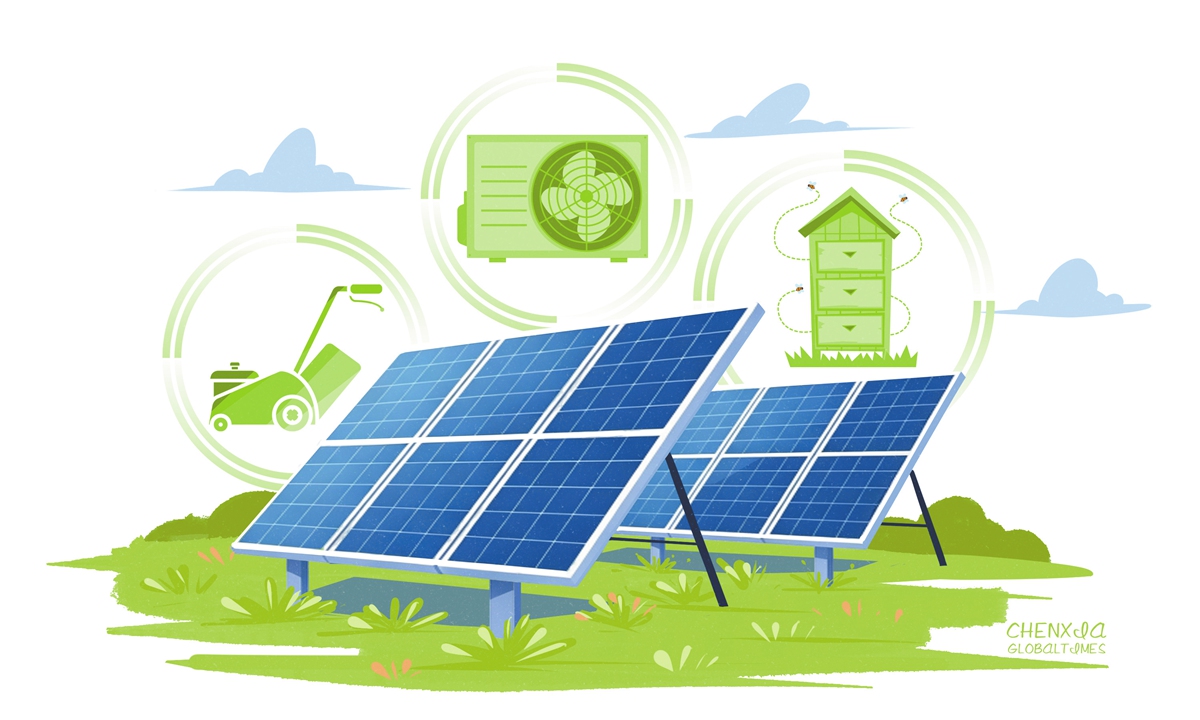
Illustration: Chen Xia/GT
While some Western commentators continue to view China's photovoltaic (PV) industry through a biased lens of "overcapacity," a more grounded perspective can be found in Dawushan Village, a small settlement tucked into the mountains of East China's Zhejiang Province. According to a report published by the People's Daily on Monday, reaching the village requires a long walk along steep mountain paths. Yet the village now has reliable electricity to meet daily needs.
Forage cutters operate normally, thermostatically controlled beehives maintain stable conditions, and air conditioners can run throughout the summer months. The experience of Dawushan draws attention to an aspect of the PV industry that often receives less attention in international debates. While discussion frequently centers on trade disputes and competitive dynamics, the village raises a more practical question: how can solar technology expand access to reliable electricity in areas where conventional infrastructure is difficult to deploy?
Large-scale power grids and long-distance transmission remain essential parts of modern energy systems. But in remote, mountainous areas, these networks face inherent constraints. Installing power lines along steep terrain is technically difficult and costly, and aging infrastructure can be vulnerable to disruption during extreme weather. Solar power, by contrast, offers a more flexible solution. According to the People's Daily, Dawushan Village has installed an off-grid solar-plus-storage system comprising 4 kilowatts of PV panels paired with a 16-kilowatt-hour battery. The system provides people deep in the mountains with a stable, clean source of electricity.
Dawushan is far from an isolated example. Viewed on a broader scale, several new developments, including distributed PV systems, are increasingly demonstrating their value in areas where traditional power supply faces practical constraints. Distributed PV systems, in particular, can be installed on-site, allowing electricity to be generated and consumed locally while offering considerable flexibility in deployment. In remote mountainous regions, on islands, or any location where extending the grid is costly or technically challenging, such systems can serve either as an alternative to conventional supply or as a complement to existing networks, providing reliable electricity without the need for major infrastructure expansion.
Distributed PV technology in China is highly mature, and it is playing a growing role in strengthening electricity supply across a wide range of regions. According to a report published by the Economic Daily in May, the country's total installed solar power capacity stood at 1.2 billion kilowatts as of the end of 2025. Distributed PV accounted for 44.2 percent of the total, with cumulative installed capacity reaching 530 million kilowatts.
For example, in Taxkorgan Tajik Autonomous County, Northwest China's Xinjiang Uygur Autonomous Region, high altitude and a remote location once led to serious electricity supply challenges. However, distributed PV systems have effectively resolved these difficulties, laying a solid power foundation for both livelihoods and economic development, the Guojia Nengyuan Jituan Bao newspaper reported in April.
Taken together, these cases point to how PV technology is being deployed in practice. Its relatively light infrastructure requirements underscore one of the practical advantages offered by renewable energy development.
Electricity is a basic input to both living standards and economic activity. The expansion of PV deployment therefore has implications for local development. It also points to the potential for international cooperation in the solar sector to deliver practical gains, including investment and broader access to reliable energy.
Chinese companies are actively participating in the construction of PV power stations in developing countries, creating jobs, providing clean energy, and generating economic benefits for local communities.
For example, most rural areas in Ethiopia are far from the main electricity grid. Off-grid PV power station projects, which offer advantages such as rapid electrification, low cost, and sustainability, have been promoted as an important step in local electricity access. Chinese enterprises have made significant contributions to this effort, according to a People's Daily report in October 2025.
The applications of PV technology continue to broaden. International discussion of the solar sector could usefully focus on how to extend the benefits of this growth, rather than on narratives of market share or geopolitical competition that have featured in parts of Western commentary. The experience of Dawushan Village in China provides a concrete example of the practical value PV systems can deliver. That value is not limited to any one region and can be shared more widely through international cooperation grounded in mutual benefit and tangible outcomes.