


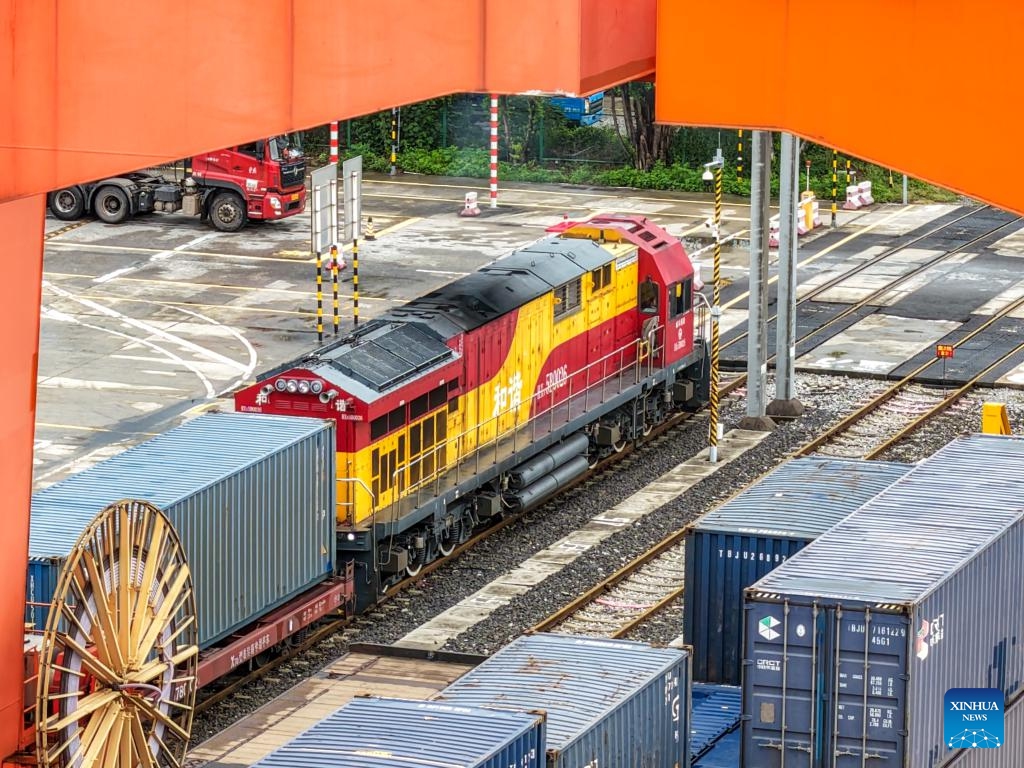
A drone photo taken on Sept. 13, 2025 shows a freight train bound for Central Asia loaded with auto parts, laptops and other goods waiting for departure at Tuanjiecun Station in Chongqing, southwest China. In the first eight months of this year, 35 freight trains have been dispatched from Chongqing to Central Asia, with a container volume of more than 3,000 TEUs and a total value of nearly 600 million yuan (about 84.2 million U.S. dollars), according to statistics from the Chongqing Railway Logistics Center. (Photo: Xinhua)
The 9th China-Eurasia Expo will be held from June 25 to 29 in Urumqi, capital city of Northwest China's Xinjiang Uygur Autonomous Region, officials from the Ministry of Commerce (MOFCOM) announced on Tuesday.
The event has already secured participation from 27 countries, regions and international organizations, with more than 2,000 companies and institutions confirming their attendance, a record high, according to the MOFCOM.
The expo will witness multiple highlights this year. The UAE, South Korea, Russia and Thailand will debut their national pavilions to display their competitive industries and signature products. Meanwhile, it will launch a dedicated zone for new quality productive forces for the first time, featuring cutting-edge fields including digital technology, intelligent equipment, low-altitude economy and advanced manufacturing.
The zone focuses on frontier industries and systematically presents new technologies, applications and solutions in digital technology, intelligent equipment, low-altitude economy and advanced manufacturing. It is designed to offer immersive, interactive experiences, allowing visitors to see, test and explore potential collaborations around latest technological innovations.
The expo will be a carbon-neutral event with full carbon accounting and offset measures, while AI-powered services are deployed to deliver smart experiences.
Focusing on trade promotion, investment cooperation, consumption expansion and innovation cooperation, the expo will hold more than 80 events including product launches, cross-border economic and trade fairs, and investment promotion activities.
Specialized matchmaking events — such as the "Export to China" Kazakhstan session and dialogues between Chinese enterprises and Central Asian markets — will help build direct bridges between suppliers and buyers.
The Expo builds a mutually beneficial cooperation ecosystem for all participating economies. It offers a platform for Eurasian countries to showcase their featured products, while enabling deeper collaboration on industrial advantages and investment opportunities across the region, Hu Qimu, a professor at the Maritime Silk Road Institute of Huaqiao University, told the Global Times on Tuesday.
China-Eurasia economic and trade cooperation focuses on the digital economy, AI, advanced manufacturing, and other emerging frontier fields. Through joint exploration and technology alignment, the partnership prioritizes green, low-carbon, and high-end technologies, supporting the region's collective push toward high-end, intelligent, and green industrial upgrading, Hu said.
The expo comes as China-Central Asia goods trade exceeded $100 billion for the first time in 2025, making China the largest trading partner and a major source of investment for Central Asian countries, the MOFCOM said.
In 2025, China's exports to Central Asia reached $71.2 billion, a year-on-year increase of 11 percent, driven by strong growth in mechanical and electrical products and high-tech products. Imports from Central Asia stood at $35.1 billion, a year-on-year increase of 14 percent, according to Xinhua.
China will deepen and upgrade economic and trade cooperation with Central Asian countries, the MOFCOM said.
Zhang Dong, an official from China’s Ministry of Commerce, said that China will keep strengthening trade in energy, minerals, and other bulk commodities while supporting Central Asian countries in expanding their exports of non‑resource goods and agricultural products to China.
Meanwhile, China will foster new growth drivers including services trade, digital trade, and cross‑border e‑commerce, advance cooperation in minerals, new energy, digital economy, and advanced manufacturing, and leverage investment funds to boost industrial upgrading and build resilient industrial and supply chains.