


More and more German companies are ramping up their investments in east China's Jiangsu Province.
In 2025, the value of imports and exports between Jiangsu and Germany reached $31.9 billion, and in the first quarter of 2026, it increased 24.4 percent year on year. By the end of April 2026, the province was home to 2,455 German-funded enterprises, with a growing number of so-called "hidden champions" woven into Jiangsu's supply chains for high-end equipment, new energy vehicles (NEVs), and auto parts.
Hidden champions refer to highly successful yet lesser-known small and medium-sized enterprises that are global leaders in terms of market share in their respective niches.
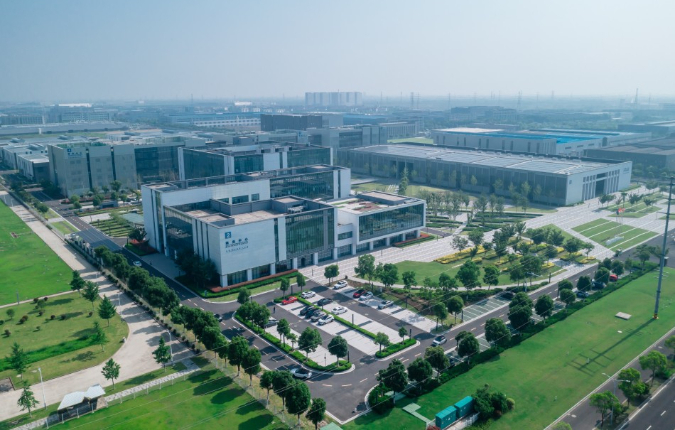
A bird's eye view of the Sino-German (Changzhou) Innovation Industry Park in Changzhou, east China's Jiangsu Province. (Photo: Xinhua)
When German company RAPA Group first entered China in 2020, it set up a trading company in Shanghai. According to Roman Pausch, the group's chairman, the group was watching whether China's NEV sector would truly take off and whether local supply chains could support a long-term commitment.
Now, the group's subsidiary, RAPA Electromagnetic Technology (Jiangsu) Co., Ltd., located in the Sino-German (Changzhou) Innovation Industry Park in Changzhou, Jiangsu Province, produces solenoid valves for air suspension systems used in NEVs rolling off assembly lines across China.
Sales, which stood at roughly 5 million yuan (about $738,132) when the group entered China, are expected to approach 900 million yuan this year.
"Even we didn't expect growth to be this fast," said Wang Zinan, the group's executive partner for China. The local R&D team has grown to more than 30 people, with an increasing share of product development driven by the specific demands of China's new energy market.
What has impressed many German firms is the coordination capacity of China's manufacturing ecosystem and supply chains. Tooling, component sourcing, product validation, and engineering iteration often advance in parallel. Processes that once required cross-regional coordination can now be completed within a single industrial park or within a radius of just a few kilometers.
Nearly 30 German companies are now participating in the development of Changzhou's new energy supply chain, forming what has been described as a "German firms plus Changzhou manufacturing" collaborative model. To date, the Sino-German (Changzhou) Innovation Industry Park has attracted 91 enterprises from German-speaking regions, with total investment exceeding 2.4 billion euros, more than 60 percent of them hidden champions.
At a joint laboratory on advanced manufacturing established by Siemens and the Nanjing Institute of Technology in Nanjing, a digital production line runs continuously, while Siemens engineers regularly visit to discuss equipment operation with faculty members and students.
The institute first imported a batch of CNC machine tools from Germany in the 1980s and was among the earliest universities in China to offer a CNC program. Over the following decades, the partnership steadily expanded—from a CNC training center to a joint lab, and now to the joint laboratory on advanced manufacturing. The collaboration has also deepened in scope, extending from classroom instruction to joint R&D, talent cultivation, and industry collaboration.
A growing number of German companies are now relocating their R&D, testing, and even global innovation operations to China.
Germany is now Nanjing's largest European trade partner. In 2025, bilateral trade exceeded $4.2 billion, accounting for one-quarter of Nanjing's total trade with Europe. The establishment of projects in Nanjing, including BMW's global IT R&D center and the BSH global R&D center, reflects a shift in German investment from traditional manufacturing toward R&D, digital services and innovation platforms.