


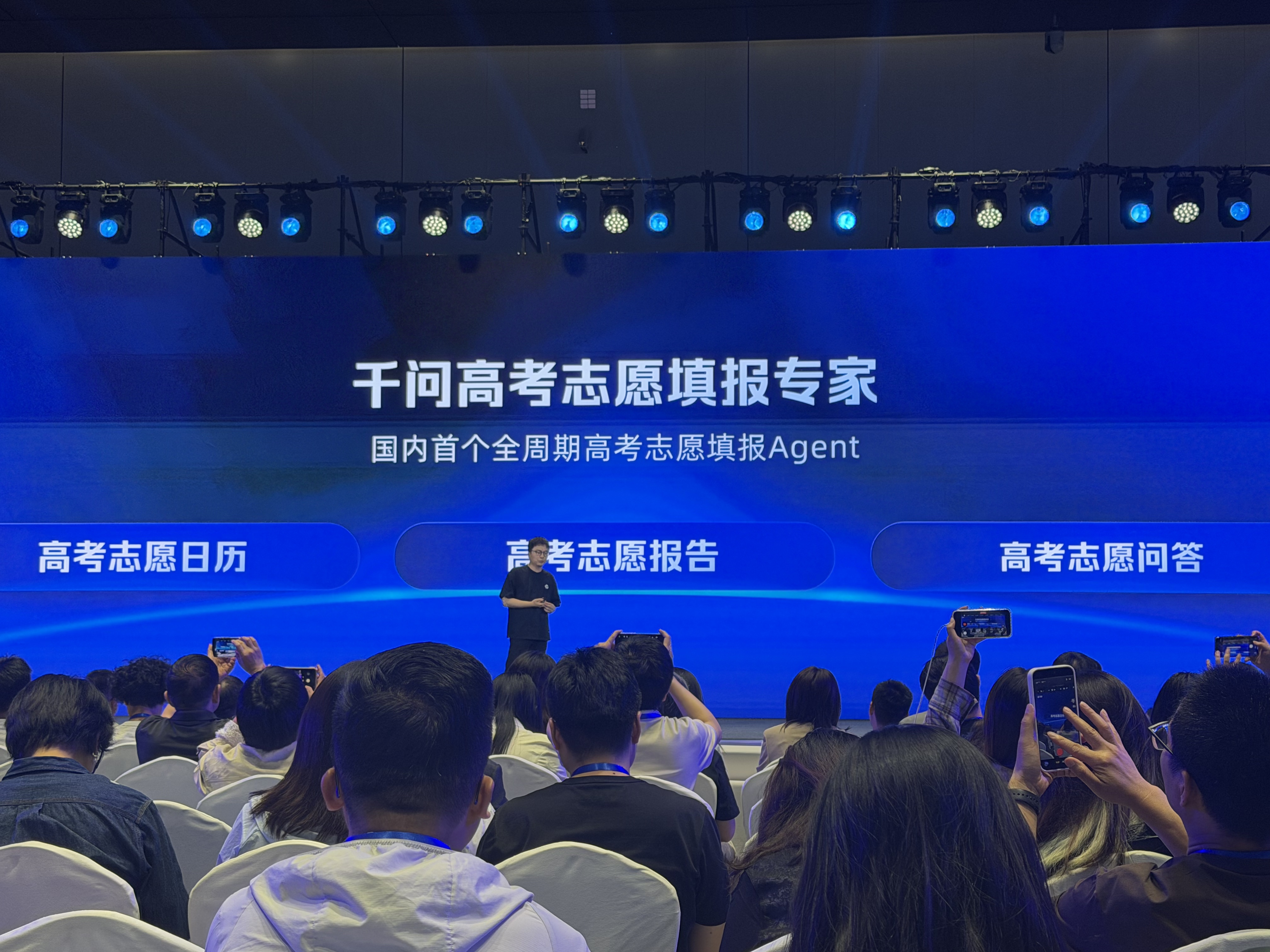
People attend the launch event for the Qianwen AI college-admission advisory agent in Beijing on June 10, 2026. (Photo: Zhang Weilan/GT)
Alibaba's Qwen App on Wednesday unveiled an artificial intelligence (AI) agent for college admissions counseling, offering free consultation and application guidance to the nation's more than 10 million annual college entrance examinations (gokao) candidates. A Chinese expert said it marks an important development at the intersection of AI and educational decision-making – representing both a notable technical achievement and a potentially valuable public service.
Built on Qwen’s gaokao admissions large model and eight years of high-stakes exam data experience from Alibaba’s AI assistant Quark, the Qwen AI college admission advisory agent centers on three core functions: an “application report,” an “application calendar,” and an “application Q&A” service. Qwen told the Global Times on Wednesday that the tool is designed to be a personalized AI admissions expert for every gaokao candidate.
High-quality admissions counseling services in the market often cost more than 5,000 yuan ($737), Zheng Sishou, product lead of Qwen’s business unit, said at the agent’s launch event in Beijing. Its free service aims to provide customized admissions reports covering dozens of possible application combinations, Zheng added.
According to Zheng, more than 10 million students take gaokao each year in China, but fewer than 5 percent of families hire professional admissions consultants.
"Qwen hopes to provide every candidate with a free AI admissions expert," Zheng said.
The company said that the AI agent is built to be proactive and personalized, learning continuously from conversations about a student’s interests, preferred universities, target cities, personality traits, strengths, and even MBTI personality type.
Qwen said the agent not only incorporates professional admissions methods used by human experts, such as rank-based positioning, but also draws on historical university admissions data and user behavior patterns to produce recommendations that are more aligned with students’ real-world needs.
Based on a candidate's basic profile and preferences, Qwen’s AI agent generates a personalized "admissions report" for gaokao candidates. The report goes beyond raw scores and rankings; it also incorporates forward-looking career pathways, including employment prospects, civil service examination opportunities, graduate study prospects, and development trends in the AI era.
“Compared with other AI assistants, Qwen’s responses to gaokao-related questions are more restrained, rigorous, and accurate. The agent can call on a range of tools and human-expert methods, including rank-based positioning, to answer students’ questions,” said Jiang Guanjun, head of AI algorithms at Qwen’s business unit.
Jiang noted that college admissions decisions are extremely complex, involving 10 core dimensions including universities, majors, geography, and employment prospects, with the number of possible combinations theoretically reaching into the hundreds of millions.
Qwen said its admissions knowledge base covers nearly 3,000 universities and more than 2,000 majors nationwide, while also integrating unstructured information such as transfer policies, student reviews, and cafeteria quality.
To support candidates in county-level and rural areas and improve access to admissions guidance in underserved regions, the AI agent said it will also launch a public welfare initiative, which will provide admissions guidance to students in remote areas.
The Qwen agent should be viewed not as a decision-maker but as a decision-support tool. Its value lies not in telling students where to apply, but in helping them better understand the trade-offs among options they may not have previously considered, Wang Peng, an associate research fellow at the Beijing Academy of Social Sciences, told the Global Times on Wednesday.