


Chinese brands are gaining ground in South Korea, from electric vehicles (EVs) and smart devices to tea drinks and cosmetics, highlighting stronger competitiveness and a broader shift in bilateral ties toward more horizontal competition and cooperation amid closer, mutually beneficial economic engagement, Chinese analysts said.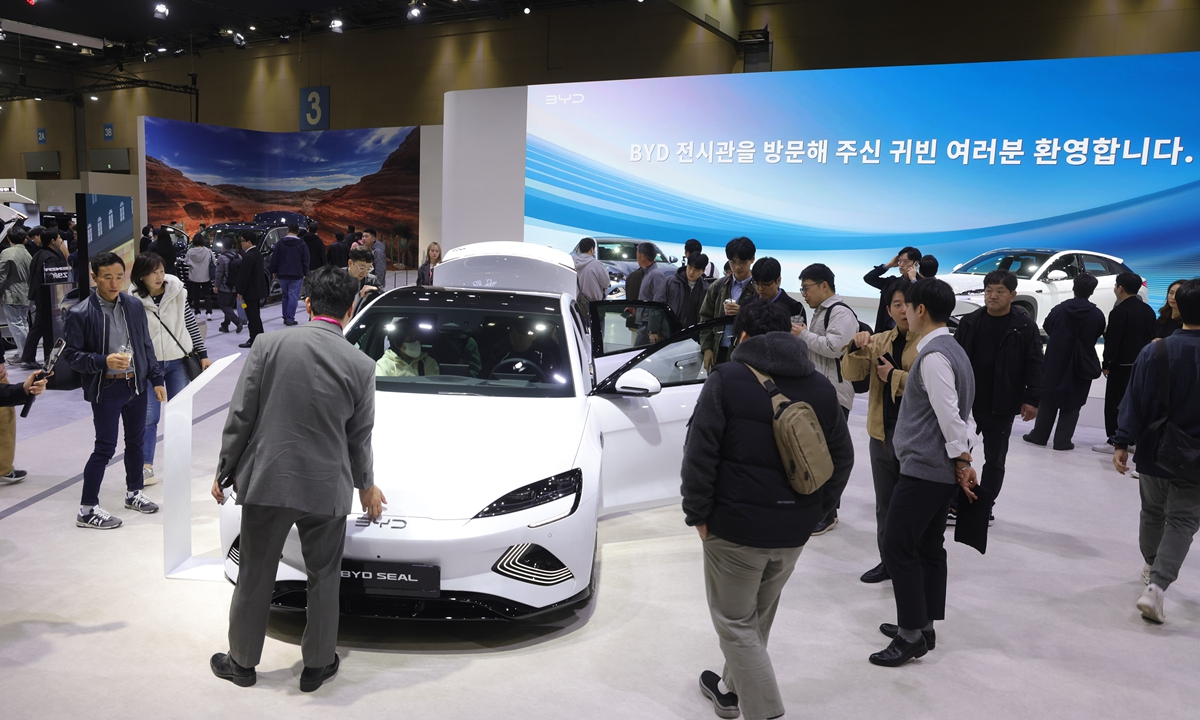
Visitors look at BYD vehicles displayed at the 2025 Seoul Mobility Show in Goyang, Gyeonggi Province, South Korea, on April 4, 2025. Photo: VCG
South Korean consumers' perception of Chinese brands is gradually improving, with product quality and reliability gaining greater recognition, Yonhap News Agency reported on Monday, citing analysts.
Chinese carmaker BYD accounted for 4.8 percent of South Korea's imported electric vehicle market in the first five months of this year, ranking fourth after Tesla, BMW and Mercedes-Benz, Yonhap reported, citing data released by the Korea Automobile Importers & Distributors Association on Monday.
The momentum was already evident earlier this year. According to Korean industry data, BYD Korea ranked fourth in imported car sales between January and April, selling 5,991 EVs in South Korea, up about 1,000 percent from a year earlier.
More Chinese EV brands are moving into the market. Xpeng completed registration of its Korean unit in June 2025 and plans to enter the market this year, according to Yonhap. Zeekr, Geely's premium EV brand, has opened a showroom in Seoul's Gangnam district, formally launching its market push, China News Service reported.
Chinese-made EVs become a stronger force in South Korea's electrifying imported car market. They helped EVs account for more than half of imported car sales in April, while their first-quarter sales surged 286.1 percent year-on-year, according to Korean industry data cited in reports.
The trend also extends to consumer electronics. According to Yonhap, Xiaomi, which set up a South Korean subsidiary last year, now operates eight offline stores and has posted steady sales growth. Xiaomi electric fans sell more than 1,000 units a day in South Korea, while its products rank among Coupang's top wearable-device bestsellers, the Yonhap report said.
"Chinese brands' growing presence is particularly significant given South Korea's mature and highly competitive market with strong domestic brands," said Zhang Huizhi, director of the Institute for North Korea and South Korea Studies at the Northeast Asian Research Institute of Jilin University. "It shows that Chinese brands and China's technological strength are being viewed in a more positive and objective way in South Korea."
The stronger competitiveness of Chinese products themselves is the fundamental driver, as advantages in technology, market scale, cost performance and industrial-chain maturity make them increasingly attractive to local consumers, Zhang told the Global Times on Monday.
The change is unfolding as China-South Korea economic cooperation shifts from a previous vertical division of labor to more horizontal collaboration, a consensus reached by business communities from both sides during the South Korean president's visit to China earlier this year, according to the Chinese Embassy in South Korea.
"South Korea's changing view of competition with China reflects a more realistic recognition among political and business circles of China's rapid economic and technological progress, as well as the need to adapt to a new stage of parallel competition and cooperation between the two countries," Zhang noted.
EVs are a clear example: China's large-scale application scenarios and mature industrial ecosystem offer practical reference value for South Korea, an energy-deficient country seeking industrial transformation, she added.
In January, the two sides also agreed to further tap the potential of traditional industries while expanding new growth points in areas such as artificial intelligence, the green economy, high-end manufacturing and the silver economy, in order to upgrade bilateral economic cooperation, per the embassy.
Recent industry-level exchanges have also reflected this broader shift. In March, South Korea sent a research group to China to study autonomous driving technologies and policy systems, aiming to strengthen its own industry by drawing on China's experience.
On June 1, South Korea's Ministry of Climate, Energy and Environment said a public-private green industry delegation of 14 Korean companies would visit China to explore cooperation in hydrogen, waste battery recycling and EV battery recycling, including exchanges in Tianjin on energy supply chains, resource security and demonstration projects.
Beyond cars and electronics. Chinese food, tea-drink, beauty and fashion brands are gaining ground in South Korea, helped by visa-free travel since November 2024 and growing exposure to Chinese consumer trends.
In tea drinks, CHAGEE entered South Korea in April and has continued to expand, while Auntea Jenny, Chabaidao and Mixue are already in the market and Luckin Coffee is preparing to launch there. Chinese cosmetics brands such as Flower Knows and Judydoll have also gained attention through word of mouth on social media platforms, Yonhap reported
A consumer survey by South Korean market research firm Embrain Trendmonitor showed that more than 80 percent of respondents felt the influence of China-related services and content was expanding, while 71.1 percent said they had used Chinese services or products in the past year.
For South Korean consumers, the growth of Chinese brands means more choices and more cost-effective products and services, Zhang said, adding that stronger China-South Korea cooperation in supply chains, technology, industry and rules-setting can help stabilize regional economic development and create broader benefits for both sides.