


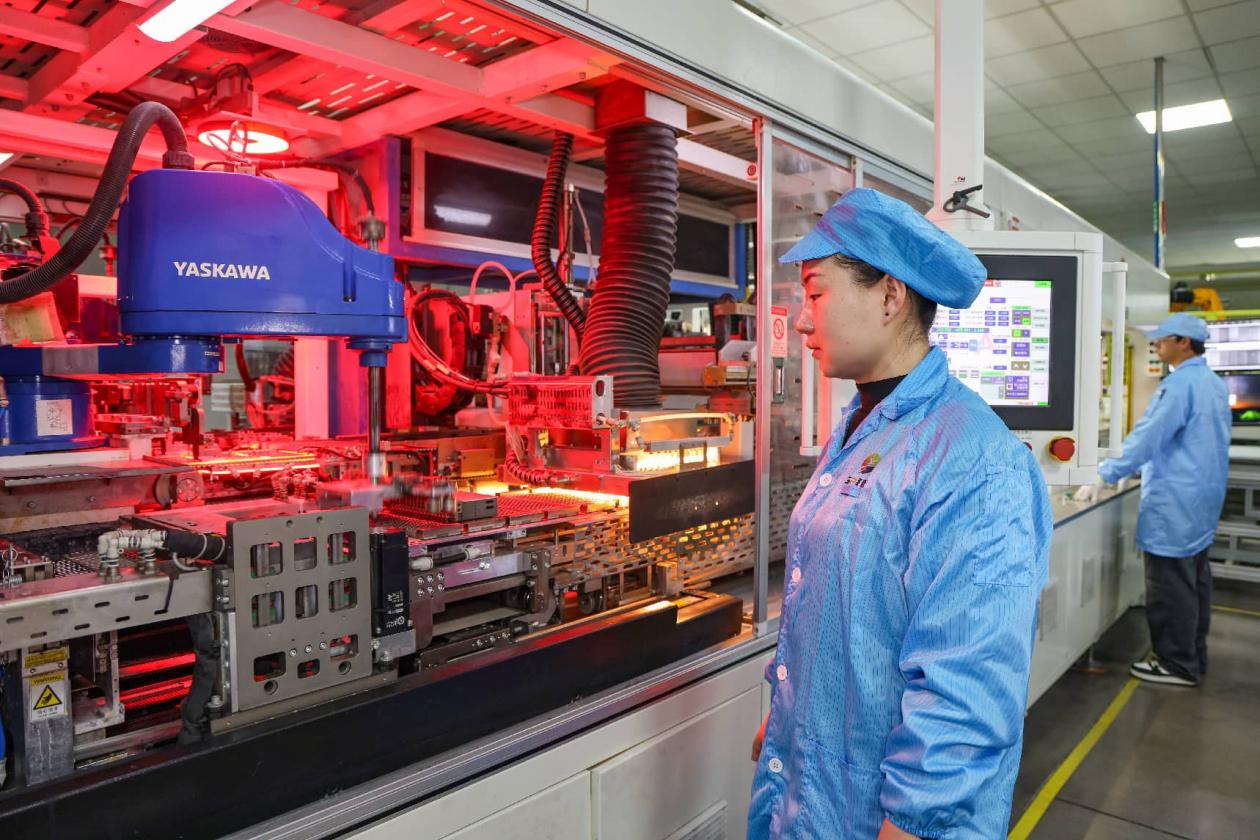
Solar equipment bound for overseas destinations is manufactured in a workshop of a photovoltaic company in Jinhua, east China's Zhejiang province. (Photo/Jin Sicheng)
As one of the most competitive emerging renewable energy industries, the photovoltaic (PV) sector has experienced rapid growth in China in recent years.
During the 14th Five-Year Plan period (2021–2025), the annual output value of China's PV manufacturing industry exceeded 1 trillion yuan ($147.65 billion); total exports surpassed $180 billion; cumulative installed capacity topped 1,200 GW (gigawatt); PV modules were exported to more than 200 countries and regions.
Yet challenges have emerged. Since 2024, Chinese PV products have faced increasingly intense and often unreasonable competition across overseas markets -- a trend defined by rising export volumes paired with plummeting selling prices.
According to a representative of the China Photovoltaic Industry Association, some companies have engaged in excessive low-price competition during exports, eroding industry profits while increasing the risk of trade disputes such as anti-dumping and countervailing duty investigations against China's PV sector.
Beginning April 1, 2026, China eliminated export tax rebates for photovoltaic products. Industry experts believe the move will encourage companies to shift away from extensive, scale-driven expansion and focus instead on technological premiums, brand building, and the development of higher-efficiency, more reliable, and smarter products, thereby accelerating industrial upgrading.
Inside the factory of Ronma Solar in Jinhua, east China's Zhejiang province, robotic arms and automated material-handling systems work in coordination as silicon wafers move through a series of processes before becoming solar modules.
"We recently received new orders from Central Asia and Southeast Asia and are now ramping up production," said Xiao Yuanbiao, a company executive.
For leading firms, going global has long evolved beyond simply exporting products. It now encompasses exporting brands and even production capacity.
"Going global is not just about establishing overseas sales channels," said Huang Haiyan, executive vice president of Astronergy, an intelligent manufacturing enterprise focusing on photovoltaic cells and modules. "More importantly, it means putting down roots in local markets and building fully localized operations across the entire value chain."

Farmers release crawfish fry into fish ponds beneath solar panels at a fishery-solar complementary power generation base in Changxing county, Huzhou, east China's Zhejiang province. (Photo/Chen Haiwei)
In March, Astronergy secured a major solar-plus-storage project in Ereğli of Konya province, Türkiye. All PV modules required for the project were supplied by the company's local factory in Türkiye. More significantly, its parent company, Chint Group, provided a comprehensive one-stop solution covering modules, energy storage systems, and construction services.
"Our ability to deliver the entire value chain -- from core products and system integration to full project delivery -- creates a significant advantage in international competition," Huang said.
Zhejiang ranks among China's leading provinces in both the size of the PV industry and grid-connected installed PV capacity. According to an official with the digital economy division of the Zhejiang provincial economy and information technology department, the industry has seen continuous capacity expansion since 2023, leading some companies into what is commonly described as "involution-style" competition. In response, Zhejiang rolled out new supportive policies last year encouraging industry self-discipline and production control.
Huang pointed out that the current predicament of rising output yet falling profits is mainly caused by the massive launch of new production capacity over the past two years, which has dragged down prices throughout the supply chain. Enterprises cannot just wait for a market rebound; they must take the initiative.
At Astronergy's Haining base in Jiaxing, Zhejiang province, a national-level green factory, production has become increasingly digitalized and intelligent. According to Pang Shaohua, head of the facility, the factory pioneered a "PV manufacturing plus internet" model as early as 2016.
"Take AI-powered inspection of semi-finished products as an example. Previously, four production lines operating day and night required eight workers. After introducing AI inspection, only two workers are needed, while inspection efficiency has increased fourfold," Pang explained.
A representative of Aiko, a global leader in new energy technology based in Zhejiang province, noted that outdated production capacity will inevitably be phased out and that industry competition must ultimately return to a healthy cycle driven by technology and quality.
"The removal of PV export tax rebates marks the beginning of a new era of 'value-driven globalization' for the solar industry," the representative said. "The policy's core goal is to accelerate the elimination of outdated capacity and optimize the industry structure. In the long run, this will help prevent export prices from remaining trapped at unsustainably low levels and support a more rational recovery of prices in overseas markets."
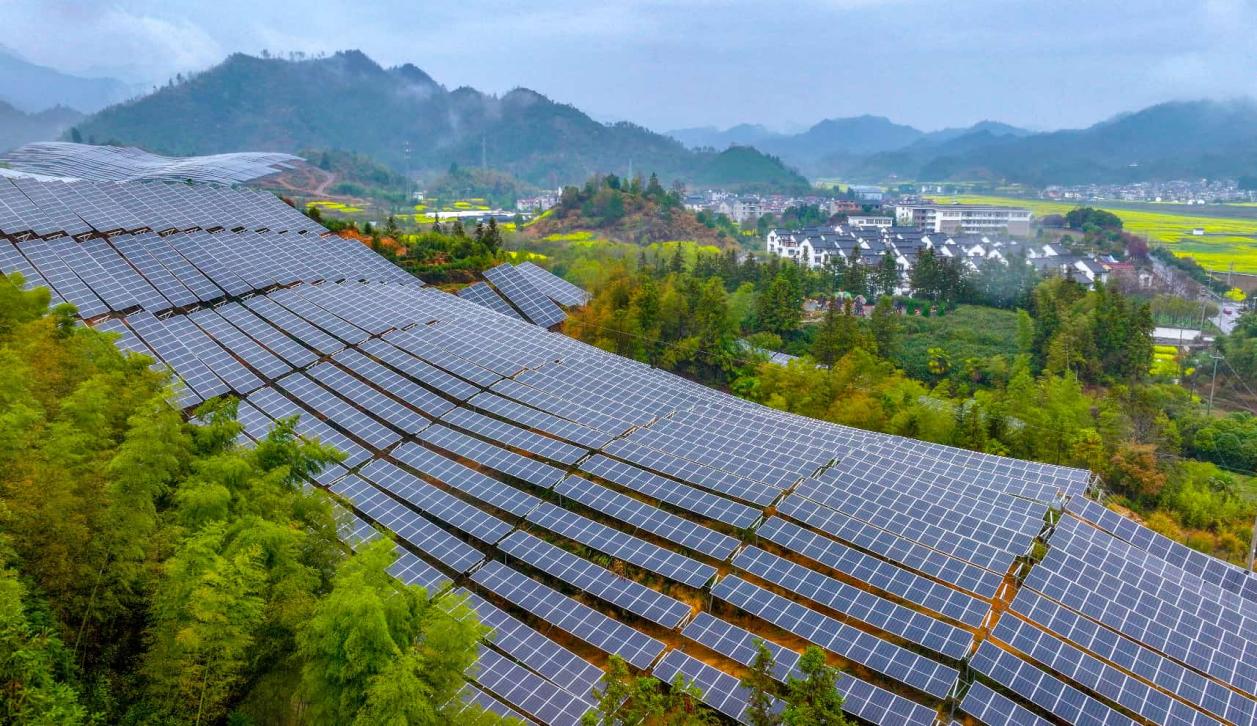
Photo shows a 40 MW solar-plus- camellia oleifera project in Songjing village, Hangzhou, east China's Zhejiang province. (Photo/Yang Bo)
Amid fierce competition, the range of "PV-plus" application scenarios continues to expand. About 700 meters offshore from the Wengle reclamation area in Yueqing, Zhejiang province, nearly half a million silver-blue solar panels shimmer in the sunlight. Beneath them, fish swim freely in the shaded waters. This is the Wenzhou Hengtai fishery-solar complementary power generation project.
"From the very beginning, we integrated aquaculture into the project design," said the project manager. "By fully utilizing the water resources beneath the solar panels, each mu (about 667 square meters) of tidal flat generates an additional 3,000 yuan ($443.57) in annual fishery output while creating more than 1,000 jobs."
In Mianqianling village, Xiyang township, Taishun county, Wenzhou, Zhejiang province, rows of solar panels stretch across the hillsides. Making use of the forest land beneath the panels, the village has developed a demonstration base combining photovoltaics with the cultivation of medicinal Chinese yew trees.
The project generates roughly 200,000 yuan($29,571.20) in annual income for the village collective. In addition, leveraging a nearby aviation sports camp, the village has launched a tourism program that allows visitors to view the solar installations from the air.
According to Shen Fuxin, secretary-general of the Zhejiang Solar Energy Industry Association, the continued development of new application scenarios can help alleviate the pressure created by expanding production capacity. Looking ahead, the replacement of smaller installations with larger, more efficient systems, as well as the upgrading of aging facilities, may become important new growth drivers for the PV industry.