


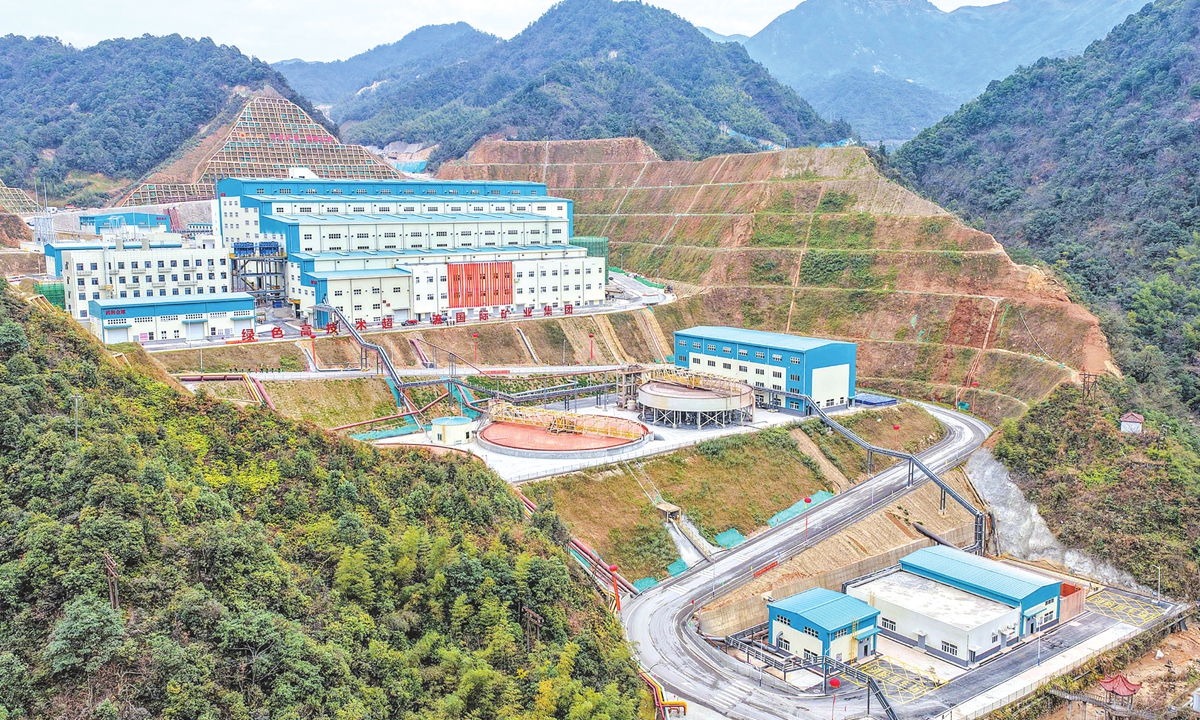
Production facilities at the 5 million ton per year mining and processing site of the Xiangyuan Lithium Polymetallic Mine of Hunan Zijin Lithium Co in Yongzhou, Central China's Hunan Province, on December 10, 2025. (Photo: VCG)
China's new regulations implementing the Mineral Resources Law took effect on Monday. The Ministry of Natural Resources (MNR) described them as a comprehensive and systematic legal framework for safeguarding mineral resources, and said they are significant in strengthening the country's capacity in this area, pledging more systematic measures going forward.
Chinese experts noted that the strengthened legal framework is primarily aimed at improving the overall governance system for mineral resources, providing clearer rules and greater certainty for long-term investment, and supporting more stable development of critical minerals and contributing to resilient global supply chains.
During a Monday press conference, the MNR voiced its intention to continue to strengthen its capacity to ensure resource security through more systematic measures.
It is aimed to advance the formulation and implementation of the 15th Five-Year Plan (2026-30) for mineral resources, set science-based targets for expanding reserves through exploration and increasing production, and improve the spatial planning of resource development and conservation, according to Yan Bo, an official with the MNR.
The MNR will also step up domestic exploration and development, with a focus on boosting reserves and the output of strategic minerals, Yan said.
Yan said that the MNR will enhance the security of critical and scarce mineral resources, improve coordination between product and capacity reserves, and carry out surveys and preliminary assessments of potential reserve areas alongside exploration, in order to designate several strategic mineral reserve zones.
Notably, the regulations refine a strategic mineral reserve system built around "products, capacity and origin," while introducing provisions on import and export management and countermeasures against activities that may threaten China's mineral resource security and related industrial and supply chain stability, said Yan.
Yan noted that the promulgation and implementation of the regulations mark the establishment of a legal system for mineral resource management centered on "one law and one set of regulations," representing a substantial step forward in strengthening the rule of law in this area.
The measure further consolidates the legal foundation for mineral resource governance and is significant in improving resource security, promoting the rational development and utilization of mineral resources, safeguarding the legitimate rights and interests of mining rights holders, and advancing the high-quality development of the mining sector, Yan said.
The development and utilization of mineral resources are characterized by clear stage-specific and time-sensitive features, with their applications and value structures evolving across different development phases, Zhou Mi, a senior researcher at the Chinese Academy of International Trade and Economic Cooperation, told the Global Times on Monday.
Against this backdrop, he stressed that the new regulations should not be interpreted as tightening measures, but rather as an effort to further standardize and institutionalize governance of the sector.
The regulations are designed to support the implementation of the revised Mineral Resources Law, which was amended on November 8, 2024 and came into effect on July 1, 2025, according to the MNR. The ministry described the revision as the first major amendment to the law since it was introduced in 1986, saying that it is of great significance for safeguarding China's mineral resource security and advancing the high-quality development of the mining sector.
To safeguard national resource security, the new Mineral Resources Law upholds a holistic approach to national security and establishes, at the legal level, a comprehensive and systematic framework for ensuring mineral resource security, the Xinhua News Agency said on Monday.
Zhou said that mining investment typically involves long cycles and therefore requires strong policy stability and forward-looking guidance. By clarifying key factors that may affect future investment returns, the framework helps improve regulatory transparency, reduce long-term uncertainty, and support more efficient resource allocation, thereby stabilizing investor expectations and the predictability of returns.
China made major breakthroughs in its latest round of mineral exploration efforts. During the 14th Five-Year Plan (2021-25) period, China discovered 398 new medium-sized and large strategic mineral deposits and oil and gas fields, according to the MNR. Exploration of bulk minerals such as copper, gold and potash also achieved a series of historic breakthroughs. Exploration of strategic emerging minerals including lithium, helium and high-purity quartz also saw leapfrog development.