


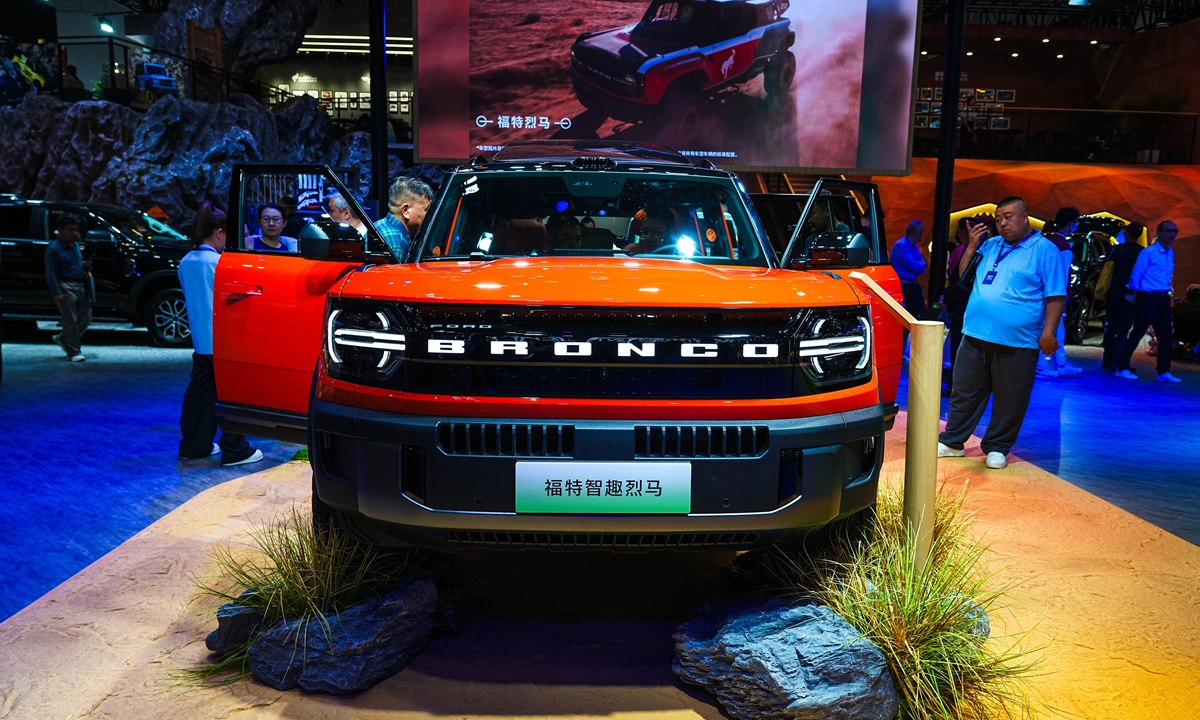
A Ford Bronco SUV is seen at the 2026 Beijing Auto Show in Beijing on May 2, 2026. (Photo: VCG)
Ford Motor and other automakers are seeking US authorization to keep selling China-built models already available in American showrooms, Reuters reported on Monday, in a case analysts said shows Washington's security-driven connected-vehicle curbs are already disrupting US automakers' own production plans and adding costs and uncertainty.
Ford confirmed to Reuters that it has asked the US Commerce Department for authorization to continue importing the China-built Lincoln Nautilus SUV, one of a small number of China-built vehicles that automakers were already selling in the US before the connected-vehicle restrictions came into force.
Ford said the Nautilus' software is developed in the US but installed into the vehicle in China, meaning the China-built SUV requires government approval for continued US sales under the new rule, Reuters reported.
The issue stems from a US Commerce Department connected-vehicle rule finalized in January 2025, which restricts certain China-linked software and hardware in vehicles sold in the US on national security grounds. Its software curbs apply from the 2027 model year, followed by hardware restrictions from the 2030 model year.
That timeline puts Ford under pressure. The automaker is likely to begin importing 2027 model year Nautilus vehicles in January, leaving only several months to secure approval for continued US sales, Reuters reported.
The report described Ford as one of several automakers navigating a "complex and opaque licensing process," which is exposing how closely the US auto industry remains linked to China's manufacturing and supply-chain ecosystem.
The Ford authorization request shows that US restrictions on Chinese auto technology and supply chains are beginning to hit US automakers' own global production networks, Li Yong, an executive council member of the China Society for WTO Studies, told the Global Times on Tuesday.
"Modern auto production is a deeply integrated supply-chain system in which China plays a key role, and US automakers are closely tied to China's mature supply chains and vast market," Li said. "Forced disruption of these links could raise costs, weaken supply stability and undercut their competitiveness."
The connected-vehicle restrictions, adopted last year under the previous US administration over so-called data-security concerns, remain in force under the current government, while some US lawmakers proposed further tightening the ban in May, according to Reuters.
The report said the US restrictions are pushing automakers toward the more difficult task of "decoupling the US auto hardware supply chain from China," a process Rhodium Group researchers said is "likely to be more cumbersome and require more time for automakers to adapt."
The problem for Washington is that the auto industry cannot be decoupled by decree, Li said. "Many auto parts are tied to specific models, technical routes and quality-control systems, and supplier relationships take years to build, leaving automakers with few immediate alternatives that can match China's efficiency, cost and reliability."
Volvo Cars, majority-owned by China's Geely, said in May that it had received authorization, but confirmed that it needed a specific authorization because of its ownership structure. The US Commerce Department does not publish specific authorization applications or decisions, leaving unclear how many automakers have sought similar relief, Reuters said.
The opaque licensing process and the rule's expanding reach show how US restrictions may extend beyond software to ownership links and hardware supply chains, adding uncertainty to the industry, according to industry analysts.
The Ford case comes as some US observers question whether protectionism can help the US auto industry catch up. In a Monday article, Forbes cited industry expert Michael Dunne as saying that "the current strategy of just throwing up a wall" to keep out Chinese autos is not workable in the long run for the US.
Citing Tesla's experience in China, the article pointed to how integration with a mature manufacturing ecosystem can strengthen industrial competitiveness. China business expert Ker Gibbs said the US needs "a much more nuanced and more strategic approach," including allowing Chinese EV makers to invest in the US, build vehicles locally, bring their technology and comply with US data and software rules.
Responding to the US connected-vehicle rule, a Chinese Foreign Ministry spokesperson said last year that the US practice disrupts economic and commercial cooperation between companies, violates the principle of market economy and fair competition, and is typical protectionism and economic coercion, urging the US to stop its wrongdoings of overstretching the concept of national security.
In April, China's International Trade Representative and Vice Minister of Commerce Li Chenggang said the China-US automotive industries are highly complementary and have broad scope for cooperation during a meeting with Ford Executive Vice President and Chief Policy Officer Steven Croley in Beijing.
Croley said Ford values the Chinese market, industrial and supply chains, and is willing to explore new business opportunities with partners, according to the Ministry of Commerce.