


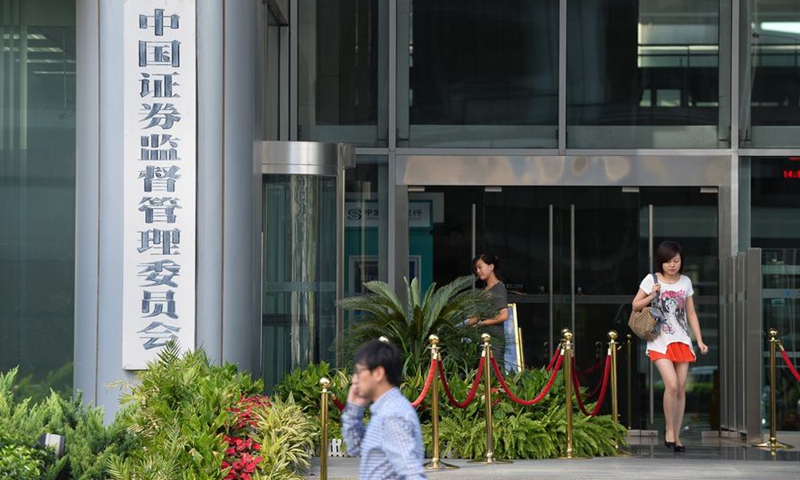
File photo shows the entrance of the China Securities Regulatory Commission (CSRC) in Beijing, capital of China. (Photo:Xinhua)
China Securities Regulatory Commission (CSRC), the country's top securities regulator, will expand the applicable range of its fifth listing standards for the STAR Market in the Shanghai Stock Exchange (SSE) to the artificial intelligence (AI) sector, and actively support high-quality AI large model companies in going public, Wu Qing, chairman of the CSRC, said at the 2026 Lujiazui Forum in Shanghai on Wednesday.
Wu said that currently, a new round of technological revolution, represented by AI, is integrating into production and daily life at an unprecedented pace and leading profound development and transformation. Major global capital markets are accelerating reforms to better adapt to the needs of innovation and seize development opportunities.
From China's perspective, a series of technological innovations have achieved intensive breakthroughs. A large number of high-quality sci-tech enterprises are thriving vigorously, realizing historic shifts from following others to paralleling and even leading in multiple fields. Traditional industries are also accelerating transformation and upgrading, continuously rejuvenating with new vitality, Wu said.
"The CSRC will better promote the deep integration of scientific and technological innovation with industrial innovation, and provide stronger support for Chinese modernization and the building of a financial powerhouse," the official noted.
According to the SSE, the fifth standards is specifically aimed at technology companies that are not profitable but have high growth potential. It uses "market value + R&D" as the evaluation method to break the restrictions of traditional capital markets on corporate profits and other aspects, emphasizing that the main business or products of enterprises are approved by the state, have a large market space and have achieved phased results. It opens up financing channels for innovative companies that are in the critical period of R&D and have not yet made a profit.
Tian Yun, a Beijing-based veteran economist, told the Global Times on Wednesday that incorporating the AI sector into the fifth set of listing standards will open a direct financing channel for high-quality unprofitable AI enterprises, enabling them to secure long-term, stable, and large-scale capital support that better meets their rapid development needs.
Moreover, the move demonstrates the state's firm determination to position AI as a core future industry, guiding social capital and patient capital toward hard technologies. It will help China seize the initiative in global AI competition and enhance its national technological competitiveness, Tian noted.
During the forum, Wu said the commission will support more "hard tech" enterprises in fields such as quantum technology, bio-manufacturing, embodied intelligence and beyond to list on the STAR Market. At the same time, it will steadily advance reforms of the ChiNext Board, strengthen support for new consumption and modern services sectors, and better serve the development of growth-oriented innovative and entrepreneurial enterprises, the official noted.
Tian said that the measures represent the implementation of the forward-looking deployment of future industries as emphasized in the outline of the 15th Five-Year Plan (2026-30) for national economic and social development, which aims to build a full-chain cultivation system for future industries. The capital market can effectively match the supply and demand of capital, significantly boosting industrial development and providing strong support for the implementation of national strategies, the expert noted.
Wu noted that currently, the technology sector accounts for more than 30 percent of the total market capitalization of the A-share market. Among listed companies with a market value exceeding 100 billion yuan, technology enterprises already represent 45 percent. A group of innovative companies have efficiently listed on the A-share market, and a mutually reinforcing trend between the capital market and new quality productive forces is accelerating.
For instance, Chinese humanoid robot maker Unitree Robotics won approval from the SSE's listing committee for its planned STAR Market initial public offering. The move marked one of the fastest IPO reviews in China this year as investors have piled into the country's fast-growing robotics sector.
Tian said that these measures will inject new vitality into China's capital markets while further attracting global capital inflows. The capital market will act as a powerful amplifier, enhancing China's competitiveness on the global stage in both technology and finance.