


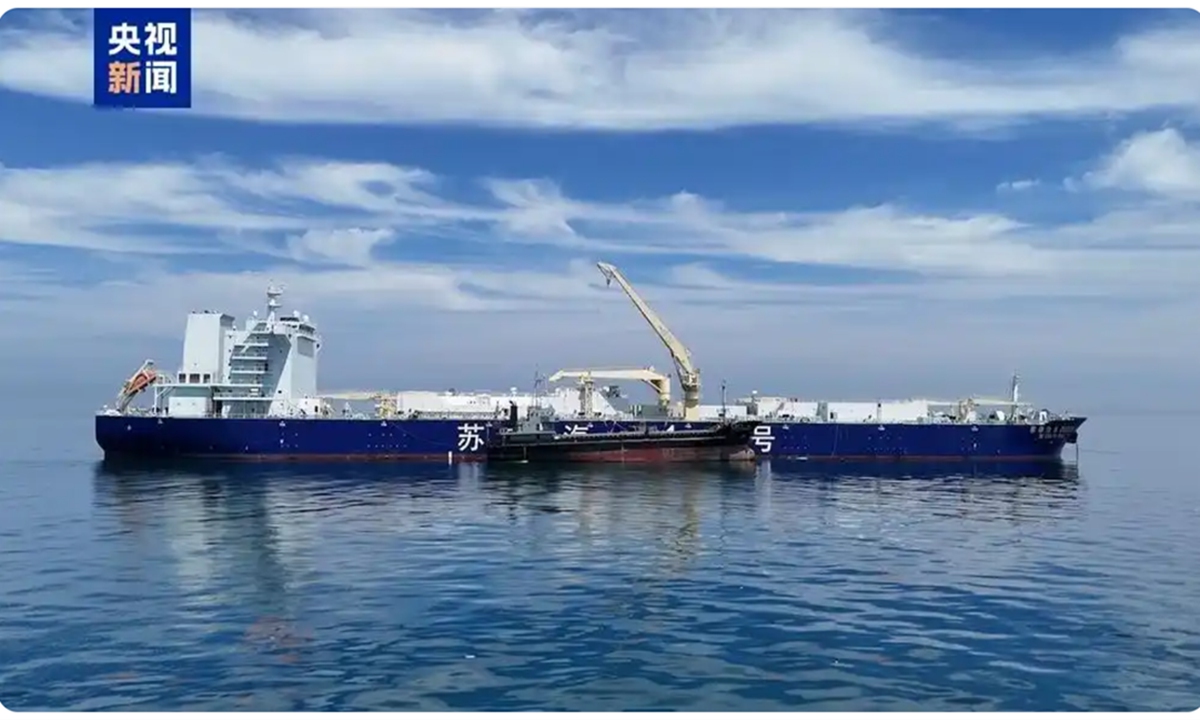
China's first large-scale 100,000-ton-class salmon farming vessel, Su Hai No.1, begins the harvest of its inaugural commercial fish, on June 23, 2026. (Photo: CCTV)
China's first large-scale 100,000-ton-class salmon farming vessel, Su Hai No.1, has commenced the harvest of its inaugural commercial fish in waters off Weihai, East China's Shandong Province, China Central Television (CCTV) reported. Analysts view the development as a significant operational milestone for the country's deep-sea aquaculture platform.
The vessel was officially put into operation in Lianyungang, East China's Jiangsu Province on December 23, 2025. The first batch of salmon fry was then transferred onboard after initial land-based cultivation and has since been raised in deep-sea cold-water environments within fully enclosed farming systems, the report said.
The project marks an important step in China's development of industrialized offshore aquaculture capacity, with the vessel expected to improve the domestic self-sufficiency of salmon supplies over time, industry analysts said.
The vessel is equipped with 15 fully enclosed aquaculture tanks and provides an effective farming water volume of 83,000 cubic meters. Once fully stabilized, it is expected to reach an annual production capacity of more than 8,000 tons of salmon, with projected annual output value exceeding 500 million yuan ($70 million), according to CCTV.
The platform features an integrated digital control system enabling real-time monitoring of farming conditions, automated feeding, and coordinated ship-shore management, while also operating under a "mobile farming" model that allows it to adjust location based on water temperature and ocean currents and avoid extreme weather conditions such as typhoons and red tides, the report said.
To preserve freshness, Su Hai No.1 has adopted an "on-demand harvesting" model, in which mature fish are processed onboard through slaughtering, pre-cooling and packaging before being transported to shore-based facilities for further processing, allowing the final products to be tailored to different consumption scenarios.
The vessel also allows year-round continuous farming operations. By adjusting farming zones and timing, it can support off-season supply and provide more stable salmon output to the market, according to CCTV.
In addition, the vessel can relocate across deep-sea areas, selecting more suitable waters for fish growth based on environmental factors such as temperature and ocean currents, ensuring more stable harvesting conditions, industry analysts said.
China's development of aquaculture vessels is widely seen as being at the global forefront, or among the most systematically advanced approaches worldwide, with the technological pathway jointly driven by domestic research institutions and enterprises through multiple rounds of engineering practice and equipment upgrades, said Fan Xubing, a council member of the China Aquatic Products Processing and Marketing Alliance.
Su Hai No.1 was built by China State Shipbuilding Corp's Huangpu Wenchong Shipbuilding Co and was delivered in Guangzhou's Nansha district, South China's Guangdong Province, in June last year, CCTV reported.
The delivery of the vessel is a milestone in the development of China's modern marine fishery sector and is seen as potentially reducing the country's reliance on imported chilled salmon, the CCTV report said.
Salmon has become one of the most popular seafood products among global consumers, with steadily rising demand. However, China still relies heavily on imports, with more than 80 percent sourced from overseas markets, according to industry estimates.
China's imports of aquatic products and related goods totaled 8.11 billion yuan in the first four months of the year, up 27.8 percent year-on-year, while import volumes reached 1.838 million tons, up 23.2 percent, customs data cited by the national chamber showed.
Industry observers said that the gradual adoption of deep-sea aquaculture vessel technology is expected to support the transformation and upgrading of salmon farming models in China. "These systems, with advantages under specific species and environmental conditions, will accelerate China's ongoing efforts to advance industrialized deep-sea aquaculture systems," Fan said.