


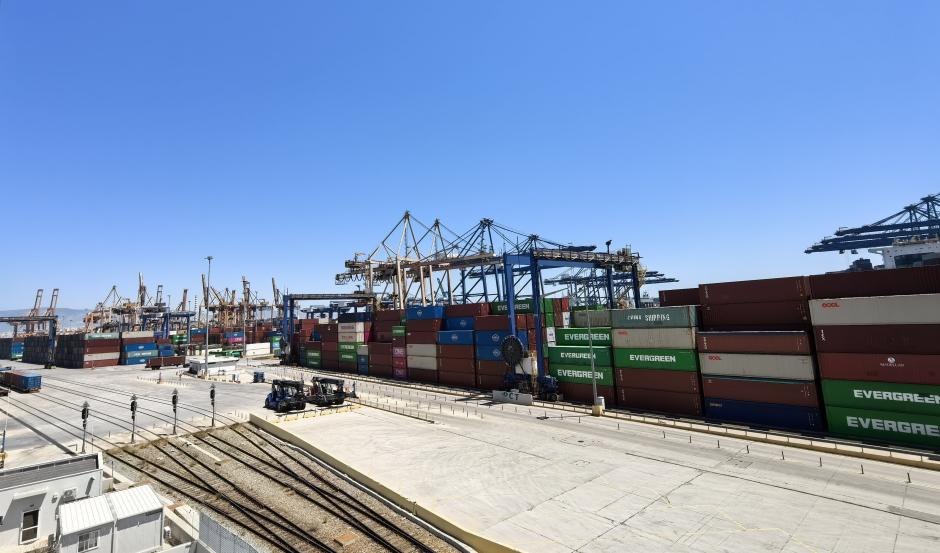
Photo shows the starting point of the China-Europe Land-Sea Express Line at the Port of Piraeus, Greece. (People's Daily/Wang Xinping)
Along the Mediterranean shores, Greece's Port of Piraeus in Greece is bustling with activity and vitality. Massive cargo vessels line its docks, rows of containers stretch across the docks, towering cranes dominate the skyline, and China-Europe Land-Sea Express trains loaded with goods stand ready for departure.
A decade ago, this historic harbor was on the verge of irrelevance, but the turning point arrived in 2016 when China's global shipping leader, COSCO Shipping, revitalized the port as a centerpiece of China-Greece collaboration under the Belt and Road Initiative.
Located about 10 kilometers southwest of Athens, Piraeus is Greece's largest port. As one of the world's oldest seaports, it occupies a strategic location, linking maritime routes from the Mediterranean to the Atlantic Ocean, from the Red Sea to the Indian Ocean, and through the Sea of Marmara to the Black Sea.
A decade ago, however, the port faced severe challenges. Aging facilities, inefficient operations, and outdated management had left it struggling to compete. Many international shipping companies shifted their business elsewhere, and economic activity around the port stagnated.
In 2016, COSCO Shipping officially assumed management of the port. At that time, the port handled approximately 3.74 million twenty-foot equivalent units (TEUs) annually and ranked 93rd among the world's container ports. Today, it is one of the busiest ports in the Mediterranean, with annual container throughput exceeding 5.6 million TEUs and a global ranking that has risen as high as 25th.
"The past 10 years have witnessed how the Port of Piraeus has transformed from a corner of the Mediterranean to a global hub," Han Chao, chairman of COSCO Shipping Piraeus Port Authority SA, told People's Daily.
According to Han, a decade of modernization and refined management has transformed every major segment of the port's operations.
Its cruise business has expanded significantly, attracting nearly 1.8 million international visitors annually and placing the Port of Piraeus among the world's top 10 cruise home ports and the Mediterranean's top three.
Its ferry operations have become industry-leading, with high-speed passenger and vehicle ferry capacity ranking first in Europe and among the strongest worldwide, serving more than 18 million passengers each year.
Meanwhile, container operations have achieved rapid growth, dramatically improving the port's global standing. Looking ahead, the Port of Piraeus is aiming to become one of the world's top 20 ports and one of Europe's top three container hubs.
Supported by a comprehensive industrial ecosystem, the port has also developed into a major ship repair center and automotive transshipment hub in the Eastern Mediterranean. In 2025, it ranked eighth in the Xinhua-Baltic International Shipping Centre Development Index, further strengthening its influence as a regional shipping center.
Over the past decade, the Port of Piraeus has expanded its business portfolio in all directions, building 6 core business segments: container shipping, cruise services, ferry transportation, automobile roll-on/roll-off operations, logistics and warehousing, and ship repair and shipbuilding. Together, these sectors have created a diversified and integrated maritime industrial ecosystem.
Han noted that the China-Europe Land-Sea Express Line, built around the port's strategic advantages, now connects 9 European countries and more than 1,500 service points, serving a population of 71 million. The service has established a major sea-rail transport corridor stretching from the Mediterranean deep into Central and Eastern Europe. It has enabled Chinese products and opportunities generated by the Belt and Road Initiative to reach European markets more efficiently, while helping high-quality European goods and resources gain better access to the Asia-Pacific region.
"Since COSCO Shipping took over the port, I have witnessed the fastest period of development in the port's history," said Savvas Sanozidis, a resident of Piraeus who has served as the secretary of the board of directors of Piraeus Port Authority for nearly 20 years.
He observed that the Chinese company combined strategic vision with practical execution, completing a comprehensive modernization of the port within a relatively short period of time and driving its transformation from a regional harbor into an international maritime hub.
"The expansion and upgrading of the three container terminals, alongside simultaneous development of the cruise terminal, automobile facilities, and shipbuilding and repair zone, have fundamentally reshaped the port," he said. "It is no exaggeration to describe this as a rebirth for Piraeus, and COSCO Shipping deserves enormous credit."
The port's revival has also generated substantial benefits for the local community. Over the past decade, COSCO Shipping Piraeus Port Authority SA has directly created thousands of quality jobs and indirectly supported tens of thousands more positions in logistics, maintenance, trade, and services. As a result, many local residents have enjoyed more stable incomes and improved living standards.
From dockworkers and equipment maintenance technicians to truck drivers and service personnel within the port area, many families have benefited from the resurgence of the Port of Piraeus.
"China-Greece cooperation has changed far more than the appearance of a port. It has reshaped urban development trajectories and improved the lives of the people," said Yiannis Moralis, Mayor of Piraeus.
During the past decade, COSCO Shipping has invested more than 10 billion yuan ($1.48 billion) in Greece. These investments have not only revitalized the port itself but also stimulated broader regional economic development. More than 20 workshops and supporting businesses now operate around the port, providing services ranging from electrical systems and marine engineering equipment to structural repairs and hull painting. Many also offer training programs that help local workers acquire ship repair skills.
The rebirth and rise of the Port of Piraeus have challenged simplistic perceptions of international port cooperation and vividly demonstrated the principle of extensive consultation, joint contribution, and shared benefits. In Han's view, the project is far more than a conventional overseas investment.
"It is a vivid example of civilizational exchange and mutually beneficial cooperation between China and Greece," he said. "Chinese capital, technology, and management expertise have complemented Greece's local resources and geographical advantages, contributing to economic growth and development. At the same time, the port's growing role as a maritime hub has strengthened the land-sea connectivity framework of high-quality Belt and Road cooperation and enhanced the efficiency of international logistics corridors linking Asia and Europe."