


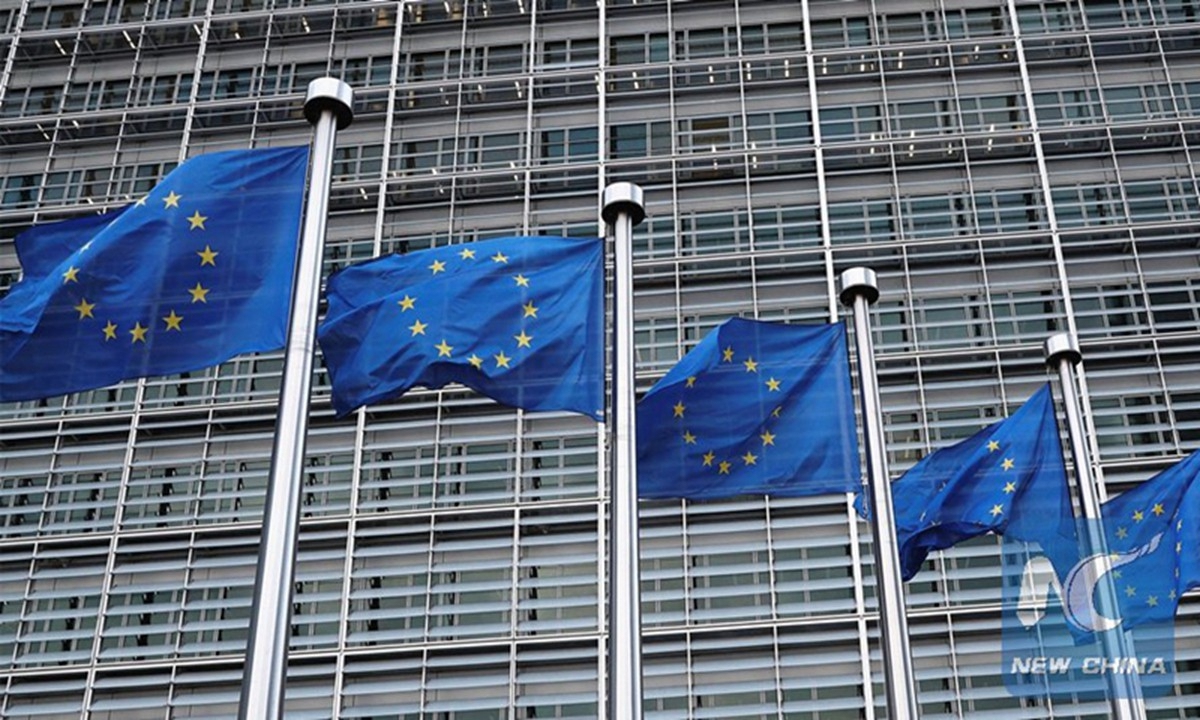
The European Union flags in front of EU headquarters in Brussels, Belgium. (Photo: Xinhua)
Chinese and EU teams have held intensive consultations this week, conducting extensive discussions on China-EU economic and trade issues in preparations for the first meeting of the China-EU Trade and Investment Consultation mechanism, the Global Times learned from a source familiar with the matter, who warned that the EU’s lack of sincerity during talks is raising concerns that China-EU ties may drop to a freezing point.
“The EU side, on the one hand, expresses willingness to talk with China, but on the other hand, lacks the sincerity in doing so. This inevitably raises concerns about whether the first meeting of the China-EU trade and investment consultation mechanism will yield results, whether China-EU economic and trade relations will deteriorate, and whether they will reach a freezing point,” the source told the Global Times.
The source listed multiple examples of the EU showing no sincerity in addressing issues of China’s concern. For example, no new progress has been made in their consultations on price undertakings for Chinese electric vehicles (EVs). In terms of export control, the EU side only asked China to address the EU’s concerns in rare earth while no progress has been made in addressing obstacles faced by China’s imports from the EU.
In addition, the EU has formally launched nine investigations against Chinese companies under its Foreign Subsidies Regulation, which severely impact Chinese enterprises’ investments in the EU, constituting new investment barriers, according to the source.
As for the negotiations on EU’s modification on its tariff concessions on steel, the EU side has rarely responded to China’s requests, even as the extent of damage caused to China is far greater than the average to other countries, the source noted.
Jian Junbo, director of the Center for China-Europe Relations at Fudan University’s Institute of International Studies, said that the EU’s approach of ignoring China’s core concerns, while seeking to coerce China into making concessions, is misguided and will never work.
“To prove its sincerity, the EU must take concrete steps to respond to China’s concerns,” Jian told the Global Times, adding that in recent years, the EU’s own competitiveness problems have grown increasingly pronounced, but instead of addressing it through internal structural reforms, Brussels has been increasingly trying to blame China and resort to protectionism.
This is also reflected in a series of claims and moves recently made by EU officials. Following discussions on relations with China at the EU summit last week, European Commission President Ursula von der Leyen said that the EU has already built an extensive toolbox in recent years. “Now we must use it more proactively and more strategically to defend our European interests.”
Moreover, the European Commission is reportedly planning to impose countervailing duties on Chinese PHEVs, according to media reports. On June 22, European Central Bank President Christine Lagarde urged global leaders to discuss undervaluation of the Chinese currency as a facet of the imbalances endangering the global economy, according to media reports.
“The EU’s characterization of the so-called ‘trade imbalance’ with China – and the measures it has taken or proposed in response – is simply wrong. Such steps will not genuinely rebalance bilateral trade; rather, they risk intensifying economic frictions and even further undermining the overall China-EU relationship,” Jian said.
“The more realistic and constructive approach for the EU is to properly manage differences through dialogue and consultation, foster stable and healthy development of bilateral economic ties, promote deep integration across industrial chains, and thereby achieve shared prosperity,” Jian said.