


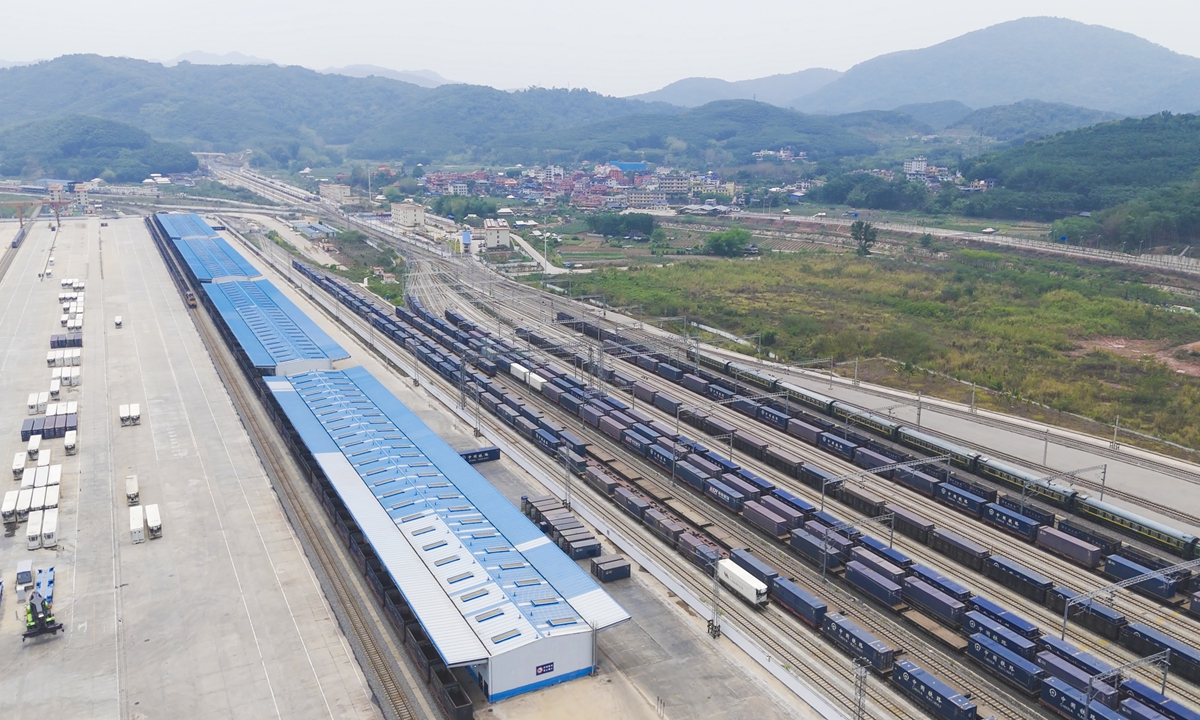
Cargo trains park at a train depot along the China-Laos Railway in April, 2026. Photo: Courtesy of China Railway Kunming Group Co
Qiu Bo, a veteran fruit importer in Shenzhen, South China's Guangdong Province, has watched the market transform before his eyes. Through an increasingly expansive network of entry points, a far wider array of fruit varieties and supply sources is now flowing into China from an expanding roster of source countries.
Gone are the days when imported fruit meant little more than a handful of mainstream staples from a few dominant producers. Today, the market is brimming with tropical delicacies such as mangosteen, wax apple, salak, and longkong - many of which are now rushed in by air to lock in their peak freshness.
Equally noteworthy is the broadening geographic diversity of suppliers. Earlier this month, Cambodian durians officially entered the Chinese market, adding a fresh new origin to the established roster of Thailand, Vietnam, and Malaysia.
It's not only land ports that are busy. Air cargo and other logistics channels are also bustling. From fresh produce to cutting-edge equipment, China's rapidly growing logistics network is accelerating the outbound flow of "Made in China" goods while simultaneously smoothing the inbound route for premium products from around the world.
China's foreign trade grew 16.9 percent year on year in May, data from the General Administration of Customs showed recently. In the first five months of the year, total foreign trade amounted to 20.68 trillion yuan ($3.04 trillion), up 15.3 percent year on year.
Expanding trade channelsOn June 23, the expanding geographic diversity of suppliers that Qiu noticed was underscored by the official launch of a new transit route between Cambodia and Laos, designed to facilitate the export of Cambodian agricultural products to the Chinese market.
The agreement reached by both sides not only opened up new transportation routes but also further simplified transit procedures for Cambodian agricultural products exported to China via Laos. Currently, agricultural products permitted to be exported to China through this route feature six products: bananas, mangoes, rice, Pailin longan, cassava starch, and durian, according to the Ministry of Commerce (MOFCOM).
Air cargo operations are also bustling. On June 23, one cargo flight under China Eastern Air Logistics took off from the Shanghai Pudong International Airport bound for London Stansted Airport, carrying 96.3 tons of cargo. The route marks the carrier's first all-cargo service between the two cities.
Outbound flights from Shanghai primarily carry high-value goods such as cross-border e-commerce parcels, premium light industrial products, electronic components, and precision parts. On return legs from London, the flights will not only transport imported items such as medical equipment and auto parts, but also leverage the direct flight advantage to carry premium fresh produce such as Atlantic salmon.
In May of this year, Cathay Cargo increased order by adding two more Airbus A350 freighters, bringing its total order to eight new-generation freighters. In June, the company signed a long-term lease for an Airbus A330 freighter. According to the company, these aircraft will allow it to carry more cargo, and enhance its ability to connect cargo flows through Hong Kong - linking the Chinese mainland to key long-haul destinations such as North America and Europe, as well as regional markets in Southeast Asia.
"Through our fresh-produce lanes into Macao and Zhuhai, growing frequencies into Guangzhou, and our sea-air connectivity through the Cathay Cargo Terminal Dongguan, we have been expanding our footprint and seeing growing demand in inbound specialist cargo, such as perishables including fruit, seafood, tuna and lobsters," James Evans, General Manager Cargo Commercial, told the Global Times on Wednesday.
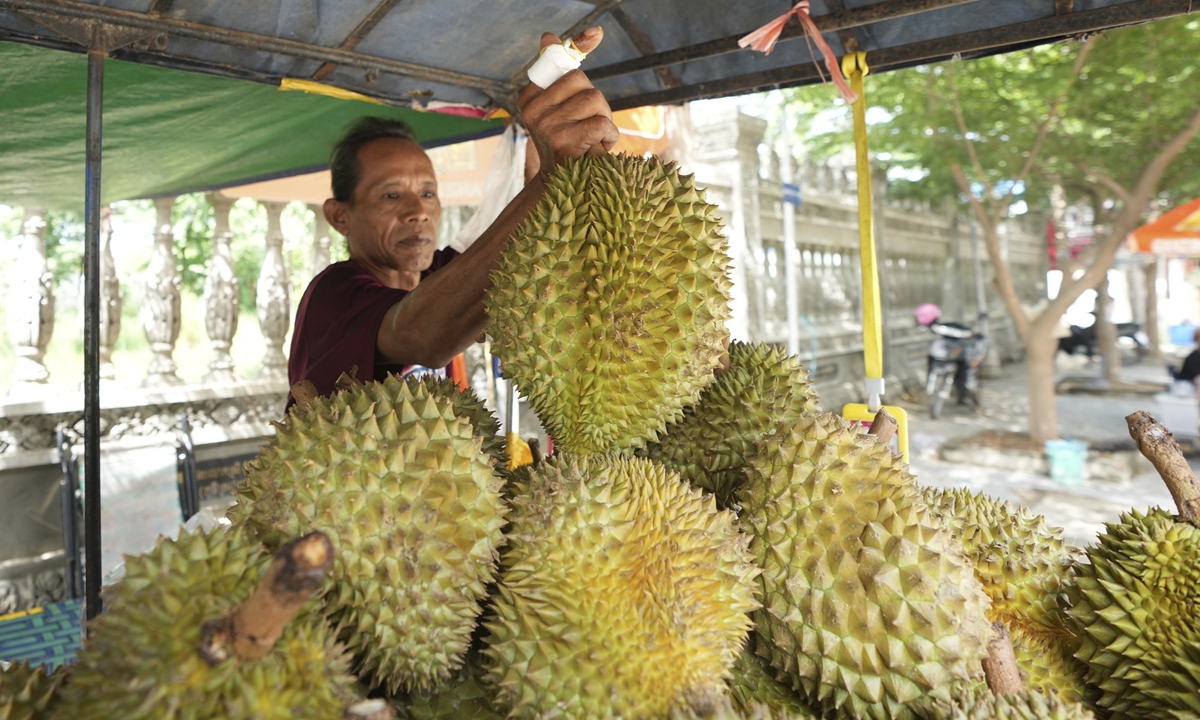
A vendor cuts a durian at his fruit's store in a village outside Phnom Penh, Cambodia. File photo: VCG
Hong Kong International Airport is the world's busiest air cargo hub, and Cathay Cargo is the largest operator. In 2025, about one-third of all cargo handled through Hong Kong was carried by Cathay Cargo.
Cathay Director Cargo Dominic Perret highlighted the importance of the Chinese market. In his view, the Chinese mainland has long been one of the most important export and source markets for cargo.
"We have the Chinese mainland, a major manufacturing powerhouse, right on our doorstep. This gives us a great opportunity to serve that market and connect businesses from the Chinese mainland with the rest of the world through Hong Kong," he said.
"Our two largest source markets for outbound cargo are Hong Kong, where a lot of cargo also comes from the Greater Bay Area, and the Chinese mainland," he added.
This dual-engine dynamic - with Hong Kong serving as the premier international gateway and the Chinese mainland acting as the world's manufacturing backbone - underscores a broader truth: China as a whole is indispensable to the global air cargo ecosystem.
Emirates SkyCargo is strengthening its commitment to facilitating trade from China to the rest of the world. The company said that it has increased its weekly freighter services to Hong Kong to 37 flights from 32 earlier in the year, making it the largest freighter hub for Emirates outside of Dubai, according to information the company shared with the Global Times on Monday.
The company has also expanded its freighter footprint into Central China with thrice-weekly flights from Zhengzhou, connecting the industrial hub of Henan Province to Dubai and beyond while also providing valuable direct global connectivity to local exporters.
Divisional Senior Vice President with Emirates SkyCargo Badr Abbas said that through over 50 weekly freighter flights and more than 70 weekly passenger flights from the Chinese mainland and Hong Kong, the company offers the Chinese manufacturing sector a high-speed trade lane with a weekly capacity of nearly 6,000 tons.
China holds a pivotal position in global trade. Through the optimization of logistics networks, connectivity between the Chinese market and global markets - particularly the Global South - has been significantly enhanced, and we are eager to share the immense market potential, Li Yong, an executive council member of the China Society for WTO Studies, told the Global Times on Monday.
"We are working across all fronts - maritime, land, and air - to make the vision of connectivity clearer and the channels smoother. The importance of the Chinese market also creates greater opportunities for foreign enterprises to tap into China's growth story," he added.
"Backed by China's vast consumption base and mature logistics network, new sources of supply can always find a market, and ultimately the entire industrial chain - both at home and abroad - stands to benefit," Qiu, the fruit importer, noted.