


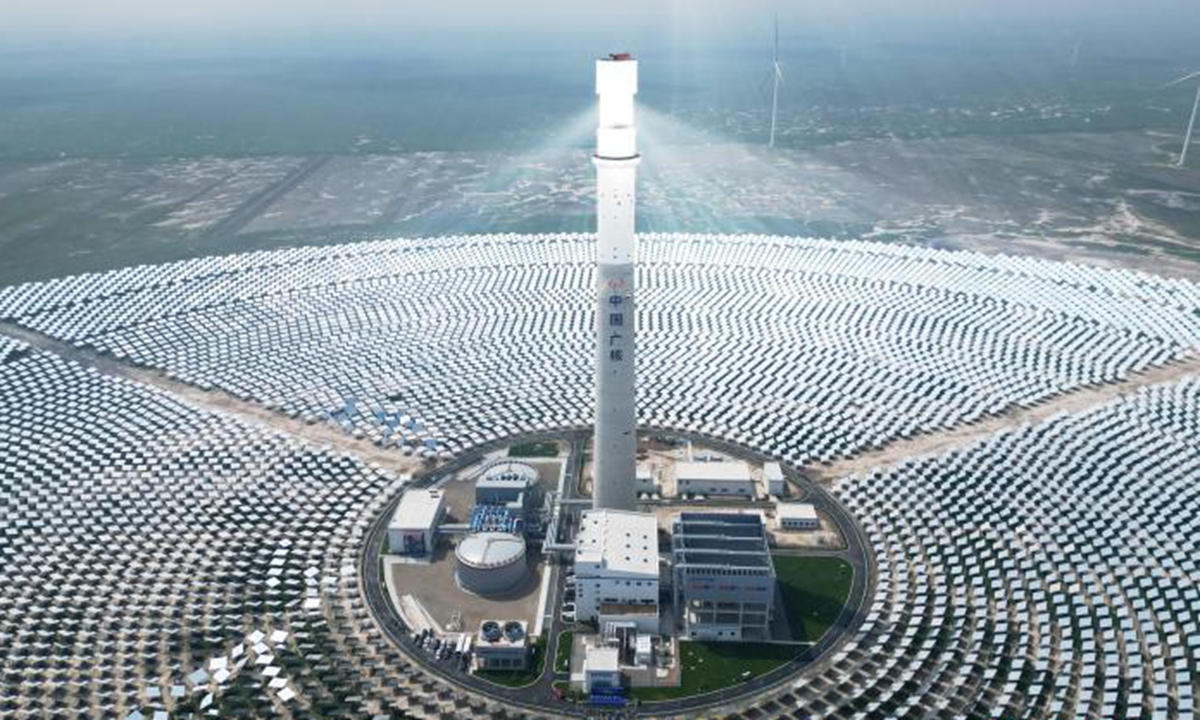
Jixi 100-megaWatts (MW) solar thermal power plant in Da'an, Northeast China's Jilin Province (Photo: China News Service)
China General Nuclear Power Group (CGN) announced on Monday that its Jixi 100-megaWatts (MW) solar thermal power plant, the country's northernmost and the first of its kind in Northeast China, was connected to the grid and began generating electricity in Da'an, Northeast China's Jilin Province.
This marks a major breakthrough in the application of solar thermal power generation technology in high-latitude, frigid regions, providing a replicable and scalable model for developing similar projects in comparable areas, and demonstrating that China now possesses the capability to build large-scale solar thermal power stations in extremely cold environment, the company said in a statement sent to the Global Times on Monday.
Located in a frigid climate zone at 45.36 degrees north latitude, the plant adopts a single-tower, single-mirror-field molten salt tower technology with an installed capacity of 100 MW and a thermal energy storage duration of up to eight hours, enabling safe, stable and continuous 24-hour operation. The turbine-generator unit can achieve rapid deployment, the company said.
The mirror field consists of 19,667 high-precision heliostats with a total area of approximately 590,000 square meters, which track the sun's trajectory in real time and precisely reflect sunlight onto a heat receiver standing 210 meters tall at the center of the tower.
The receiver converts the light energy into thermal energy at 565 C, which is then stored in the supporting molten salt thermal storage system. Due to temperature drops in the storage tanks that are better than design specifications, the stored thermal energy can be used for power generation on the same day, or, depending on weather conditions, for the following day or even longer periods, according to CGN.
As one of the country's first batch of integrated "wind, solar, thermal and storage" demonstration projects in desert and Gobi regions, the solar thermal plant is equipped with a 40-MW molten salt electric heater, enabling effective coordination with the adjacent CGN Jixi 260-MW wind power project and 130-MW photovoltaic project already in operation. This linkage allows surplus electricity generated by wind and solar power to be converted into thermal energy and stored, effectively mitigating curtailment of wind and solar power when power generation outstrips demand, improving the overall efficiency of energy utilization, the company said.
Jiang Tonghai, chairman of CGN (Jilin) New Energy Investment Co, said the project is expected to deliver significant energy-saving and environmental benefits.
After the project goes into full operation, it is expected to generate 180 million kilo-watt hours of electricity annually, equivalent to saving about 54,000 tons of standard coal and reducing carbon dioxide emissions by about 139,000 tons, Jiang said.
China aims to basically establish a clean, low-carbon, secure and efficient new energy system by 2030, according to a plan recently issued by the National Development and Reform Commission and the National Energy Administration.
The plan specifically sets targets to scale up the development of solar thermal power and oceanic power, with the construction of a number of solar thermal power plants in the country's northern, northwestern and southwestern provinces where solar power is rich. By 2030, the total installed capacity of solar thermal power plant should reach 15 gigawatts, according to the Securities Times newspaper.
Sun Chuanwang, a professor at the School of Economics at Xiamen University, told the Global Times on Monday that the commissioning of the Jilin plant is a milestone achievement, as it not only breaks the conventional perception that such plant is confined to high-irradiation regions in the northwest, but also confirms the technical feasibility of achieving round-the-clock continuous and stable power supply in high-latitude, frigid areas.
Solar thermal power plants possess a lower electricity carbon footprint and the ability to achieve continuous generation and flexible peak-shaving through molten salt thermal storage, thereby effectively addressing the challenge of renewable energy curtailment. Going forward, the deployment of such projects should focus on integrated "wind-solar-thermal-storage" scenarios, positioning it as a "grid stabilizer" rather than a mere source of electricity, Sun said.
Through technological iteration to reduce costs and improve efficiency, solar thermal power plants should be precisely deployed in regions with high peaking demands, Sun said.