


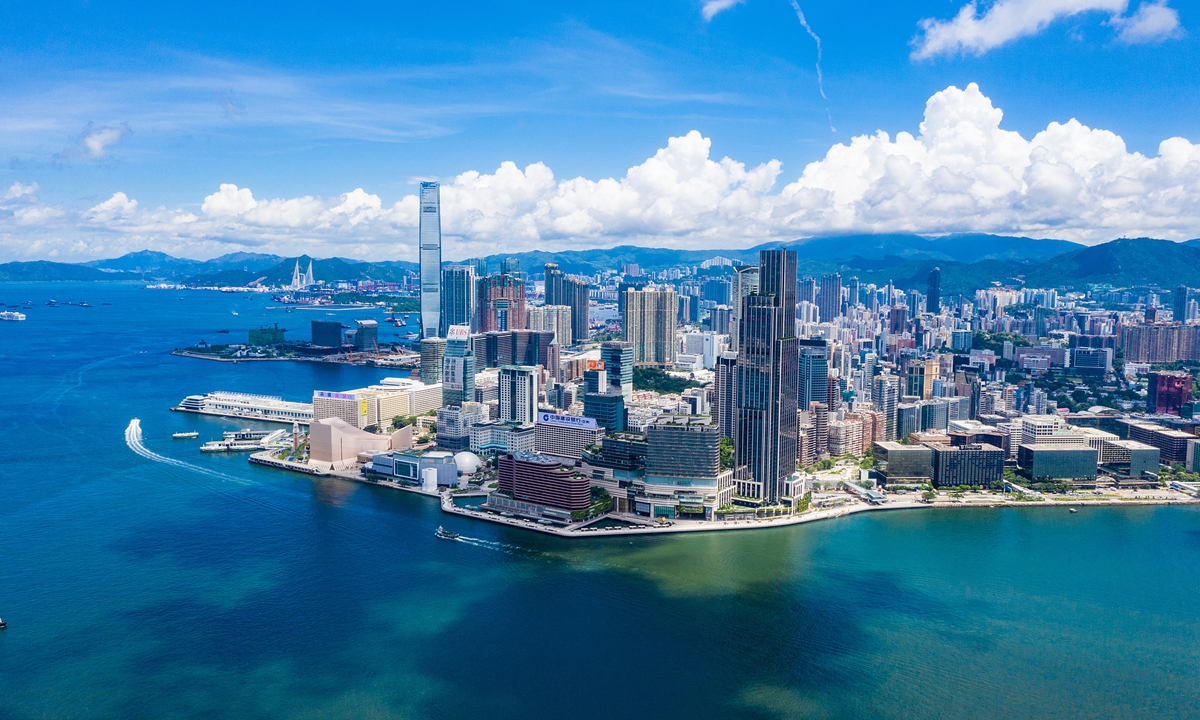
An aerial view of Kowloon, Hong Kong Special Administrative Region (Photo: VCG)
Hong Kong's asset and wealth management industry saw accelerated growth in 2025, as its total assets under management (AUM) rose 20 percent year-on-year to a historic high of HK$42.20 trillion ($5.41 trillion) at year-end, outstripping the prior record hit in 2021, according to a Securities and Futures Commission (SFC) survey report published on Thursday.
Net fund inflows surged nearly threefold, up 193 percent to HK$2.1 trillion, marking a third consecutive year of growth, according to the report. Growth was pronounced for both major segments of asset management and fund advisory, and private banking and private wealth management, the report said.
A Chinese expert noted that this is the latest example highlighting Hong Kong's role as a "haven" for finance amid global geopolitical tensions, and reflects the city's continued attractiveness as an international financial center.
The record AUM topped the previous high of HK$35.5 trillion set in 2021, partly fueled by a 193 percent year-on-year surge in net found inflows that reached HK$2.1 trillion, marking the third consecutive year of growth for capital inflows, according to SFC.
Among the major segments, the AUM of the asset management and fund advisory business recorded 19 percent year-on-year growth to HK$31 trillion; that of the private banking and private wealth management business also increased by an impressive 24 percent year-on-year to HK$12.9 trillion.
Hong Kong's unique geographic position makes it a "super connector" linking two-way capital flows: serving both as a gateway for international capital entering the mainland and as a platform for mainland funds going global, Liang Haiming, dean of Hainan University Belt and Road Research Institute, told the Global Times on Thursday.
The city's role as a wealth management safe haven is underpinned by the "one country, two systems" framework, strong central government support, a highly open and free business environment, and an internationally aligned legal and financial regulatory system, as well as mature professional services and financial infrastructure, Liang said. "These advantages continue to sustain global investor confidence amid rising geopolitical and market uncertainty."
Notably, according to the Global Wealth Report 2026 published by the Boston Consulting Group on May 27, Hong Kong is now the world's largest cross-boundary wealth management center, according to data from the Hong Kong Special Administrative Region (HKSAR) government.
Boston Consulting Group's report projects that from 2025 to 2030, cross-boundary wealth managed by HKSAR will grow by 9 percent on average annually and maintain first place globally, fully affirming its position as a world-leading cross-boundary wealth management center.
Commenting on this, Paul Chan, financial secretary of the HKSAR government said that the national 15th Five-Year Plan (2026-30) clearly supports Hong Kong in strengthening its functions as an international asset and wealth management center, which is also a key component of Hong Kong's "Finance +" development strategy, according to HKSAR government.
"Currently, global investors are actively seeking diversified asset allocation. Leveraging the advantages of 'one country, two systems,' complemented by free, open, transparent and predictable economic policies, as well as a stable and secure investment environment, and cross-market connectivity, Hong Kong is attracting more and more ultra-high-net-worth individuals and family offices to establish a presence and invest in the city," Chan said.
Hong Kong could further strengthen its role as a "super connector" to enhance its long-term competitiveness in wealth management, Liang said, noting that as a key node in the Guangdong-Hong Kong-Macao Greater Bay Area, it should deepen connectivity mechanisms to facilitate more efficient capital flows between global investors and the mainland market.
He added that Hong Kong can expand cooperation with Chinese mainland cities in industrial planning, regulatory alignment and technological development, while leveraging fintech and green finance to support regional transformation and deliver mutual benefits.