


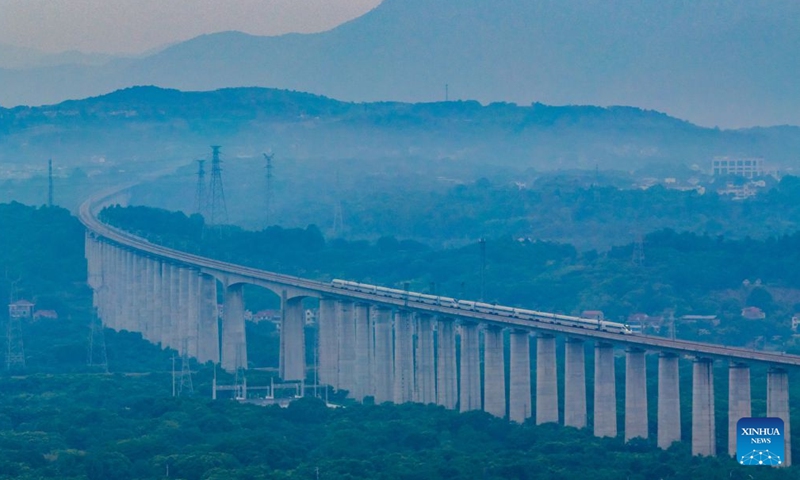
An aerial drone photo taken on June 27, 2026 shows a high-speed railway train running on the Hangzhou-Taizhou high-speed railway in Shengzhou, east China's Zhejiang Province. (Photo: Xinhua)
From high-speed railways to highways and tunnels, a wave of major transport projects has been completed or opened recently across China, underscoring how infrastructure investment continues to fuel the country's economic momentum.
The steady rollout of major transport projects across China highlights the continued strengthening of its modern infrastructure system, enhancing connectivity and facilitating the movement of people and resources, injecting momentum to future development, a Chinese analyst said.
A recent example is the 129.8-kilometer-long highway G3036, which officially opened to traffic on Wednesday, the Xinhua News Agency reported on Thursday. Spanning Aksu and Alar in Northwest China's Xinjiang Uyghur Autonomous Region, the corridor is expected to serve as a new transport driver for high-quality development in southern Xinjiang.
Built to a dual four-lane standard with a maximum design speed of 120 kilometers per hour, the highway serves as an important link in the national G30 highway that connects Lianyungang in East China's Jiangsu Province to Horgos in Xinjiang region.
Travel time between Aksu and Alar has been cut to about one hour, filling a key gap in southern Xinjiang's road network and significantly improving regional connectivity and transport efficiency.
On the same day, Lugu Lake Super Bridge, part of the G7611 Xichang-Shangri-La highway project, marked a breakthrough with the successful completion of the world's first U-shaped rotary tunnel anchor.
The highway spans 233.13 kilometers and forms an important part of the Shangri-La tourism loop. Once completed and opened to traffic, the highway will end the history of no expressway access in Yanyuan and Muli counties, and play a significant role in improving the region's trunk highway network.
On Tuesday, the Xi'an-Shiyan high-speed railway officially opened to traffic with Xi'an East Railway Station in Xi'an, capital of Northwest China's Shaanxi Province, also completed and put into operation. As a result, the Xi'an-Wuhan high-speed rail corridor has been fully linked, reducing the travel time between Wuhan, capital of Central China's Hubei Province and Xi'an to two hours and 41 minutes, Xinhua reported.
According to the State-owned Assets Supervision and Administration Commission of the State Council, on June 26, with the full breakthrough of the Zhaotong tunnel, all tunnels along the route of the Chongqing-Kunming High-Speed Railway have been completed. This marks a major breakthrough in the construction of 350 kilometers per hour high-speed rail tunnels under complex geological conditions in China, laying a solid foundation for the full completion and opening of the Chongqing-Kunming High-Speed Railway.
The successive completion and commissioning of major transport projects across China reflects the continued strengthening of the country's modern infrastructure system, with high-speed rail, highways and cross-regional corridors jointly improving spatial connectivity and factor mobility, Hu Qimu, a professor at the Maritime Silk Road Institute of Huaqiao University, told the Global Times on Thursday.
Hu noted that these transportation projects are not isolated developments, but part of a coordinated national transportation network expansion, which is increasingly focused on integrating regional economies, reducing intercity travel time and supporting coordinated development between major urban clusters and less-developed areas.
China has already made significant progress in building its transport network.
During the 14th Five Year Plan (2021-25), China's fixed asset investment in the transport sector totaled 18.8 trillion yuan, marking the highest level of investment and the fastest pace of network development since 1949, according to Minister of Transport Liu Wei at a recent briefing, the People's Daily reported.
Liu said that during the 15th Five Year Plan (2026-30), the country will focus on improving its modern integrated transportation system by advancing the development of a high quality national comprehensive three-dimensional transportation network. It also aims to increase the completion rate of the network's main framework to 95 percent by the end of the plan period, according to the media report.
As China begins implementing the 15th Five Year Plan, improved transportation infrastructure will continue to play a foundational role in stabilizing investment, supporting industrial relocation and facilitating the flow of goods, services and human capital, underpinning high quality economic growth over the long term, Hu said.