


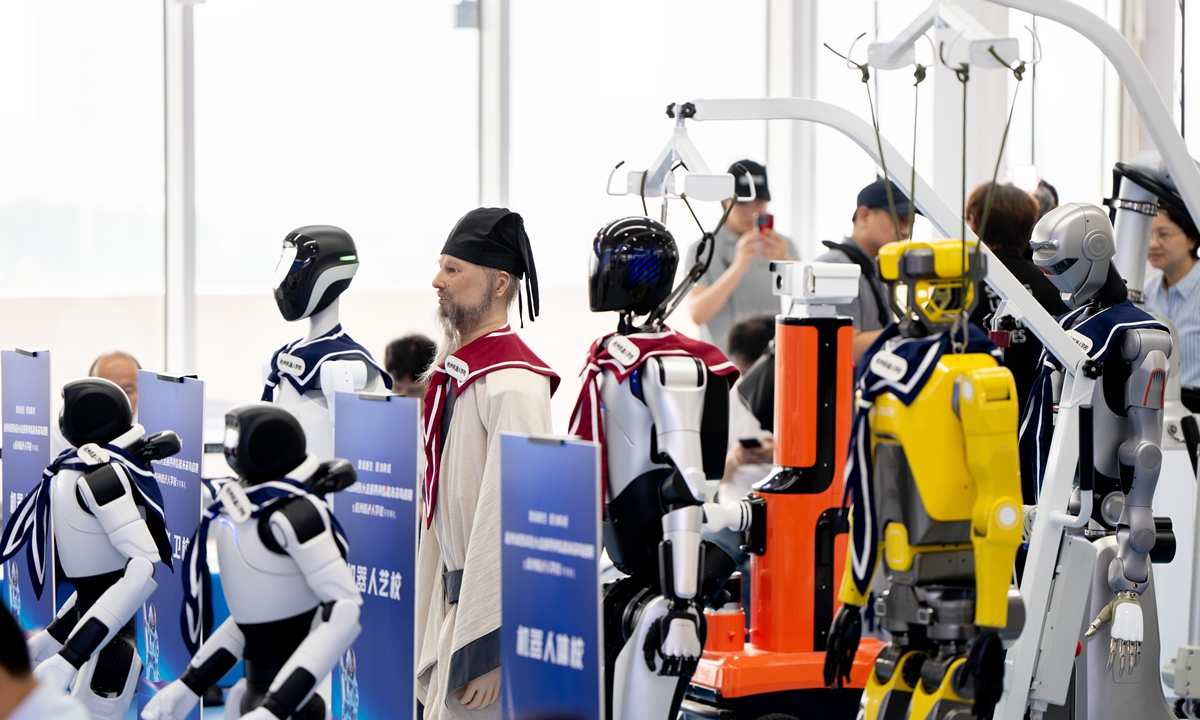
Robot "students" register at the robot school in Hangzhou, East China's Zhejiang Province on June 29, 2026. (Photo: VCG)
On June 29 an unconventional opening ceremony was held in Hangzhou, East China's Zhejiang Province, with some 30 humanoid robots and quadruped machine dogs lining up as the first batch of "students."
Hailing from industrial, security, cultural and services sectors, these robotic "freshmen" will go through admission check-ups, major assignments, systematic courses and final assessments before earning official skill certificates to start formal workplace duties.
Co-initiated by Zhejiang University Robotics Institute, the Zhejiang Institute of Quality Sciences, and Hangzhou Chengxi Sci-Tech Innovation Corridor, this is China's first integrated industrial platform delivering standardized vocational training and certification exclusively for robots.
"Drawing on philosophies adopted by human educational institutions, we have incorporated modules teaching robots to abide by human ethical norms and laws and regulations. We have developed a complete curriculum system, covering cognition, object recognition, human-machine communication, emotional companionship, motor skills and locomotion courses" Zhu Shiqiang, founder of the school, told the Global Times on Thursday. "While the curriculum forms an integrated framework, we tailor customized training programs for each robot according to its individual conditions upon enrollment."
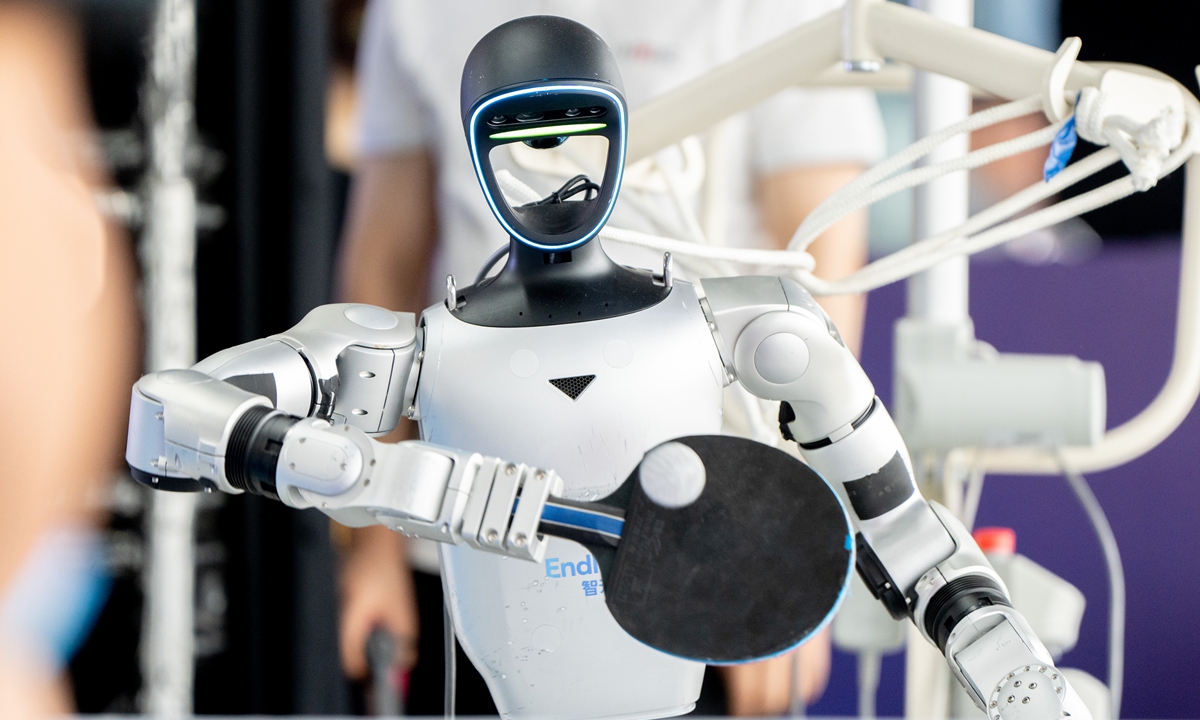
A robot "student" learns table tennis skills at the school on June 29, 2026. (Photo: VCG)
After enrollment, the robots will be assigned to different specialized tracks based on their pre-admission competency assessments and graduation criteria. The tracks include physical training, arts, technical engineering and medical care, with targeted upgrades to each robot's core control system and intelligent agent capabilities.
For instance, table tennis robots are trained to precisely read ball trajectories and execute accurate forehand and backhand strokes. Meanwhile, companion robots are trained to perceive human emotional cues, respond to negative moods with comforting remarks, and even tell jokes to soothe users and lift their spirits.
The robots that pass all assessments will be issued a special skill level certificate, allowing each robot to work with a unique digital ID for full traceability. The school will also keep tracking how the robots perform in real work scenarios and revise its training programs accordingly.
The school directly addresses a widespread industrial bottleneck. "Many enterprises are capable of manufacturing decent robot hardware, yet that does not guarantee high-quality finished products. The crux lies in their inability to develop intelligent control systems tailored to real application scenarios," said Zhu.
Robot training hubs boomAgainst this backdrop, a nationwide network of robots training hubs has risen to bridge this gap. At the embodied intelligence robot data and training base of the Beijing Innovation Center of Humanoid Robotics, machines are trained to practice delicate chip assembly, precise chemical lab operations and household chores like folding clothes, the Xinhua News Agency reported.
According to Xia Hualin, the director of the training base, household humanoid deployment may take another five years, given unpredictable domestic environments, high hardware costs and insufficient high-quality datasets. The industry currently adopts a phased road map: Robots first serve power inspection, factory assembly and elderly care to accumulate real-world data before entering civilian homes.
Shanghai is also scaling its training ecosystem. The National and Local Co-Built Humanoid Robotics Innovation Center in Shanghai will launch a version 2.0 training ground within 2026, Jiang Lei, the center's chief scientist, told the Global Times.
Meanwhile, a 10,000-square-meter venue in Zhangjiang Robot Valley in Shanghai will be opened in the second half of the year to support data collection, prototype testing and full-lifecycle robot management, Jiang said.
Real-scenario training lays a solid foundation for the large-scale commercialization of humanoid robots, Wang Peng, an associate research fellow at the Beijing Academy of Social Sciences, told the Global Times on Thursday.
"On one hand, it equips robots with advanced decision-making capabilities, specialized work skills and standardized safety mechanisms, boosting market recognition and sales," he noted. "On the other hand, it shortens deployment periods, lowers operating costs for businesses and improves robots' price competitiveness."
On a broader scale, the widespread deployment of robots will catalyze the transformation of traditional manufacturing toward intelligent and automated systems, optimizing the industrial structure and sharpening the global competitive edge of China's manufacturing sector, Wang noted.
On June 8, the Ministry of Industry and Information Technology and the State-owned Assets Supervision and Administration Commission of the State Council issued a special work plan for training humanoid and embodied AI robots in real working environments.
The document pushes for a complete set of rules to manage and support these robots throughout their whole service life. By the end of 2026, leading robot models will be tested and put into regular use across many typical workplaces, moving past simple show displays to actual "working mode." The country plans to roll out over 100 valuable use cases and diversify embodied AI applications.
A core task is to build standardized real-scene training venues covering industrial, services and special-purpose sectors. These training environments span manufacturing, laboratory testing, maintenance, logistics, retail, elderly care, workplace safety and emergency response. Governments and enterprises are required to select standardized, cost-effective real-world work scenarios to train humanoid and quadruped robots for authentic, job-specific missions.