


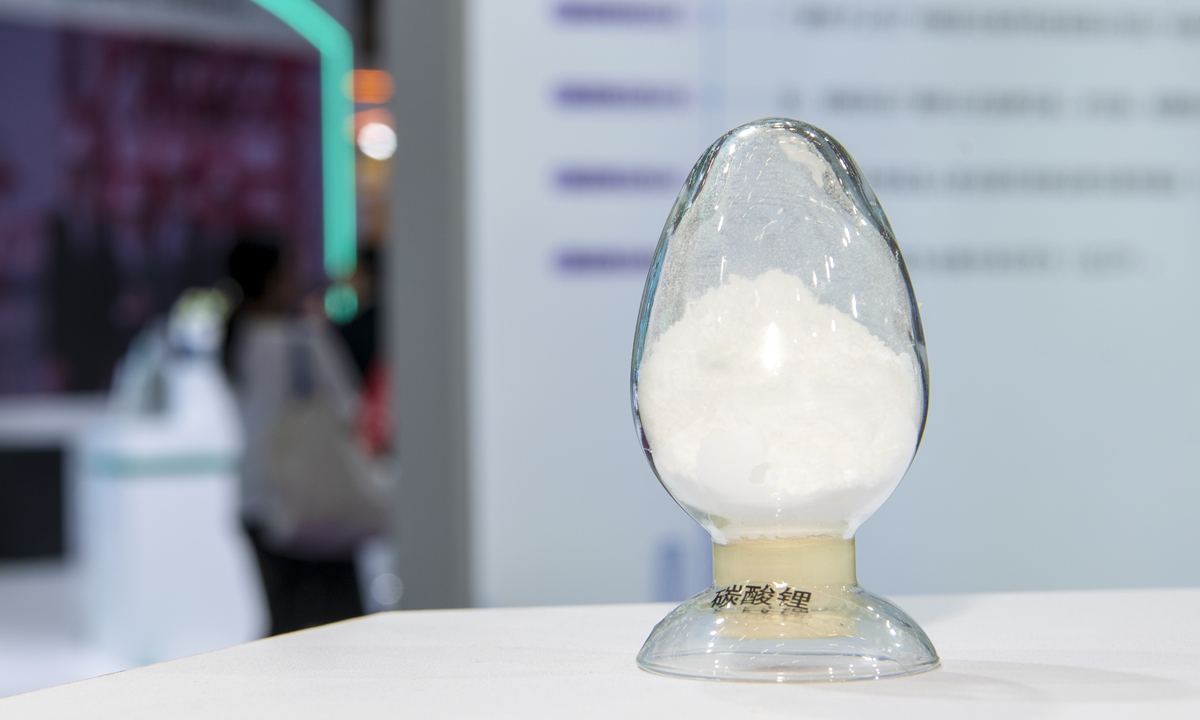
A lithium carbonate futures sample is displayed at the Guangzhou Futures Exchange in Guangzhou, South China's Guangdong Province, on June 3, 2026. (Photo: VCG)
China opened lithium carbonate futures and options on the Guangzhou Futures Exchange (GFEX) to overseas traders on Friday, giving overseas participants access to a key Chinese futures product for the battery-material supply chain, and marking another major step in the opening-up of China's futures market.
The broader access could help the GFEX lithium carbonate futures gain a larger role in global lithium pricing, while also supporting wider use of the yuan in international commodity transactions, experts said.
Lithium carbonate is a key raw material in the battery supply chain, and is widely used in power batteries for electric vehicles and energy storage systems.
The products are the first on the GFEX to be opened to overseas traders under China's specified domestic futures product mechanism, and this comes after industrial silicon, lithium carbonate and polysilicon futures and options were made available to qualified foreign investors last year.
Under arrangements announced by the GFEX, eligible overseas clients have been able to apply for trading codes through futures company members or overseas intermediaries since June 18. They were formally allowed to start trading lithium carbonate futures and options from Friday, according to the China Futures Association.
Guo Chenguang, deputy director of the GFEX's commodity department, said the opening will provide global lithium battery companies with more convenient tools to manage price risks. "Lithium resource projects often require long development cycles and large upfront investment. When prices fluctuate sharply, futures and options can help companies lock in margins, stabilize returns and manage risks linked to resource development and production," Guo said.
The opening could help bolster lithium carbonate futures hedging role by bringing more domestic and overseas players into the same market, Zhou Mi, a senior research fellow at the Chinese Academy of International Trade and Economic Cooperation, told the Global Times on Friday.
With much of the production capacity in China and lithium battery demand spread worldwide, broader participation could help prices better reflect global market expectations and ease volatility caused by supply-demand mismatches, Zhou said.
China is the world's largest lithium resource consumer and an important importer, with a complete lithium battery industrial chain. Customs data showed that China imported 242,940 tons of lithium carbonate and 7.7704 million tons of spodumene in 2025.
Many overseas producers and trading firms already use lithium carbonate futures prices as an important pricing reference. Opening lithium carbonate futures and options to overseas traders is expected to further strengthen China's pricing role in the lithium battery supply chain, according to reports.
Duan Debing, vice chairman and secretary-general of the China Nonferrous Metals Industry Association, said the introduction of overseas traders is an important sign of the globalization of China's lithium carbonate industry. The move will help Chinese lithium companies expand overseas, stabilize returns from their international operations and allow foreign participants to make more direct use of China's futures pricing system, Duan said.
The opening has moved forward in stages. In March 2025, GFEX made lithium carbonate futures and options - along with industrial silicon and polysilicon futures and options - available to qualified foreign institutional investors and yuan qualified foreign institutional investors.
In January 2026, the China Securities Regulatory Commission announced a further expansion of the opening-up of China's futures market, adding 14 futures and options products to the list of specified domestic futures products. GFEX lithium carbonate futures and options were included in the list, paving the way for overseas traders to participate in the market through relevant arrangements.
The yuan-denominated structure is also central to the opening. Overseas traders may use US dollar funds as margin, subject to a 0.95 discount rate, but trading and settlement are conducted in yuan, the Securities Times reported, citing industry analysts.
Zhou said the arrangement lowers participation costs for overseas companies while keeping pricing and settlement in yuan, a natural setup for a Chinese futures product backed by a large domestic industrial base. "As GFEX lithium carbonate futures become more closely linked with cross-border trade, yuan-denominated pricing could offer companies another tool for managing currency and payment risks," he added.
Since their launch on July 21, 2023, lithium carbonate futures have traded steadily and played a growing role in serving the real economy. By the end of June 2026, lithium carbonate futures and options averaged 347,300 lots and 25.81 billion yuan in daily turnover, showing solid liquidity, according to Securities Times.