


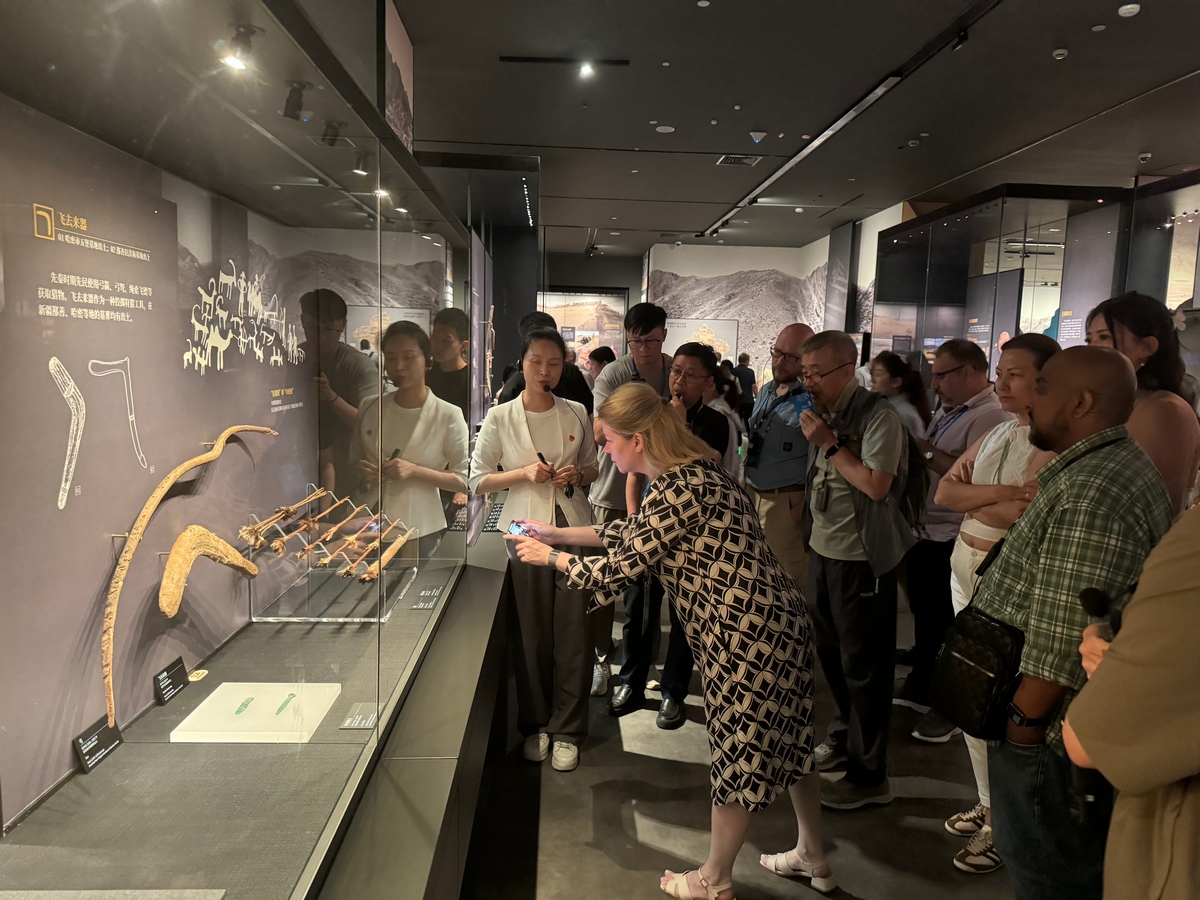
Journalists view an exhibit at the Xinjiang Uygur Autonomous Region Museum in Urumqi, Northwest China's Xinjiang Uygur Autonomous Region,on June 30, 2026. (Photo: GT)
"What I have seen in Xinjiang is a great transformation," Kanashyts Siarhei, editor-in-chief of Belarusian newspaper Narodnaya Gazeta told the Global Times. He was impressed by the pace of change in Xinjiang. "The economy and culture are advancing rapidly, and everything here is full of positive energy which impressed us," he added.
Siarhei is one of a delegation of 17 media representatives from 14 countries who visited Northwest China's Xinjiang Uygur Autonomous Region from June 29 to July 5, touring major infrastructure projects, cultural heritage sites and local communities to witness the region's development firsthand.
During the week-long journey — "Silk Road Economic Belt Joint Construction Countries Media Head Seminar", the participants traveled to Urumqi, Mongolian Autonomous Prefecture of Bayingolin and Turpan, gaining a close look at Xinjiang's role as a core link of the Silk Road Economic Belt and its growing strength in transport, logistics, tourism and public services. Many foreign media representatives said the trip offered them a rare chance to see real Xinjiang.
At the Tianshan Shengli Tunnel — the world's longest expressway tunnel, located in the remote depths of the Tianshan Mountains, the journalists described the project as a landmark in transportation engineering and regional connectivity.
They said the tunnel showed how technology can overcome geographical barriers and improve connectivity between northern and southern Xinjiang, with important implications for improving people's livelihood.
Ahmed Saail Ali, a journalist from the Maldives, said the tunnel was far more than a passage through the mountains. "This is a project that has rewritten the history of civil engineering," Ali told the Global Times. "Although I had read about projects of this magnitude, seeing the Tianshan Mountains in person made me realize how difficult it was to comprehend the scale of this undertaking beforehand."
A massive change for the people has taken place. The transformation slashes logistics costs for industries, secures supply chains between major production hubs, and opens up the breathtaking alpine landscape in central Xinjiang to more tourists, said Ali.
The Tianshan Shengli Tunnel has long been seen as a crucial piece of infrastructure in a region where the Tianshan Mountains once posed a formidable natural barrier. It is a key project of the Urumqi-Yuli Expressway, which runs from the regional capital of Urumqi in northern Xinjiang to Yuli county in southern Xinjiang, the Xinhua News Agency reported.
Before the tunnel opened on December 26, 2025, travel between northern Xinjiang's Urumqi and southern areas such as Yuli county near Korla meant crossing dangerous, and winding mountain roads at altitudes of over 3,000 meters. Heavy snow and ice could block the routes for as long as eight months in a year, isolating communities and disrupting trade.
By creating a year-round passage through the mountains, the tunnel has significantly improved regional connectivity, cut transportation risks and helped integrate northern and southern Xinjiang more closely into the Silk Road Economic Belt, project manager Cui Jingchuan told the Global Times.
Travel time across the Tianshan Mountains has been reduced from four hours to 20 minutes now. The overall journey, including the connecting roads, has been significantly shortened, Cui noted.
The tunnel has also lowered transport costs for agricultural products such as chili peppers and cotton, improved market competitiveness and boosted tourism and rural revitalization in southern Xinjiang, Cui said. He added that the project has also served as a fast medical corridor, successfully transporting 29 critically ill patients in emergencies.
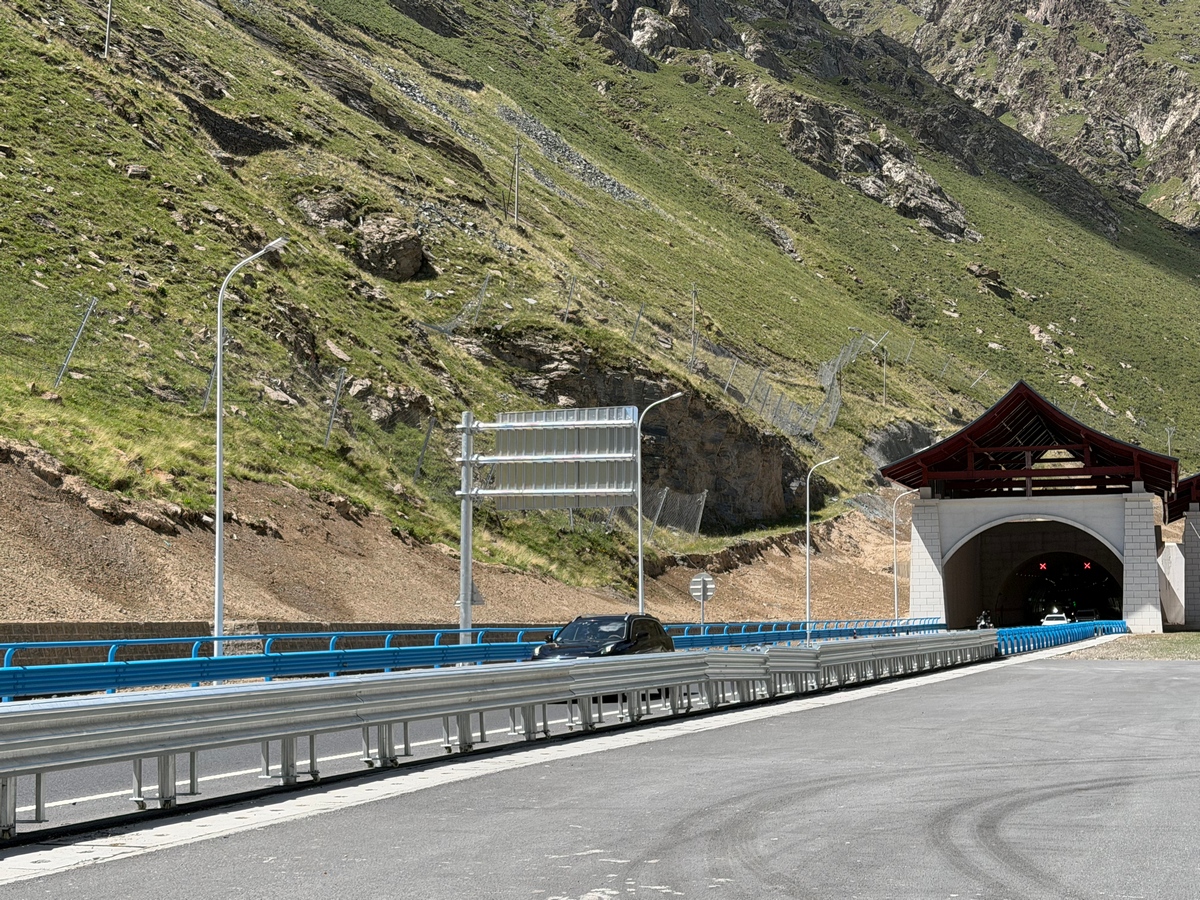
A car drives across the Tianshan Shengli Tunnel — the world's longest expressway tunnel, locates in the remote depths of the Tianshan Mountains, on July 4, 2026. (Photo: GT)
A Kyrgyzstani media representative called the tunnel remarkable, noting that it was completed in just five years in a high-altitude, difficult environment. For Kyrgyzstan, a mountainous country facing challenging construction conditions such as landslides, cooperation with China could be valuable, the journalist said, citing China's experience in engineering, training, and manufacturing.
"Because my own country's infrastructure development remains relatively weak, it is imperative to pursue friendly cooperation with China and benefit from China's strengths in expertise, experience, and manufacturing capacity," Syiagul Karaman, a columnist from Kyrgyzstan's KOOM Press News Agency, told the Global Times.
According to Karaman, Kyrgyzstan is located deep inland, and the soon-to-be-opened China-Kyrgyzstan-Uzbekistan railway will serve as a logistical hub for a century-defining national project. It will have a far-reaching impact on breaking geographic barriers, promoting regional trade flow, and facilitating the movement of people.
The delegation also visited the Urumqi International Land Port, where they learned about Xinjiang's rising role in regional trade and logistics.
Karaman said that she had visited Xinjiang in 2012 and was struck by the scale of change there. "The development is enormous," she said, adding that the port's standardized and efficient operations left him a strong impression.
Geoffrey William Thompson, editor-in-chief of the Luxembourg-based Chronicle Online, said the trip to Xinjiang gave him a first-hand look at the region's development, particularly in agriculture and machinery.
Thompson said that he was interested in Xinjiang's historical role as part of the ancient Silk Road and its current place in the Belt and Road Initiative. He noted the region's strategic location near Kazakhstan, Kyrgyzstan, Pakistan, Russia and Mongolia, and said it has potential as a hub for trade and connectivity through road, rail and air links.
Xinjiang's foreign trade in 2025 exceeded the 500 billion yuan ($73.61 billion) mark, growing by 14.7 percent year-on-year with BRI countries, data from the Urumqi Customs showed.
German journalist Anika Wuerz of the Hamburger Abendblatt said the trip was exciting, and the most memorable site for her was the Bezeklik Thousand Buddha Caves in Turpan. She said Xinjiang plays an important strategic role as China's gateway to the west, but many people in Germany do not fully understand the region and that some Western media reports about Xinjiang are inaccurate or one-sided.
Rodriguez, a columnist with the Spanish newspaper Mundo Obrero, said Xinjiang appeared to him as a highly open and fast-developing region where people are energetic and enjoy life.