


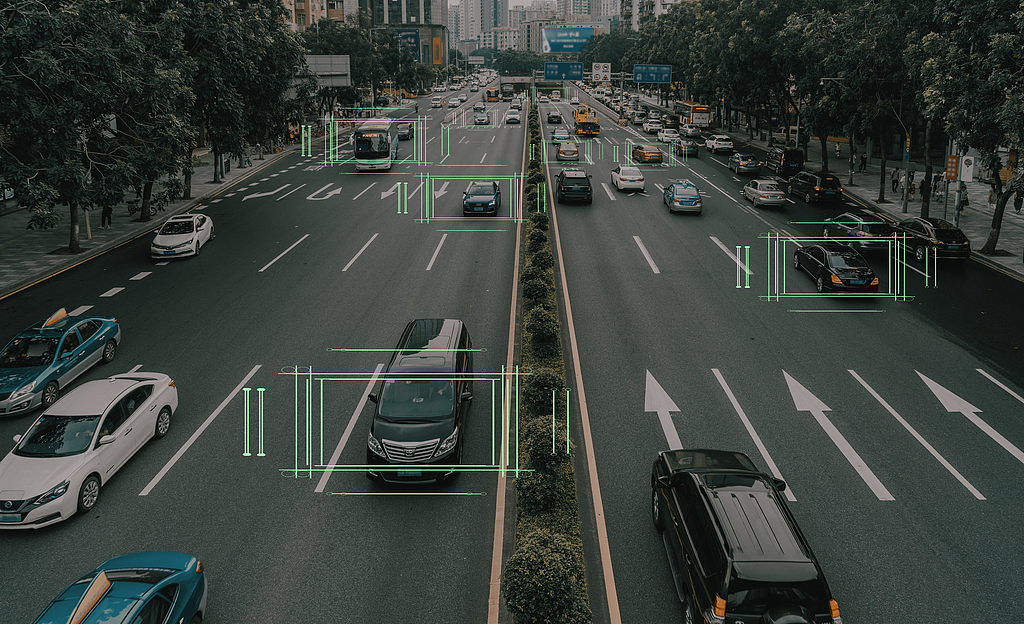
Artificial Intelligent (AI) is learning through real-time traffic. (Photos: VCG)
Wide-scale deployment of AI across integrated transportation systems
Against the backdrop of global urbanization, surging multimodal travel demands and door-to-door logistical supply, modern transportation infrastructure confronts systemic bottlenecks including recurrent congestion, frequent safety hazards and excessive carbon emissions. Artificial intelligence, represented by traffic foundation large models, computer vision and digital twin simulation, has become a core transformative technology reshaping the operation paradigm of intelligent transportation systems (ITS). Unlike conventional post-event traffic management, AI realizes full-chain proactive perception, predictive deduction and optimal scheduling covering infrastructure monitoring, passenger flow organization, equipment maintenance and risk pre-warning.
Driven by national industrial strategies such as China's "AI + Transportation" Initiative, the EU Sustainable Mobility Framework, and the AI for ITS Program for the US Department of Transportation, intelligent algorithms have been fully deployed in urban road networks, mass transit, civil aviation and intercity logistics, forming an all-dimensional collaborative intelligent transport ecosystem. As affirmed by the China Intelligent Transportation Systms Association, AI has evolved from laboratory pilot technology into a standardized core productive factor governing the whole transport industrial chain.
Authoritative domestic and overseas AI cases covering diverse transport modes
Typical cases released by China's Ministry of Transport and benchmark projects displayed at the ITS World Congress fully verify the technical maturity of AI transportation at home and abroad. In China's urban rail transit sector, the multi-modal passenger flow prediction large model of Shanghai Metro adopts hierarchical network dispatching during holiday peaks to balance line load and improve the efficiency of transport capacity allocation. The AI track defect identification system of Qingdao Metro raises inspection efficiency six times and cuts unplanned track downtime by 30%. In civil aviation, Beijing Capital International Airport has deployed AI agents for passenger diversion and apron conflict early warning to optimize passenger distribution in terminals and reduce ground operation risks of flights. In high-speed railway, AI-based intelligent dispatching system for high-speed railways leverages large models trained on historical passenger flow, weather, and equipment status data to automatically deduce delay propagation and intelligently adjust train crossing and overtaking schedules, significantly mitigating cascading delays during the Spring Festival travel rush and other holidays. As a flagship achievement exhibited at the 2026 ITS World Congress, the vehicle-road-cloud integrated platform in Shenzhen covers more than 4,000 kilometers of urban roads and delivers millisecond-level disposal responses to traffic incidents.
Overseas benchmark projects have generated quantifiable industrial benefits. The New York Metropolitan Transportation Authority leverages machine learning for predictive subway maintenance, achieving a defect recognition accuracy rate of 92% during the pilot phase. The Road Transport Authority of Dubai has launched commercial fleets of high-level automation Level 4 robotaxis, which are incorporated into the 2030 city-wide autonomous mobility roadmap and adapt to complex road conditions in desert cities. Deutsche Bahn adopts an AI-based vehicle digital twin system to accurately predict the life cycle of components and formulate differentiated maintenance schedules for regional trains.

The night view of Hainan Free Trade Port through a bullet train.
Long-term development prospects of AI-driven transportation
AI-enabled intelligent transport has yielded remarkable economic, social and environmental gains by elevating operational efficiency, reducing traffic casualties and mitigating transport carbon footprints. Nevertheless, the industry is constrained by fragmented traffic data, insufficient algorithm robustness under extreme weather scenarios and incomplete hierarchical regulatory frameworks for autonomous vehicles. In the foreseeable future, three core evolutionary trajectories will dominate the intelligent transformation of transportation.
First, the vehicle-road-cloud-network-map integrated architecture supported by general traffic large models will be comprehensively popularized, breaking cross-modal data barriers and realizing full-scenario digital twin simulation for dynamic traffic optimization. Second, emerging mobility business forms will achieve large-scale commercialization: Mobility as a Service (MaaS) platforms will integrate rail, aviation and road travel, while Level 4 autonomous passenger vehicles and unmanned fleets will expand coverage in designated operation zones. Third, unified industrial standards for cross-regional traffic data sharing and tiered supervision codes for autonomous driving will be formulated to resolve institutional obstacles restricting industrial expansion. In sum, supported by iterative algorithm optimization and perfected governance mechanisms, artificial intelligence will serve as the fundamental pillar for constructing a safe, low-carbon and integrated sustainable comprehensive transportation system.