


Xinjiang’s agricultural machinery, smart tech exports to BRI markets surge
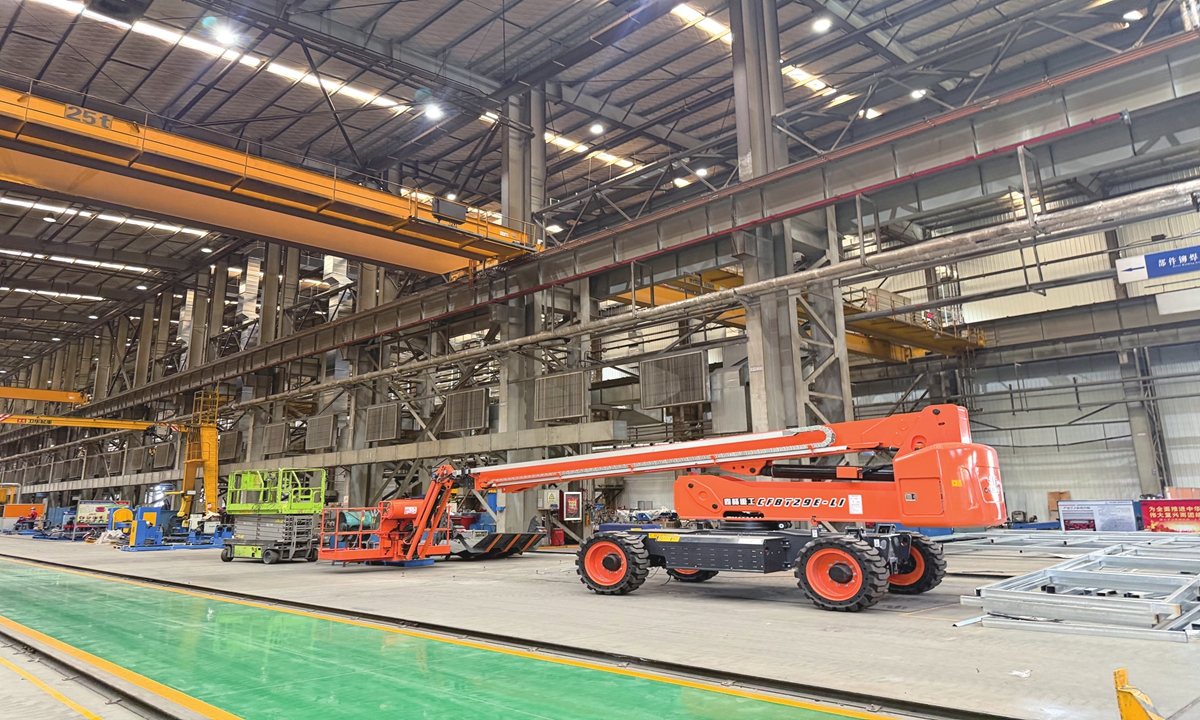
A view of the production floor of China Railway Construction Corporation Heavy Industry Xinjiang Co in Urumqi,?Northwest China's Xinjiang Uygur Autonomous Region, on June 29, 2026 (Photo: Zhang Weilan/GT)
On a recent day, the production floor of CRCC Heavy Industry Xinjiang Co in Urumqi, Northwest China's Xinjiang Uygur Autonomous Region, was buzzing with activity as workers raced to complete four-row box-type cotton pickers. The schedule is tight, as the batch must be finished and shipped to Central Asia on July 10.
Meanwhile, at a demonstration farm in Korla, in central Xinjiang, over 500 mu of cotton farmland stretches out, dotted with tender green cotton plants rising 60 centimeters high, crisscrossed by a web of intelligent drip irrigation lines. Such smart crop irrigation systems are widely adopted not only in Xinjiang but also in overseas markets like Pakistan and Kazakhstan.
These scenes picture a booming industry in Xinjiang, where locally produced agricultural machinery and intelligent farming solutions are rapidly exported overseas, with even greater potential for growth, as cooperation under the Belt and Road Initiative (BRI) deepens. The rise of Xinjiang's agricultural machinery and smart farming industry is boosted by continuous industrial upgrading and robust policy support, according to industry players and experts.
Rising demandThe batch of four-row box-type cotton pickers being produced at the factory in Urumqi is scheduled to be exported to Uzbekistan.
"This year's first batch will leave Urumqi on July 10, travelling mainly by road through Khorgos Port, a sprawling dry port on the China-Kazakhstan border, before continuing across Kazakhstan to Tashkent, Uzbekistan," Li Bakun, overseas marketing manager at CRCC Heavy Industry Xinjiang Co, told the Global Times.
Li said Chinese cotton harvesters once faced strong competition from US brand John Deere, but domestic machines are now widely used in Xinjiang and increasingly sold in the Belt and Road partner countries.
"Cost performance is one of the biggest advantages of Chinese-made cotton harvesters," Li said. "We also have a service team made up of research and development (R&D) and technical staff to ensure the machines operate smoothly throughout the harvesting season after delivery."
Unlike basket-type harvesters, which collect picked cotton into an on-board bin and unload it at the field edge for transfer to transport and ginning facilities, the box-type model is designed to match the cotton planting patterns of Central Asian countries. The machine can be adjusted for row spacing between 76 cm and 90 cm, making it suitable for large-scale, contiguous cotton fields.
According to Li, the company's technical team conducted extensive field research in Uzbekistan before finalizing the machine's design, studying local field sizes, cultivation methods and operating conditions. From wheel-track configuration to machine operating parameters, the equipment was optimized to better fit local planting standards and improve harvesting efficiency, picking rate and adaptability to difficult environments.
Thanks to such advantages, demand is surging. A company representative said total export volume in 2026 is expected to reach between 50 to 80 units, with the first batch comprising about 20 machines. Each cotton harvester is priced between $270,000 and $300,000.
For example, demand is particularly high in Uzbekistan, one of the world's major cotton producers and exporters. As part of a broader push to modernize its agricultural industry, Uzbekistan has announced plans to increase the share of automated cotton harvesting to 70 percent and purchase 10,000 units of machinery in 2026, opening a large market for Chinese manufacturers.
In recent years, companies including CRCC, Xinjiang Boshiran Intelligent Agricultural Machinery Co, Shandong Swan Cotton Industrial Machinery Stock Co and Jiangsu World Agriculture Machinery Co, have built strong roots in Xinjiang and made major breakthroughs in domestic innovation. They have developed technologies including automatic control systems and steadily improved picking efficiency, narrowing the gap with foreign brands and expanding their market share.
In doing so, they have leveraged Xinjiang's mechanized cotton industry to build product and supply-chain advantages, entering Central Asia through both complete-machine exports and SKD cooperation models, in which semi-knocked-down kits are assembled locally by partner factories.
This is part of a broader trend. China's agricultural machinery sector has seen strong export momentum. In the first quarter, the country's import and export volume of agricultural machinery and parts reached $6.28 billion, up 27.9 percent year-on-year, with exports totaling $5.94 billion, up 28.9 percent. Exports to countries participating in the BRI rose 30.4 percent year-on-year in the same period, according to official data.
The broader expansion of Chinese farm machinery in Central Asia reflects a deeper shift in China-Central Asia agricultural cooperation — one moving from trade alone toward industrial collaboration.
Smart solutionsBeyond high-end machinery helping the region accelerate agricultural mechanization, Chinese smart agriculture technologies are also benefiting more Belt and Road partner countries.
Xinjiang Cloud Cultivate Modern Agriculture Research Institute Co, a Korla-based smart agriculture company, told the Global Times its artificial intelligence (AI)-driven system — combining simplified cultivation, precision water-fertilizer management, and digital decision-making — has cut water use by 30 percent and raised cotton yields by 20 percent in southern Xinjiang.
The company has deployed technologies including AI-powered water-fertilizer integration, low-flow drip irrigation, and ultra-wide plastic mulching across Korla, Aksu, and Hotan, as well as in Ulanqab, Inner Mongolia, and Wuyi in North China's Hebei Province. It has also taken the model to Pakistan, Nigeria, and Kazakhstan.
For example, in 2024, the company launched a peanut cultivation project in Pakistan's Punjab Province. The demonstration area has since expanded to over 10,000 hectares, making it one of the largest high-value oilseed zones in the region.
Founder and agronomist Xiong Dazhen said the firm aims to make smart agriculture accessible at scale. "Arid-region agriculture can be low-cost, replicable, and sustainable," he said.
The company has also extended cotton, peanut, wheat, and soybean expertise to Kazakhstan and other BRI markets.
"This year, we have built peanut grading facilities, oil pressing plants, and food processing factories in Pakistan," Xiong said, adding that this marks not only the maturation of a "Chinese technology + local resources" cooperation model but also a significant increase in agricultural value through extending, supplementing and strengthening the industrial chain.
From cotton pickers and tractors to crop-protection robots and integrated smart agriculture solutions, Chinese manufacturing is injecting strong momentum into agricultural modernization across Central Asia and beyond through continuously upgraded technological capabilities.
Zhou Li, a professor at the College of Agricultural and Rural Development, Renmin University of China, told the Global Times that the ongoing export of Chinese agricultural equipment and smart farming technologies has not only improved local agricultural productivity, but also opened a new chapter in cooperation under the BRI.
As China and other BRI partner countries deepen cooperation, Chinese smart agriculture is gradually moving beyond the simple export of equipment toward the systematic export of technologies, standards, services and experience, offering a new practical model for global agricultural modernization, Zhou noted.