


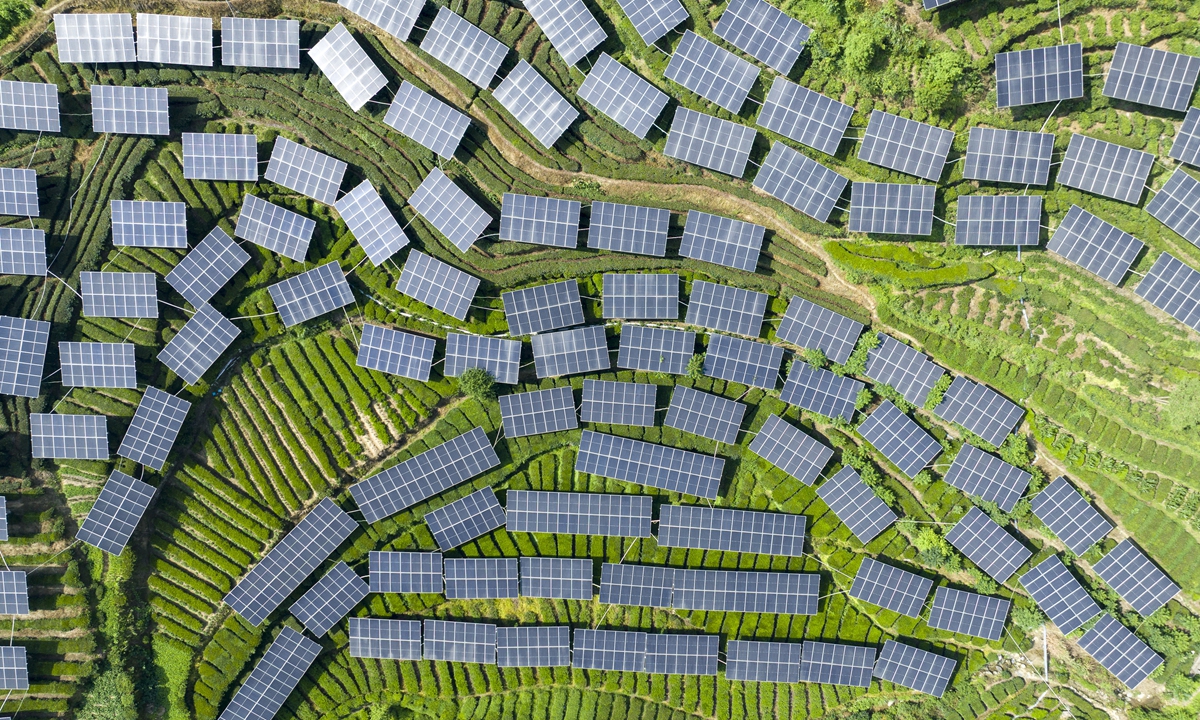
The photovoltaic (PV) panels in the tea fields deliver green electricity under the sunlight in Zigui county, Central China's Hubei Province. (Photo: VCG)
China plans to raise the share of non-fossil energy consumption to 25 percent of total energy consumption by 2030, and speed up efforts to meet new electricity demand with new clean energy production capacity, according to an action plan issued by China's State Council on Thursday.
The action plan outlined the roadmap for achieving its carbon emission peaking target during the 15th Five-Year Plan (2026-30) period, setting up key targets for 2030, including a 17-percent reduction in carbon dioxide emissions per unit of GDP from 2025.
Raising the share of non-fossil energy consumption to 25 percent marked a significant step from the 21.7 percent recorded in 2025, and will support the overarching goal of peaking coal and oil consumption by 2030, according to an official with the National Development and Reform Commission.
Effort to increase the share of non-fossil energy consumption is the key to achieving the 2030 carbon dioxide emission targets.
To achieve the goals, the plan outlined five major tasks. These include accelerating the adjustment and optimization of the energy structure, ensuring that new electricity demand is met by new clean energy capacity, and promoting the green and low-carbon transformation of the country's industrial sectors.
In upgrading traditional industries, the plan calls for reducing carbon dioxide emissions per unit of value added of industrial enterprises above designated size by more than 17 percent, while slashing energy consumption per unit of GDP by about 10 percent. Through energy‑saving and carbon‑reduction retrofitting in key industries, the country hopes to achieve energy savings equivalent to over 150 million tons of standard coal.
Among the specific goals introduced by the plan, the nation aims to build around 100 national-level zero-carbon industrial parks and 500 zero-carbon factories. In the transport sector, the goal is for new-energy vehicles to account for 30 percent of the country's vehicle fleet by 2030.
Furthermore, the plan emphasizes the green transformation of computing power infrastructure, promoting the use of renewable energy for new facilities and phasing out outdated technologies. These measures are designed to embed green, low-carbon principles throughout the economy, fostering sustainable growth and securing a foundation for long-term carbon neutrality.
Against the backdrop of turbulences in international energy markets, the plan is of great significance for consolidating China's energy security. It also means that China will bypass the stage of oil and gas-based energy consumption and enter a stage of non‑fossil energy consumption from the coal‑dominated phase, Tian Zhiyu, a researcher with the Energy Research Institute of the NDRC, was quoted as saying in a CCTV News report on Thursday.
According to the IEA's Global Energy Review 2026, released in April, growth in solar panels met more than one-quarter of global primary energy demand growth, the first time on record that a modern renewable source has contributed the largest share of the growth in global energy mix.
Within this broader trend, China remains central. Strong growth in renewable power generation in China helped curb coal consumption, the report said.
Global Times