


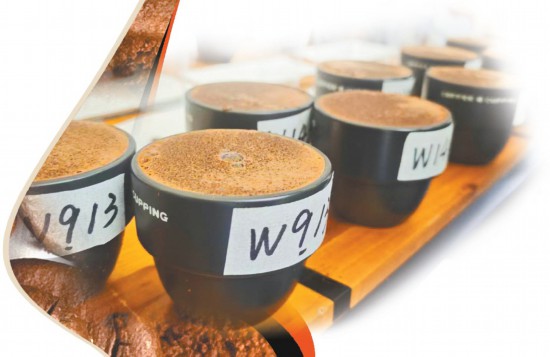
Photo shows a scene of the 2026 Second Gems of Yunnan Green Coffee Competition (Yunnan CoE Pilot Program) in southwest China's Yunnan Province. (Photo courtesy of the organizing committee of the competition)
Washed Geisha coffee beans from Gengxia Estate in Lincang, southwest China's Yunnan Province, won the top prize at the 2026 Second Gems of Yunnan Green Coffee Competition (Yunnan CoE Pilot Program), scoring 91.78. It was the highest score ever recorded in a Yunnan coffee competition, which concluded on June 25.
Under the competition's strict scoring system, a score of 90 or above is widely regarded as the threshold for "excellence," ranking those beans among the world's finest coffees.
At this year's competition, three lots of Yunnan green coffee beans cleared that bar, and all of the top 20 scored above 87, marking a milestone in the province's rise from a long slump to global recognition.
A German judge, who returned to Yunnan after a 15-year gap, said he was struck by the quality and complexity of its coffees, from citrus and mango notes to jasmine aromas.
Yunnan has grown coffee for some 130 years, but for most of that time its beans were sold cheaply by the tonne, dominated by the disease-resistant Catimor hybrid, with pricing power held by New York futures traders and major buyers.
A bumper Brazilian harvest in 2019 sent global coffee prices tumbling, driving procurement prices of Yunnan's green coffee beans below production costs.
"Some farmers even cut down their coffee trees to plant tea or corn instead," recalled Liao Xiugui, a coffee grower in Pu'er, Yunnan.
The pain forced a turnaround. In 2022, Yunnan introduced a policy focusing on specialty coffee development. Soaring domestic demand, fueled by chains such as Luckin Coffee and Manner Coffee, has reversed the trade pattern. Exports made up 90 percent of sales six or seven years ago, versus 90 percent of sales domestically today, and prices have tripled in three years.
Yunnan has designated 1.05 million mu (70,000 hectares) of land as optimal growing zones for specialty coffee, promoting the cultivation of premium varieties such as Geisha. The specialty coffee ratio in the province rose from 8 percent in 2021 to 41.7 percent in 2025, and the deep-processing rate from 20 percent to 85 percent.
The strategy has faced a fresh test this year: China implemented zero-tariff measures on all tariff lines for products from all 53 African countries with diplomatic ties starting May 1, opening the market to Kenyan and Ethiopian coffee.
Yet nothing protects Yunnan's coffee industry better than its own quality. In 2025, the agricultural output value of Yunnan's coffee industry reached 8.39 billion yuan ($1.24 billion), up more than 70 percent year on year. The shift from "selling by the tonne" to "selling by the cup" reflects Yunnan's broader push to develop its specialty coffee industry.
"This competition proves Yunnan's specialty coffee has won global recognition," said Hu Faguang, a researcher with the Institute of Tropical and Subtropical Cash Crops at the Yunnan Academy of Agricultural Sciences.