


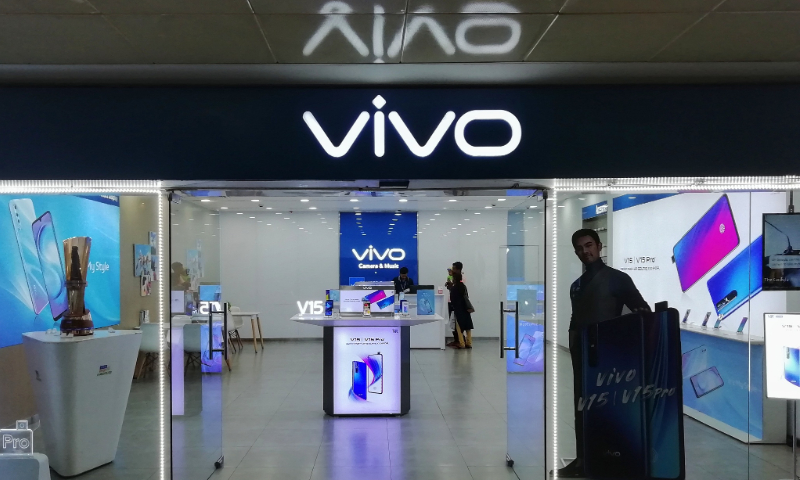
Customers are seen inside a VIVO mobile phone store in New Delhi on August 27, 2019. (Photo: VCG)
The Indian government has reportedly greenlit a joint venture (JV) between Dixon Technologies and Chinese smartphone maker Vivo Mobile for manufacturing electronic devices, including smartphones, in India, according to Reuters reports on Thursday. A Chinese expert said the decision reflects New Delhi's pragmatic recognition of market realities and the critical role of Chinese manufacturing expertise in India's electronics ecosystem.
On Thursday, Dixon said that Vivo Mobile India (VMI) has received the approval from the Government of India, dated July 8, 2026, under Press Note 3 of 2020 issued by the Department for Promotion of Industry and Internal Trade, allowing the incorporation of the JV company and Vivo India's subscription to its shares.
Dixon will hold a 51 percent stake in the venture, while VMI will own the remaining 49 percent.
The JV will undertake part of VMI's OEM orders of smartphones in India and will undertake Vivo's smartphone production orders. It can also engage in OEM business regarding various electronic products of other brands, according to media reports citing Dixon's statement.
Analysts believe the JV will strengthen Dixon's manufacturing capabilities and enhance its market position in India's Android smartphone segment.
The approval concludes a 19-month regulatory process that began when Dixon and Vivo signed their agreement in December 2024. Under Indian regulations, large investments by Chinese companies in Indian ventures draw tougher scrutiny, according to Reuters.
Qian Feng, director of the Research Department at Tsinghua University’s National Strategy Institute, said that it is a pragmatic move. “The Indian government’s decision is driven by genuine market demand and the practical needs of its domestic electronics manufacturing sector,” Qian told the Global Times on Friday. “Given India’s economic realities, it cannot build a competitive smartphone industry without Chinese technology, supply chain integration, and manufacturing expertise.”
Qian urged India to move beyond political sensitivities and focus on mutual economic benefits, saying a more open environment for Chinese firms would help India’s industrial development while also benefiting bilateral trade and investment ties.
The move comes as India's Ministry of Finance issued an order on June 24, allowing the local factories of four Chinese power equipment manufacturer — TBEA Energy, Nanjing Electric India, New Northeast Electric India and Taikai Electric (India) — to participate in government tenders for critical power projects, according to Reuters.
Chinese analysts said the recent approvals suggest that India is trying to balance geopolitical concerns with economic needs. They argued that with India seeking to expand local manufacturing, create jobs and attract technology-driven investment, it is in New Delhi’s interest to make policies more transparent and predictable for Chinese businesses.
“India’s current economic situation makes cooperation with China more necessary than ever,” Dai Yonghong, director of the Institute of Area and International Communications Studies at Shenzhen University, told the Global Times on Friday. He added that after years of restrictions on Chinese investment, the Indian government is pragmatically readjusting its economic cooperation with China.
The driving force behind this shift is not a policy reversal, but rather the pressure of practical needs, said the expert. When “Make in India” hits into industrial-chain bottlenecks, when high growth fails to mask concerns over employment and inflation, and when the trade deficit keeps widening despite the rhetoric of de-risking from China, practical needs will eventually trump ideological impulses, he said.
Through the JV, about two-thirds of Dixon’s production capacity will be integrated the local holding system, which both meets India’s localization requirements and brings Chinese manufacturing capabilities and supply-chain resources into local electric ecosystem, Dai explained.
China’s technological edge and cost-effectiveness remain difficult to replace, Dai said, noting that the approval of the Dixon-Vivo JV signals India’s strategic shift from decoupling for security to co-development for growth. This move may not be the beginning of a strategic pivot, but at least it signals a return to pragmatism.
For New Delhi, deeper cooperation with Chinese firms is a pragmatic and inevitable choice, as China offers mature technology, a complete supply chain and large-scale production capacity in areas including electronics manufacturing and power equipment, making it a potential partner for India’s economic development, Qian said.