


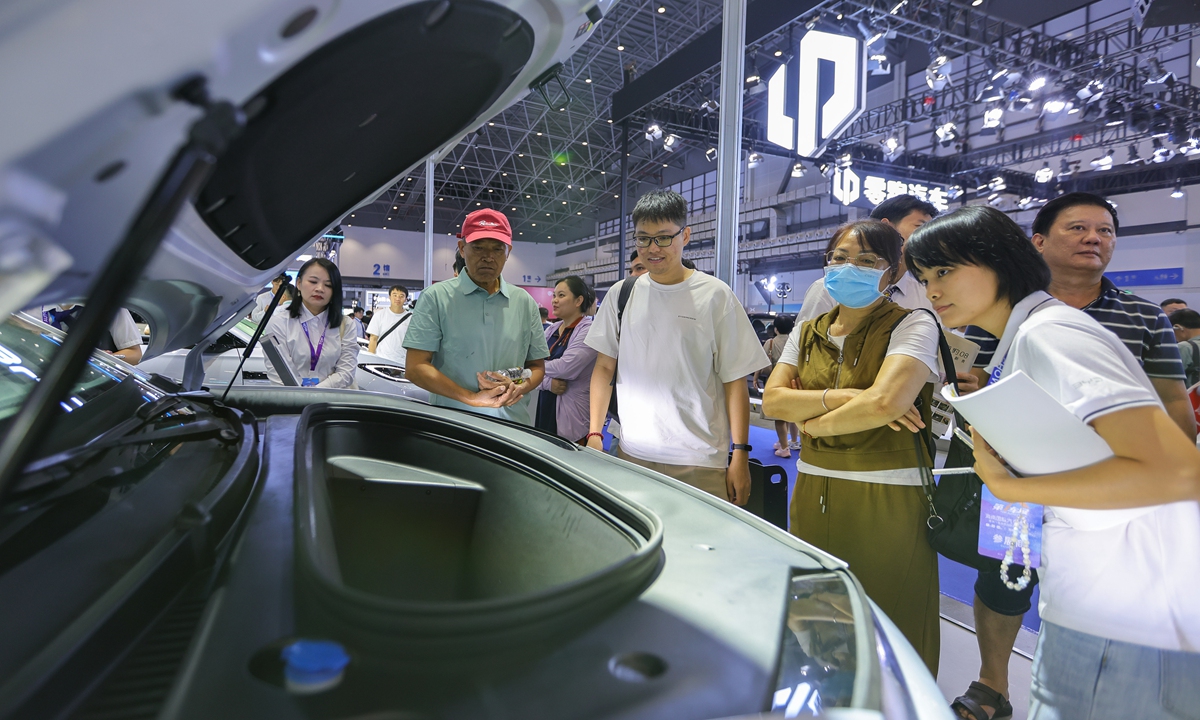
Visitors check out the front trunk of a new energy vehicle at the 2026 Hainan International Auto Expo and the 8th Hainan International New Energy Vehicle Exhibition in Haikou, South China's Hainan Province, on July 9, 2026. (Photo: VCG)
South China's Hainan Province will become the first province in China to stop sales of new fuel-powered vehicles by 2030, according to a newly released plan, as the island province accelerates the construction of its National Ecological Civilization Pilot Zone.
Hainan will steadily advance the phase-out of fuel-powered vehicle sales by 2030, media reported on Monday, citing the 15th Five-Year Plan for the construction of Beautiful Hainan released by the Hainan provincial government on July 3.
The share of new-energy vehicles (NEVs) in the province's vehicle fleet is expected to rise to 45 percent by 2030, up from 23.75 percent in 2025, multiple media outlets reported.
The plan requires that all newly added and replacement vehicles in public services and social operation sectors, except for special-purpose vehicles, use clean energy, while all newly added and replacement vehicles in the private vehicle sector be NEVs by the end of the plan period.
The policy targets new vehicle sales rather than existing vehicles on the road. After 2030, newly sold fuel-powered vehicles will no longer be available in Hainan, while registered stock fuel-powered vehicles will remain eligible for inspections and legal road use, according to media reports.
To support the transition, Hainan will improve its charging infrastructure layout and aims to keep the province-wide vehicle-to-charging-pile ratio within 2.5:1 by 2030, helping ease concerns over charging availability.
Among the measures outlined in the plan, Hainan will advance demonstration applications of fuel cell vehicles in areas such as heavy-duty trucks, cold-chain logistics and public transportation, and explore the development of zero-carbon freight corridors for outbound shipments.
The vehicle transition is part of Hainan's broader plan to accelerate green transformation during the 15th Five-Year Plan period (2026-2030). The plan aims for Hainan to achieve its carbon emissions peak before 2030, raise the share of non-fossil energy in total energy consumption to 35 percent by 2030 from 20.9 percent in 2024, successfully complete its carbon intensity reduction target, and further improve resource-use efficiency toward the country's advanced level, according to the Hainan provincial government.
To achieve these goals, Hainan will accelerate green and low-carbon transformation in key sectors, including energy, industry, transportation, urban and rural construction, and agriculture, according to the five-year plan.
During the 14th Five-Year Plan period (2021-2025), Hainan deepened and upgraded the construction of its clean energy island. New energy has become the province's largest power source, while Hainan ranked first among China's provincial-level regions in terms of NEV market penetration rate and second in terms of NEV ownership share.