


(Photo: VCG)
China's GDP expanded by 4.7 percent year-on-year to 69.57 trillion yuan ($10.28 trillion) in the first half of 2026, remaining well within the government's annual growth target of 4.5 to 5 percent and showing resilience despite growing global economic uncertainties, data released by the National Bureau of Statistics (NBS) showed on Wednesday.
In the second quarter alone, the economy expanded by 4.3 percent compared with the same period last year, easing from the 5.0 percent growth recorded in the first quarter.
The figure demonstrated that the world's second-largest economy has maintained a stable and positive growth momentum despite various challenges - ranging from rising geopolitical tensions, oil price shocks, global trade frictions to uncertainties in the external environment.
Specifically, China's value-added industrial output of above-scale enterprises in the first six months rose 5.4 percent compared to the same period in 2025, while fixed-asset investment dropped by 5.7 percent year-on-year. China's total retail sales of consumer goods expanded by 2.7 percent year-on-year in the first half, according to the latest NBS data.
Hu Qimu, a professor at the Maritime Silk Road Institute of Huaqiao University, told the Global Times that China's closely-watched first-half economic data provided important clues on China's economic resilience and new growth momentum.
"It is also important to note that the economic figures show that the upgrading of our industrial structure, breakthrough in homegrown tech innovation, and the optimization of our foreign trade structure are continuing to take strong effect, and that the medium- to long-term growth drivers are becoming increasingly evident," Hu said.
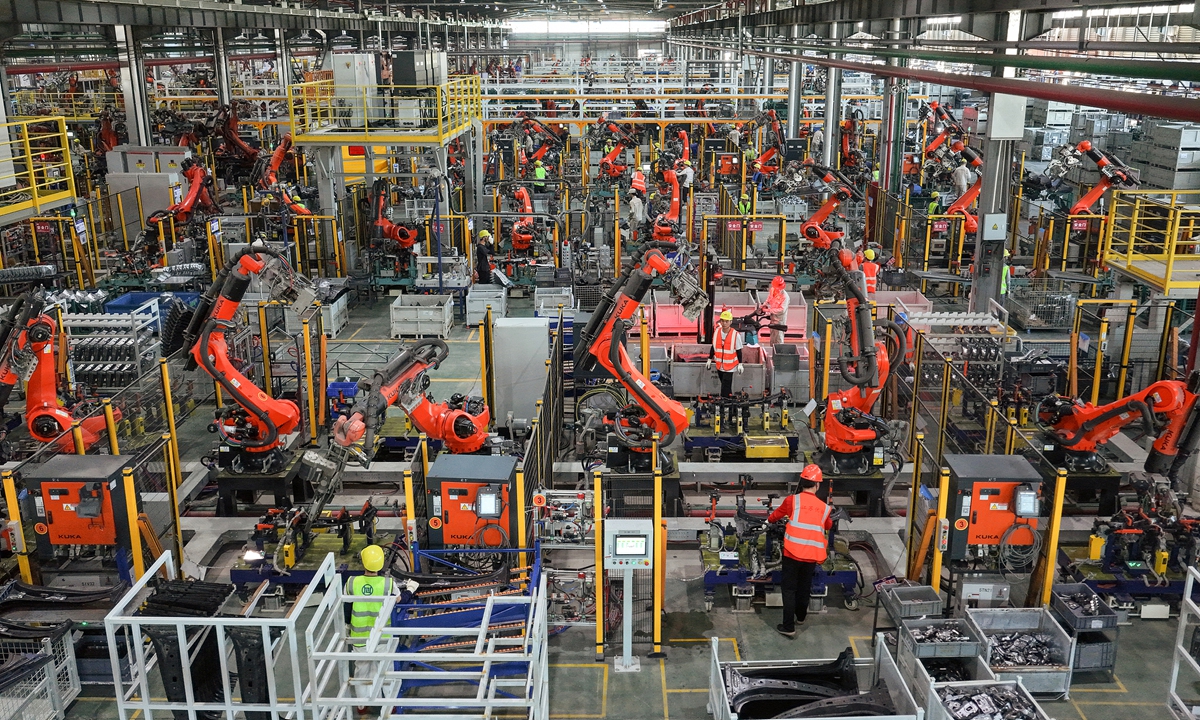
The value-added output of the equipment manufacturing sector rose by 9.3 percent year-on-year during the period, while that of high-tech manufacturing jumped by 13.3 percent. Both figures outpaced the overall growth of national value-added industrial output of above-scale enterprises by 3.9 and 7.9 percentage points, respectively.
Hu highlighted a number of new growth drivers from strategic emerging industries such as artificial intelligence (AI) and green sector, as well as strong vitality across the high-end manufacturing sector fueled by robust external demand and expanding trade and economic cooperation with Belt and Road partner countries.
Chinese customs data showed on Tuesday that the country's foreign trade rose 16.9 percent year-on-year to reach 25.47 trillion yuan, hitting a new high. Among which, imports and exports of computing hardware, including electronic components and computer parts, reached 5.13 trillion yuan, up 56.6 percent year-on-year.
Observers believed that the solid first-half economic growth has set the tone for the country to achieve the full year target of 4.5 to 5 percent, and strong momentum is expected in the second half of the year.
Tian Yun, a Beijing-based economist, told the Global Times that in the following months, he expected more growth momentum to be steadily built up amid ongoing transformation and upgrading.
"High-tech manufacturing, exports, and the AI supply chain will continue to pick up strongly," Tian said, adding more concrete efforts will likely further boost domestic demand and stabilize investment expectation.
"China is one of the world's contributors to global economic growth. Its consistent focus on innovation, the integration of AI into everyday life, high-quality development, green transformation, and greater openness will continue to provide strong positive momentum for the global economy," Khalid Taimur Akram, executive director of Pakistan Research Center for a Community with Shared Future, told the Global Times.
Meanwhile, global financial institutions have also continued to show confidence in the Chinese economy.
The IMF's World Economic Outlook update released last week projected China's growth at 4.6 percent for 2026, which is 0.2 percentage points higher than its April forecast. In comparison, the IMF cut its global growth projection to 3 percent this year, down from an average of 3.5 percent between 2024 and 2025.