


Moonshot AI releases ‘world’s largest open-source model’ Kimi K3; WAIC spotlights Chinese AI capabilities
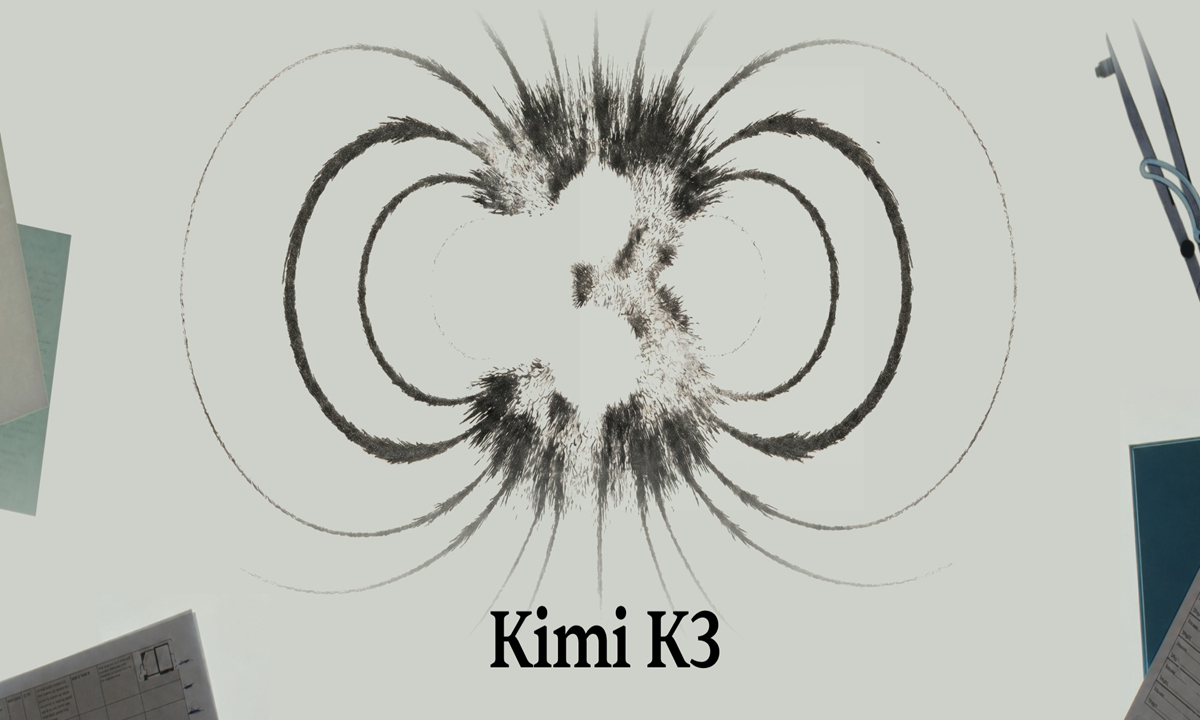
Photo: Courtesy of Moonshot AI
Moonshot AI, the Beijing-based company behind the Kimi chatbot, has released Kimi K3, a new open-source artificial intelligence (AI) model with 2.8 trillion parameters, further highlighting China's rising AI capabilities, which have drawn broad attention at the 2026 World AI Conference (WAIC) & High-Level Meeting on Global AI Governance in Shanghai.
According to a post the company published on its WeChat account on Friday, Kimi K3 is the largest open-source model in the world by parameter scale, and natively supports visual understanding and can process up to 1 million tokens of context, significantly expanding its ability to handle long and complex tasks.
The launch comes as the 2026 World AI Conference (WAIC) & High-Level Meeting on Global AI Governance opens on Friday in Shanghai, where many Chinese and foreign AI companies showcase their latest technologies and products.
WAIC 2026 is bringing together more than 1,100 companies and over 3,000 exhibits, with over 300 AI products making their global debuts, the latest official data showed. Multiple Chinese companies, including MiniMax, SenseTime, and iFlytek, are bringing their latest versions of large AI models. Over 260 large AI models are making their debut at the conference, according to the event organizers.
Moonshot said Kimi K3 is designed for demanding tasks including software engineering, knowledge work, deep research and multimodal understanding.
"Larger parameter counts can raise the upper bound of capability and enable more intelligent model performance," a Moonshot representative said, comparing parameters to neural connections in the human brain. "Nearly 3 trillion parameters mean the model can store more knowledge and patterns, understand more, think deeper and answer more accurately."
Moonshot said Kimi K3 was trained using a self-developed underlying model architecture and a set of proprietary training methods. The company said the model's overall performance is close to leading closed-source frontier systems in benchmark tests.
On Friday, Elon Musk responded with a single word — "Impressive" — to a tweet from Artificial Analysis regarding Kimi K3's performance in AI model benchmarking.
The release reflects China's broader push to strengthen its AI industry, as the country places growing emphasis on advancing AI capabilities and sharing development experience and technology products globally, according to Xinhua.
The cumulative downloads of China's open-source large AI models have surpassed 10 billion, ranking first globally. With outstanding performance and high cost-effectiveness, Chinese large AI models are becoming the "innovation foundation" for countries worldwide, particularly developing nations, the People's Daily reported.
"I believe that openness is a crucial prerequisite for AI to deliver universal benefit," Zeng Yi, a professor at Renmin University of China, and member of UN Advisory Body on AI, told the Global Times on Friday.
Only through openness can more robust competition emerge; and only through robust competition can model capabilities be continuously enhanced and costs steadily reduced, enabling more enterprises, developers, and ordinary users to share in the fruits of technological progress, Zeng said.
AI should not be monopolized by a handful of closed-source models, nor should it ultimately become a tool or toy accessible only to a privileged few; it should serve as a productive force that everyone can use and from which everyone can benefit, he noted.
In terms of China's advantages in developing advanced AI, industry experts attending the WAIC conference in Shanghai told the Global Times that the competition between the US and China in generative AI is often framed as a race to build more powerful models, but model development is only part of the competition. Equally important, they said, is the ability to deploy generative AI quickly, affordably and at scale.
From this perspective, China's advantage lies in its ability to convert generative AI into practical products and services rapidly and widely, supported by unmet market demand, mature platform ecosystems, cost-effective open-source models, a strong manufacturing base and a regulatory framework that sets guardrails for fast adoption.
Notably, many US companies have also reportedly chosen Chinese AI models. A recent CNBC report said American companies are increasingly adopting Chinese-built AI models as they roll out AI-powered products and services, noting that releases from Chinese firms such as DeepSeek and Zhipu AI have been seen by many users as highly competitive with top systems from US companies including Anthropic and OpenAI.
Yan Yijun, vice president of Shanghai-based MiniMax, told the Global Times that over the past year, Chinese models have surpassed US models in global open-source usage, with multiple Chinese companies competing closely.
He said Chinese models have made broad gains in coding and agent capabilities, and that open-source text models now approach world-leading international performance, while multimodal generation has reached parity or even leadership in some areas.
"More importantly, these breakthroughs are helping young people across the industry genuinely believe that Chinese companies can build world-class technology," Yan said. "That confidence is as important as the technical progress itself."
However, objective gaps still remain. Moonshot said in its post that although Kimi K3 is overall a highly competitive model, it still lags somewhat behind Claude Fable 5 and GPT-5.6 Sol in terms of user experience.
While Chinese models as a whole still trail the strongest closed-source models, they continue to demonstrate frontier-level capabilities, experts said.
Peng Zhihui, co-founder and president of AgiBot, told the Global Times on the sidelines of the WAIC on Friday that the WAIC serves as both an important window for observing global technology trends and a vital platform connecting research, industry, capital, and application scenarios.
The event brings the most cutting-edge research achievements and industrial practices into the same space for exchange, enabling innovators from different countries, disciplines, and development stages to inspire one another.
"For enterprises, the value of the conference lies not merely in showcasing products, but in hearing real needs, finding partners, and allowing technologies to be tested in richer scenarios," Peng said.