


Chinese company unveils world's first 'centaur' robot at WAIC, with 95% core components made at home
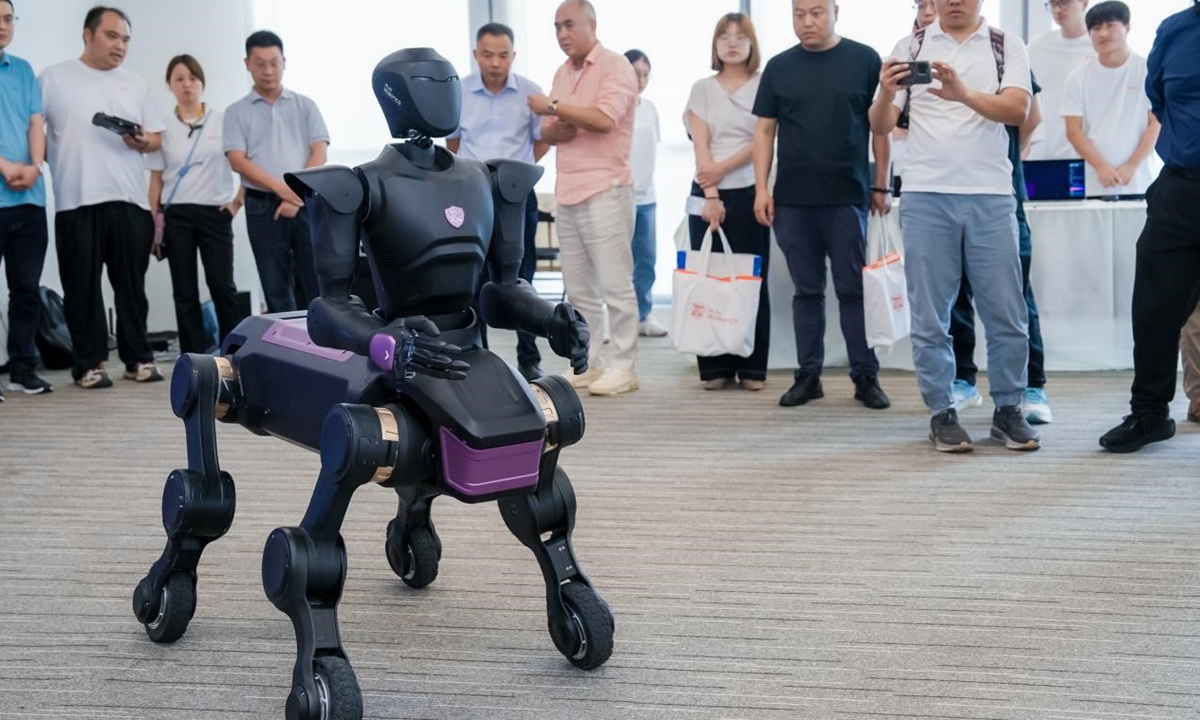
A "centaur" wheel-leg hybrid robot developed by the Shanghai-based Run Robotics is displayed at the 2026 World Artificial Intelligence Conference in Shanghai. (Photo: Courtesy of Run Robotics)
A uniquely shaped robot became one of the highlights at the 2026 World Artificial Intelligence Conference (WAIC) in Shanghai, as a Chinese company unveiled the world's first "centaur" wheel-leg hybrid robot, with more than 95 percent of its core components domestically produced, the Global Times learned on Monday.
Developed by the Shanghai-based Run Robotics, the AI-enabled robot combines the speed of wheels with the terrain adaptability of legs, allowing it to move quickly. Built for demanding scenarios, it can be used in autonomous inspection, firefighting and emergency rescue operations, the company said.
The launch came as this year's WAIC, brought together cutting-edge achievements in large models, humanoid robots and other frontier AI fields, showcasing new progress in the real-world application of AI innovations.
The conference gathered more than 1,000 companies and over 3,000 exhibits, including 349 global debut products and 201 new technologies. The "centaur" robot was listed among the 10 "treasures of the exhibition" announced at this year's WAIC, according to state broadcaster CCTV News.
Unlike most humanoid robots on the market, which rely on bipedal walking, the "centaur" robot uses a split-body design. Its lower half is built on a four-wheel all-terrain mobility system, allowing it to move quickly and flexibly through rugged sites, emergency-response settings and mining areas, the company said.
Its upper body is designed with human-like arms, allowing it to go beyond the single monitoring role of traditional inspection robots. The robot can perform hands-on tasks such as clearing obstacles, operating equipment and assisting in rescue missions, according to the company.
Zhou Bin, CEO of Run Robotics, said the birth of the "centaur" robot is not merely a technological breakthrough, but the result of product iteration.
"As an optimized solution for multiple special-purpose scenarios, it helps address long-standing bottlenecks, including weak scenario adaptability, limited operational capability and difficulties in achieving large-scale deployment," Zhou said.
The robot is designed to meet explosion-proof requirements while remaining lightweight and reliable, the company said. It can be deployed in demanding environments ranging from high-temperature steelmaking sites and long-distance oilfield inspections to radiation zones, as well as firefighting and emergency rescue operations.
The company stressed that more than 95 percent of the robot's core components are domestically produced.
Run Robotics has located its research and production base in Shanghai's Zhangjiang Science City, drawing on Pudong's strong industrial chain, talent pool and policy support to upgrade its products and improve its supply chain system.
The robot can carry an average payload of 100 to 120 kilograms, with a maximum static load of 210 kilograms, the company said. Its platform is highly expandable and can be fitted with different upper-body modules, including dual robotic arms, dexterous hands and multidimensional force sensors.
The "centaur" robot is also equipped with a self-developed end-to-end environmental perception system that integrates lidar, binocular vision and depth cameras to build real-time understanding of its surroundings.
It can accurately identify high-temperature pipelines, valves, meters, obstacles and people, determine their positions and status, independently plan routes, avoid obstacles and lock onto operational targets, enabling a seamless closed loop from perception to decision-making.
Run Robotics said it plans to complete an assembly line in the fourth quarter of 2026. The company has already secured real-world orders.
China has been accelerating the development of intelligent robotics, with a growing range of products moving from exhibition halls into real-world applications.
The country's humanoid robots now account for more than half of the global total, as the country's intelligent robotics industry continues to accelerate, the Ministry of Industry and Information Technology said on Monday.
In the intelligent robotics sector, Chinese-developed quadruped robots account for nearly 70 percent of global sales, while China has developed more than 400 humanoid robot models, or complete units, accounting for more than half of the global total, according to the ministry.