


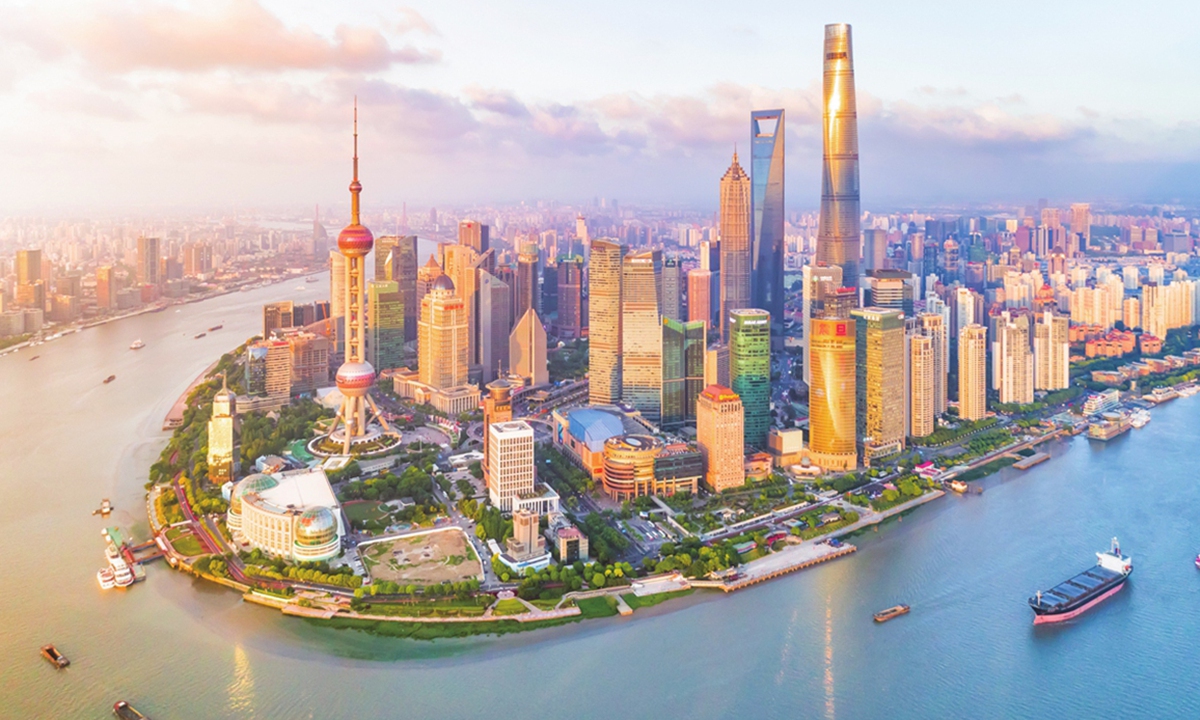
A view of Shanghai (Photo: VCG)
Shanghai released its economic data for the first six months of 2026 on Monday, with the city's half-year GDP reached 2.788 trillion yuan, or rising 5.6 percent year-on-year.
Electric vehicles, artificial intelligence (AI) and other emerging high-end industries became prime drivers of Shanghai's economic growth, indicating the city's ongoing transformation toward technology-centric and high-value-added industries, analysts say.
Data showed that during the first half of the year, Shanghai achieved coordinated growth in its secondary and tertiary industries, with the added value of the secondary industry rising 4.7 percent and that of the tertiary industry increasing 5.9 percent year-on-year.
Meanwhile, key industries, ranging from the financial sector to software and information technology services, continued to provide strong support, which together contributed more than 70 percent of the city's economic growth.
Notably, from 2023, when Shanghai's GDP growth rate was 0.2 percentage points lower than the national average, to 2024, when it matched the national growth average, and then to 2025, when it exceeded the national average by 0.4 percentage points, Shanghai's economy has kept gaining steam.
In the first half of this year, its GDP growth rate again outpaced the national average by 0.9 percentage points.
As this year marked the first year of the 15th Five-Year Plan (2026-30), Shanghai has better fulfilled its role as a major economic powerhouse of China. One highlight behind the city's economic growth is the rapid expansion of the emerging high-tech sectors.
"As an economic engine of China, Shanghai plays a leading role in the country's development. Its performance is closely linked to the city's economic transformation, particularly its shift toward new growth drivers like AI and EV production," Li Changan, an economist at the University of International Business and Economics, told the Global Times on Monday. He added that Shanghai's strong appeal in attracting talent is another driver of its rapid growth.
In the first half of the year, Shanghai's industrial sector maintained steady growth. Notably, the added value of the city's above-designated-size industrial enterprises rose 5.7 percent year-on-year, surpassing the national growth average of 5.4 percent.
From the perspective of new growth drivers, the output value of the city's leading industries increased 14.5 percent year-on-year in the first half of the year. Among them, the output value of the semiconductor manufacturing sector rose by an impressive19.5 percent.
In addition, the output value of Shanghai's strategic emerging sectors grew 7.7 percent in the first six months. Specifically, the new-energy vehicle industry recorded growth of 33.9 percent, while the new energy industry expanded by 20.6 percent.
In recent years, Shanghai has been committed to developing technology-intensive and high-value-added products. "Led by technological innovation, Shanghai has formed favorable conditions for the growth of these important industries," Xi Junyang, a professor at Shanghai University of Finance and Economics, told the Global Times on Monday.
And, the fast growth of semiconductors and AI has injected new momentum into the city's economy. Xi Junyang said that the establishment of the World Artificial Intelligence Cooperation Organization in Shanghai sends a clear signal that the city aims to become a global AI development hub.
Xi Junyang predicted that Shanghai's GDP growth for 2026 is expected to outperform the national growth average.