


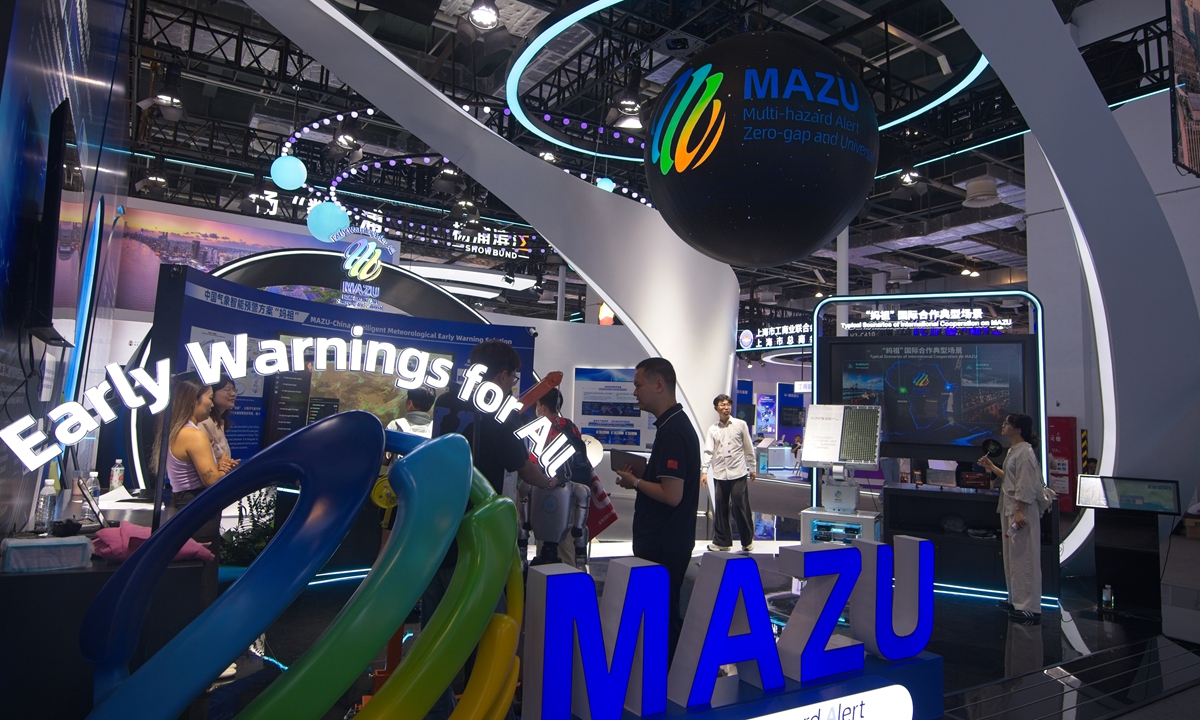
A Mazu meteorological platform is seen on display for AI forecasting of extreme weather events during the WAIC conference 2026 in Shanghai. (Photo: VCG)
At the 2026 World Artificial Intelligence Conference (WAIC) in Shanghai, one of the most crowded booths did not showcase humanoid robots, autonomous vehicles, or the latest consumer chatbot. Instead, it drew diplomats, engineers, journalists, and visitors from across Asia and Africa to a meteorological early-warning system named after a Chinese sea goddess: MAZU.
In Chinese tradition, Mazu protects sailors at sea. In the age of climate volatility, China is recasting that idea through artificial intelligence (AI). The MAZU meteorological early-warning system was launched by the China Meteorological Administration in 2025. It is designed to provide multi-hazard alerts, helping countries forestall storms, heatwaves, floods, and other extreme weather events before they become disasters.
For China, MAZU is more than a technological product. It is being presented as a model of how AI can be deployed as a public good - one that not only optimizes business efficiency at home, but also helps close the technology gap in partner countries along the China-proposed Belt and Road Initiative (BRI), as well as the Global South countries, according to Chinese experts.
As Belt and Road cooperation enters a phase increasingly shaped by digital infrastructure, climate resilience, and industrial upgrading, MAZU offers a revealing case study of how Chinese AI is moving from showcase room to real-world deployment.
Debut of MAZU warning systemAt a meteorological sub-forum of the 2026 WAIC and High-Level Meeting on Global AI Governance in Shanghai, the CMA officially handed over an upgraded version of MAZU to Djibouti, the Xinhua News Agency reported.
In July 2025, China donated MAZU-Urban, an AI-powered early warning system for multi-hazard disaster prevention, to Djibouti. It became the first version of MAZU deployed in the African country, according to Xinhua.
The event, held in Shanghai from Friday to Monday under the theme of "Intelligent Partners, Co-creating the Future," showcased MAZU as a vivid example of China's applications of AI technology to serve global development and bridge the technology gap between partners.
At the 2026 WAIC exhibition hall, You Yang, a staff from the Shanghai Meteorological Bureau, told the Global Times that the system integrates multi-source observation data, including China's Fengyun meteorological satellites, and incorporates a family of AI forecasting models such as Fenglei, Fengqing, and Fengshun. It has also been adapted into application scenarios for transportation, energy, agriculture, and low-altitude economy use cases.
The system has already been used by meteorological and disaster-prevention departments in more than 40 countries and regions through cloud-based access, according to You. Meanwhile, customized versions have also been deployed in countries such as Pakistan, Djibouti, Nigeria, and Ethiopia, where they are being used for disaster prevention and mitigation, and the supports for major events.
According to You, China's approach with MAZU is to customize the model according to a country's geography, infrastructure, and disaster profile. In Djibouti, for example, the application has been tailored to local needs, particularly the high-temperature heatwave monitoring and the strong-wind warnings at ports.
A monitoring and early-warning terminal developed alongside the system can track meteorological indicators such as temperature, pressure, and visibility, while also receiving satellite data. Deployed in national emergency or meteorological departments, the terminal is equipped with an AI model and is designed to create a closed loop of monitoring, warning, dissemination and response, You said.
In addition to technical assistance, support for "soft infrastructure" has also been provided. In recent years, nearly 1,000 trainees from more than 100 developing countries and regions have participated in China's early-warning technology training programs.
Over the past year, MAZU had been continuously upgraded with new applications and capabilities.
The CMA issued the MAZU-FengYun Satellite AI Box on Friday, which integrates the comprehensive observation capabilities of China's Fengyun meteorological satellites with AI technology to serve international users. The release marks a key step in upgrading MAZU from sharing products to delivering AI-enabled capabilities, Xinhua reported.
Bilal Bin Saqib, minister of state and chairman of Pakistan Virtual Assets Regulatory Authority, told Global Times at WAIC 2026 on Saturday that "I think it [MAZU] is absolutely great. The offer that China has made to the Global South to share this meteorological predictive analysis is very welcome in our country."
He noted that countries like Pakistan are vulnerable to natural disasters, and in this regard, it would be great to have access to such predictive analysis.
"Since we are an agrarian economy, being able to understand nature's patterns would be very beneficial for our farmers. It could help protect our crops from devastation, which would not only strengthen food security and support the UN Sustainable Development Goals, but also safeguard our GDP and the livelihoods of our farmers, who form a very important part of the economy," he said.
AI as an international public goodMAZU is only one example in a widening landscape of Chinese AI applications abroad.
In Saudi Arabia, Shanghai-based Synyi AI has launched the world's first autonomous AI clinic. In Zimbabwe, a China-aided supercomputing center has become an important foundation for local AI development. The facility has been connected to 15 universities, with average research computing speed improved by 40 percent. One drought-warning model reportedly helped improve water-use efficiency by 15 percent, the Guangzhou-based newspaper Nandu Daily reported.
Other Chinese AI applications have appeared in agriculture, remote healthcare, logistics, and cloud computing across Southeast Asia and Africa. Some help screen children for congenital heart disease while others support crop management, port operations, or industrial planning. Taken together, these projects suggest that Chinese AI is moving outward not as a single product line, but as a set of problem-solving tools aligned with infrastructure investment and development cooperation, according to Nandu Daily.
This is particularly relevant along the Belt and Road, where many countries are looking for technologies that can be deployed quickly, operated under resource constraints, and be adapted to local conditions, Zeng Yi, a professor of Gaoling School of AI at Renmin University of China, and a member of UN Advisory Body on AI, told the Global Times. He said that high-end frontier models may attract headlines, but lightweight, task-specific AI solutions are often more valuable on the ground.
In this sense, MAZU is not just a weather system. It is a statement about the kind of AI globalization China wants to promote - One where digital tools are linked to public welfare; One where the Global South is not merely a market for imported technology, but a partner in co-development; One where climate resilience, food security, and disaster preparedness are treated as legitimate frontiers of AI innovation, Zeng said.
AI should be regarded as an international public good that benefits all humanity, Zeng said, adding that at the heart of this idea is the need to break away from the narrow logic of technological exclusivity and the concentration of AI benefits in the hands of a few countries and companies, and instead promote a fairer distribution of AI achievements to the world.
"At the domestic level, the 'AI Plus' strategy should be used to promote the deep integration of AI with traditional industries, accelerate the development of new quality productive forces, and advance coordinated urban-rural and regional development," Zeng told the Global Times. "Internationally, lightweight AI solutions can support development in Asia, Africa, and Latin America through projects in smart agriculture, intelligent healthcare, and green computing infrastructure, helping Global South countries achieve sustainable development."