


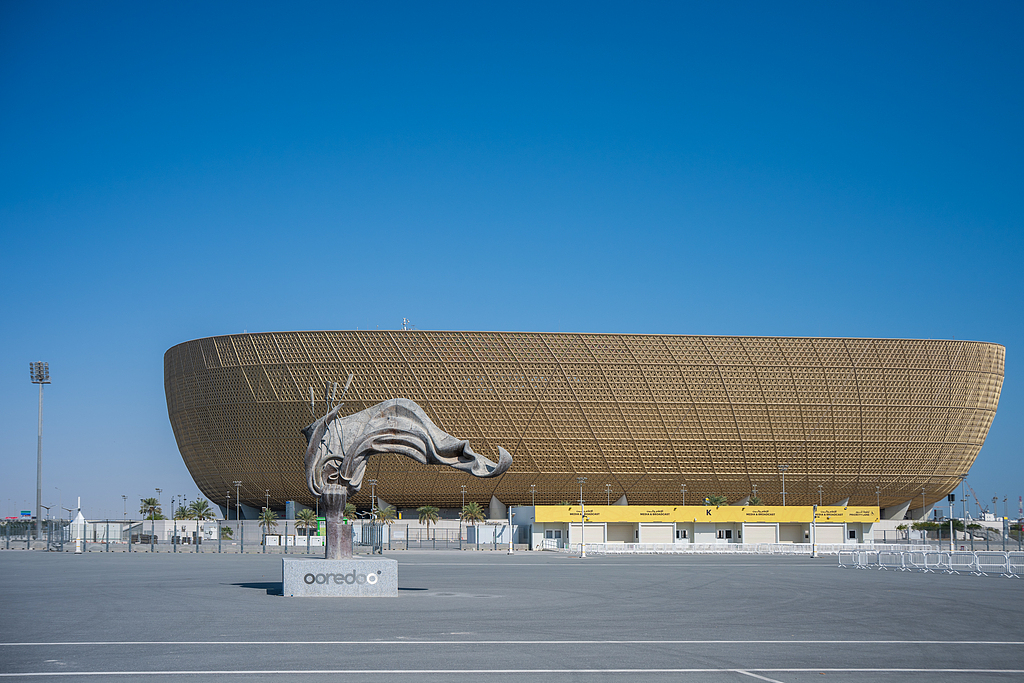
A close-up view of Lusail Stadium in Doha, the host venue of the 2022 FIFA World Cup in Qatar, February 21, 2026. (Photos: VCG)
The final curtain has fallen on the World Cup in the US, with Spain hoisting the trophy. According to FIFA, this year's tournament injected a massive 17 billion dollars into the American economy. But as the stadium lights dim, how can such a legacy be sustained? Perhaps the current hosts can take a page out of the playbook of their predecessor: Qatar.
The 2022 World Cup may be over, but Qatar's stadiums have never gone quiet. FIFA announced that starting in 2025, the U17 Men's World Cup would become an annual event. And Qatar has secured the hosting rights for five consecutive tournaments—from 2025 through to 2029. On top of that, the 2025 FIFA Arab Cup is also returning to Qatar, lighting up six of its iconic World Cup stadiums.
What's more, as Ali Salem Afifa, deputy director general of Qatar-based Aspire Academy points out, the local clubs are also participating in Asian and Gulf region-level competitions. These clubs make full use of all the venues when participating in league and cup competitions, whether serving domestic competitions, regional events, or future international tournaments.
Official data show that the 2025 Arab Cup alone generated about 790 million dollars for Qatar, drawing over 300,000 from outside Qatar and giving local businesses a massive boost.
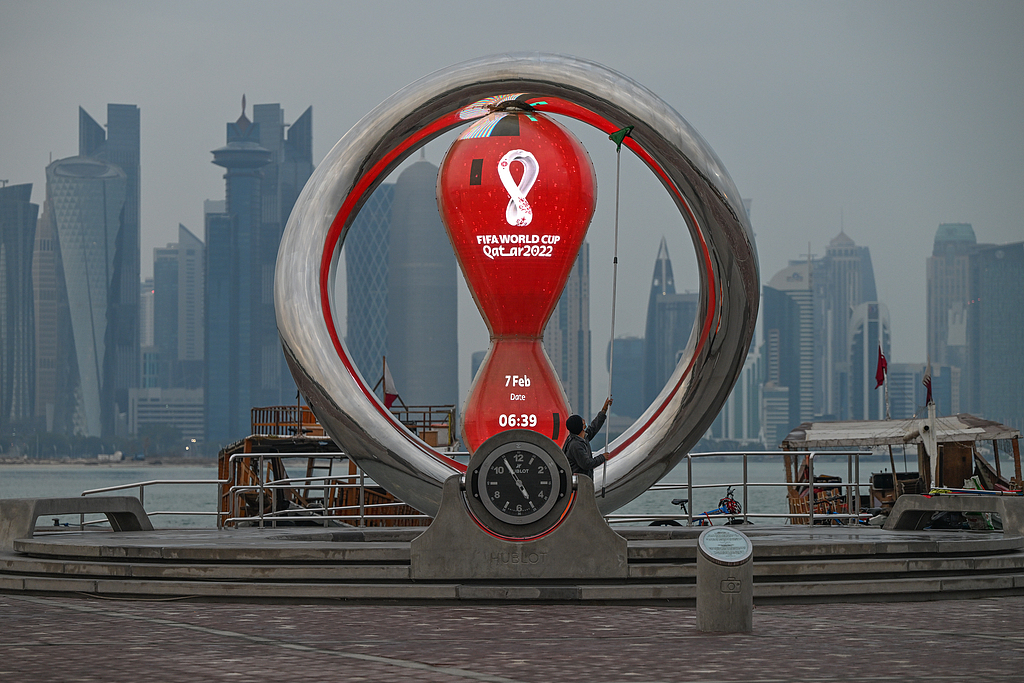
A maintenance worker cleans the base of the official FIFA World Cup 2022 countdown clock in Doha, Qatar, on February 7, 2026.
And football is just the beginning. Doha is also gearing up to host the 2027 FIBA Basketball World Cup. By leveraging its world-class venues and hosting experience, Qatar is building a full-scale sports ecosystem—covering tourism, hospitality, and venue management. In short, they are successfully turning "built projects" into "profitable, living assets."
Beyond the massive stadiums, transportation is perhaps the most transformative piece of Qatar's legacy. Before preparations for the World Cup began, Qatar didn't even have a subway system; most Doha residents got around strictly by car. To prepare for the influx of global fans, the country invested $36 billion to build three brand-new metro lines from scratch.
Dr. Mahfoud Amara, Associate Professor of the College of Sport Sciences of Qatar University, believes the metrosystem is one of the most successful tangible legacies of the FIFA World Cup.
During the 2022 tournament, the Doha Metro and Lusail Tram carried a staggering 18.2 million passengers. Today, that same rail network powers the daily commute of local residents. The World Cup didn't just ignite a passion for football in Qatar—it permanently reshaped how its people move and live.