


Chinese new consumer brands Pop Mart, Mixue Group and Laopu Gold make Fortune China 500 debut
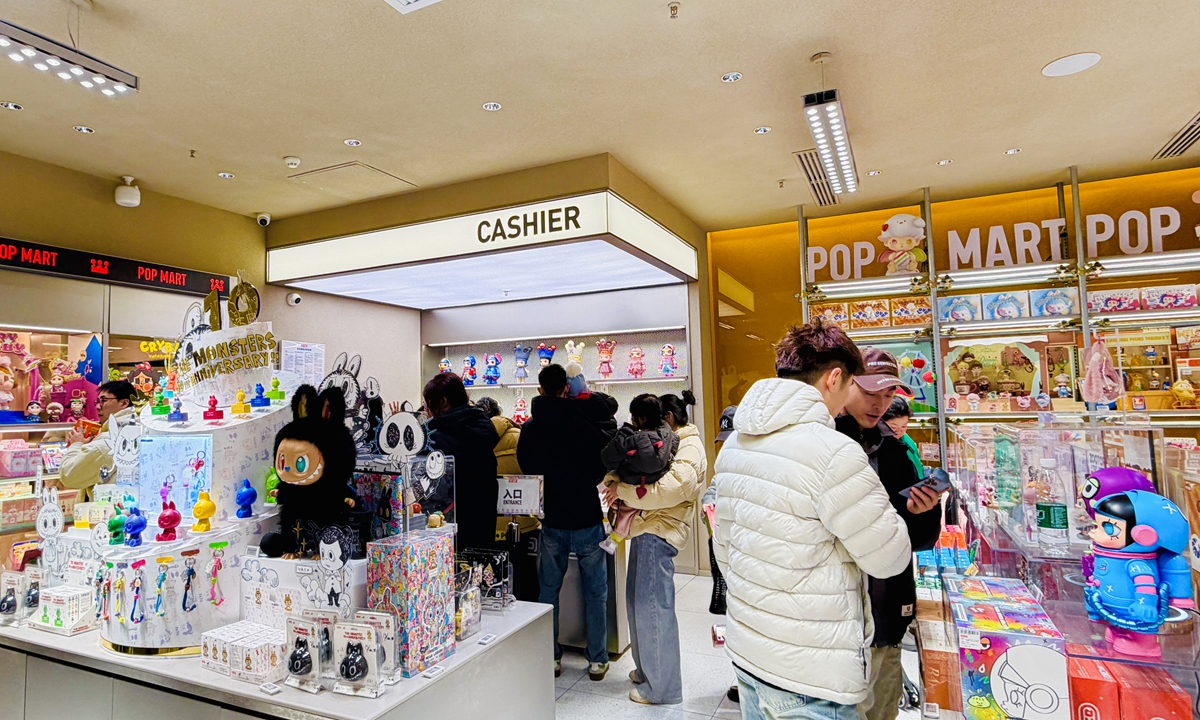
Shoppers line up at the checkout counter inside a Pop Mart store at the Solana Mall in Beijing on February 8, 2026. (Photo: GT)
Three Chinese consumer brands - designer toy maker Pop Mart, beverage chain Mixue Group and heritage-inspired jeweler Laopu Gold - have made their debut on the Fortune China 500, underscoring the rise of new business models catering to increasingly diverse consumer demand.
Pop Mart ranked 393rd, Mixue Group 423rd and Laopu Gold 481st, according to the 2026 Fortune China 500, released on Tuesday.
All three are listed in Hong Kong. Their rapid growth reflects three prominent trends in China's consumer market: demand for emotional value, value for money and the cultural appeal of homegrown brands, the publication said.
Rather than relying solely on broad-based consumption upgrades or competing through lower prices, these companies have created new consumption scenarios and developed business models, Fortune China said in an analysis accompanying the ranking.
Pop Mart sells emotional value and identification with intellectual property, Mixue has built a highly efficient supply-chain network around affordability, while Laopu Gold appeals to affluent consumers seeking cultural, aesthetic and investment value, the analysis noted.
Fortune China also identified the rise of new consumer companies as one of two emerging forces reshaping China's corporate landscape this year, alongside the rapid growth of the AI hardware supply chain, describing them as two structural trends that closely reflect the growing strength of China's new economy.
All three companies recorded robust revenue growth in 2025. Laopu Gold led the group with revenue growth of more than 220 percent, buoyed by strong demand for heritage gold jewelry and its expanding presence in premium shopping malls. Pop Mart's revenue rose about 185 percent, while Mixue Group reported growth of more than 35 percent.
Pop Mart and Laopu Gold also entered the top 10 among the 500 companies in terms of return on equity in 2025. Pop Mart ranked second with a return of 56 percent, while Laopu Gold placed fourth at 43 percent, according to the ranking.
Beijing-based Pop Mart, founded in 2010, has expanded the blind-box business into an integrated platform encompassing artist development, IP incubation, product design and global retail operations, commercializing its characters across a growing number of overseas markets.
Market forecasts cited by Fortune China put the company's 2026 revenue at around 51 billion yuan ($7.1 billion), with overseas markets expected to contribute 25 billion yuan, or nearly half of the total.
Mixue Group is China's largest freshly made beverage company by store count. According to Fortune China, its core strength lies in a highly vertically integrated supply chain and a streamlined product portfolio. About 58 percent of its stores are located in China's third-tier and lower-tier cities.
The supply-chain system has enabled Mixue to expand rapidly at highly competitive prices both at home and abroad. By the end of 2025, the company had built a global network of about 60,000 stores.
Laopu Gold is a Chinese luxury jewelry brand specializing in heritage gold craftsmanship. Its products combine traditional Chinese aesthetics and artisanal techniques with a luxury retail model, allowing the company to command a cultural premium beyond the intrinsic value of gold.
Citing data from Frost & Sullivan, Fortune China said Laopu Gold generated nearly 1 billion yuan in average sales per shopping mall in 2025, ranking first among global luxury brands in both sales per mall and sales per unit of retail space.
The two emerging forces highlighted by the ranking - new quality productive forces powered by technological capabilities and new business models arising from an increasingly segmented consumer market - offer a vivid snapshot of China's transition from traditional to new growth drivers, Fortune China noted.
The fast rise of these companies also reflects broader shifts in China's consumption landscape, as policies continue to unlock the potential of the country's vast domestic market.
China's total retail sales of goods and services rose 2.7 percent year-on-year in the first half of 2026, as service consumption maintained solid momentum, goods consumption expanded and upgraded, and new growth areas gained traction, according to National Bureau of Statistics last week.
Policy support has also been strengthened. China recently approved the 15th Five-Year Plan (2026-30) for expanding consumption, which calls for expanding service consumption, upgrading goods consumption and creating more diverse business models and consumption scenarios.
The plan sets a target of increasing China's total retail sales of consumer goods to around 60 trillion yuan by 2030, further strengthening consumption's role in driving economic growth.