


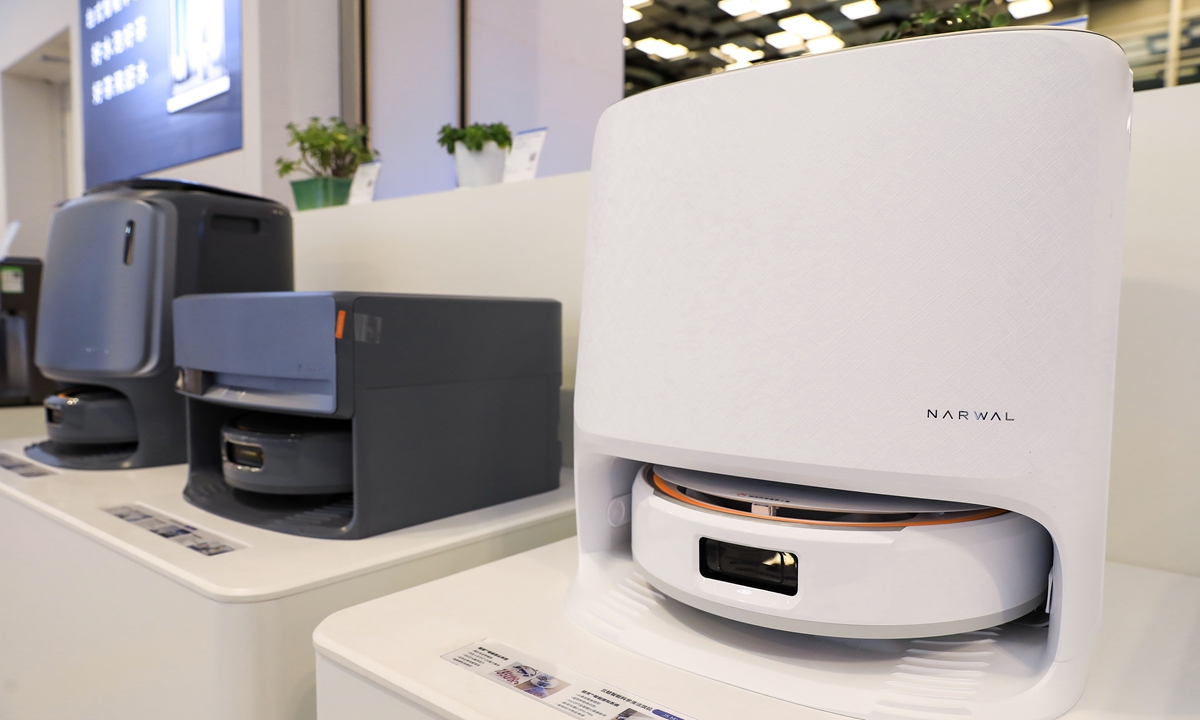
Robot vacuum cleaners are displayed in the home appliance section of Suning.com in Shanghai on January 11, 2026. The products are eligible for subsidies under the new round of the trade-in program for consumer goods. (Photo: VCG)
Beijing has added 10 categories of products to its trade-in subsidy program, including a range of smart products such as embodied intelligent robots and robot dogs, according to the Beijing Municipal Commerce Bureau on Thursday. A Chinese expert said the move could help accelerate the integration of artificial intelligence (AI) technologies into everyday consumption and support the expansion of the smart product market.
According to the Beijing Municipal Commerce Bureau, subsidies will be provided to individual consumers in Beijing purchasing 10 categories of products, including smart door locks, smart cameras, smart robot vacuum cleaners (including smart floor scrubbers and smart vacuum cleaners), smart toilets (including smart toilet seats), digital cameras (including action cameras), smart headphones, whole-home smart systems (including smart home servers and smart gateways), smart beds (including smart mattresses), smart electric wheelchairs, and embodied intelligent robots (including companion robots, robot dogs, exoskeleton robots and elderly care robots).
Individual consumers purchasing the smart home products listed above, including elderly-friendly home products, will receive a subsidy equal to 15 percent of the final sales price after all discounts, with one subsidized item allowed per person in each category and the subsidy capped at 1,500 yuan ($221) per item, the bureau said.
Beijing is not an isolated case. Recently, multiple regions in China, including Shanghai, East China's Jiangsu and Anhui provinces, and Central China's Hubei Province, have issued related policies to expand the coverage of the consumer goods trade-in program, with robots included in the subsidy scheme.
Anhui has expanded its subsidy program to cover a range of popular products, with differentiated subsidy standards set based on product categories to maximize benefits for consumers. Individual consumers purchasing five categories of products, including smart cleaning robots, exoskeleton robots, smart toilets, smart door locks and dishwashers, will receive a subsidy of 15 percent of the final sales price after all discounts. Each consumer is eligible for one subsidized item in each category, with the subsidy capped at 1,500 yuan per item.
For individuals purchasing smart health monitoring and assistive products, the subsidy rate is set at 20 percent of the final sales price after all discounts. Each consumer can receive a subsidy for one item in this category, with the subsidy capped at 2,000 yuan per item.
According to an announcement by the Hubei Provincial Department of Commerce, individual consumers purchasing 10 categories of products from participating retailers, including smart service robots, smart headphones, smart speakers, smart door locks, smart air purifiers, smart dishwashers, smart range hoods and cooktops, smart toilets, smart water purifiers and ventilators, will receive a subsidy of 15 percent of the final sales price after all discounts. Each consumer is eligible for one subsidized item in each category, with the subsidy capped at 1,500 yuan per item.
Wang Peng, an associate research fellow at the Beijing Academy of Social Sciences, told the Global Times that the policy adjustment sends a clear signal of the country's stronger support for the smart consumer goods industry. By extending subsidies from traditional home appliances and basic digital products to a broader range of smart-home devices, the policy is moving beyond simply stimulating short-term consumption and toward fostering a more complete industrial ecosystem. It is also encouraging household consumption to shift from replacing individual products to upgrading toward integrated smart-home scenarios.
He said including smart electric wheelchairs, elderly-care robots and embodied intelligent robots in subsidy programs could help lower the cost of adopting emerging technologies and accelerate their entry into everyday life. Such measures can make advanced products more accessible to ordinary consumers, helping technologies move beyond laboratories and niche markets and deliver more tangible benefits to people.
In the first half of 2026, China's consumer goods trade-in program drove 1.1 trillion yuan in related product sales and benefited 150 million consumer visits, according to data released by the Ministry of Commerce on Wednesday. Smart consumption continued to expand rapidly, with sales of digital and smart products rising 13.4 percent year-on-year from January to June, and increasing 32.0 percent in June alone. Since the implementation of the policy, sales of smart glasses have accelerated month by month, with June sales rising 30.6 percent year-on-year, according to the ministry.