


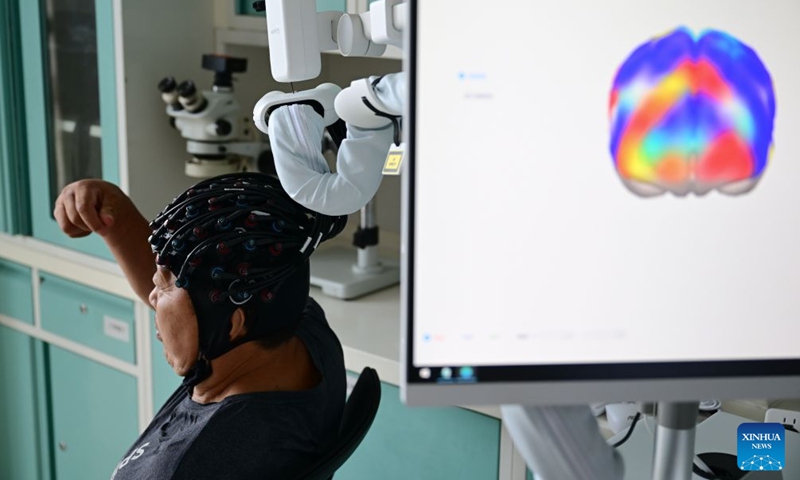
A medical worker uses a brain imaging device to assess a patient's brain activity at a hospital in Bengbu, east China's Anhui Province, July 17, 2026. (Photo: Xinhua)
A Chinese research team has unveiled new electroencephalogram (EEG) signal collection equipment capable of simultaneously gathering brainwave data from more than 1,000 participants across different regions. The achievement marks a major step forward in training neural foundation large language models (LLMs) and advancing general-purpose brain-computer interface (BCI) technologies, according to a report by state broadcaster CCTV on Thursday.
According to the research team, achieving thousand-person-scale, cross-regional synchronous data acquisition required overcoming two major technical bottlenecks: first, ensuring signal collection precision while miniaturizing the devices; second, overcoming network latency to achieve millisecond-level time alignment across multiple devices and regions, ensuring that disparate EEG signals can be uniformly analyzed, according to the report.
Looking ahead, large-scale EEG collection technology will continuously accumulate data to train neural foundation LLMs. This implies that AI's learning materials will no longer be limited to indirect information such as text, images, and videos, but will be able to directly understand human cognitive states through neural signals, the report said.
The BCI is a critical frontier in the global future industry landscape, and large-scale, high-quality EEG data serve as the core foundation for advancing the technology from the laboratory to industrial application.
The BCI sector was designated a future industry in this year's government work report. It was also included in the outline of the 15th Five-Year Plan (2026-30) as the country aims to cultivate it into a new engine of growth.
More specifically, a guideline issued by seven government departments last August laid out short-term targets for the innovative development of this sector, including achieving key breakthroughs in BCI technologies with an advanced technology system, industrial system and standards system by 2027, and significantly enhancing the innovation capacity of the industry with its overall strength ranking among the world's leaders by 2030.
China's BCI market is projected to be valued at 6.14 billion yuan ($907 million) by 2028, with a compound annual growth rate of 17.7 percent from 2024 to 2028, according to CCID consulting under China's Ministry of Industry and Information Technology.