


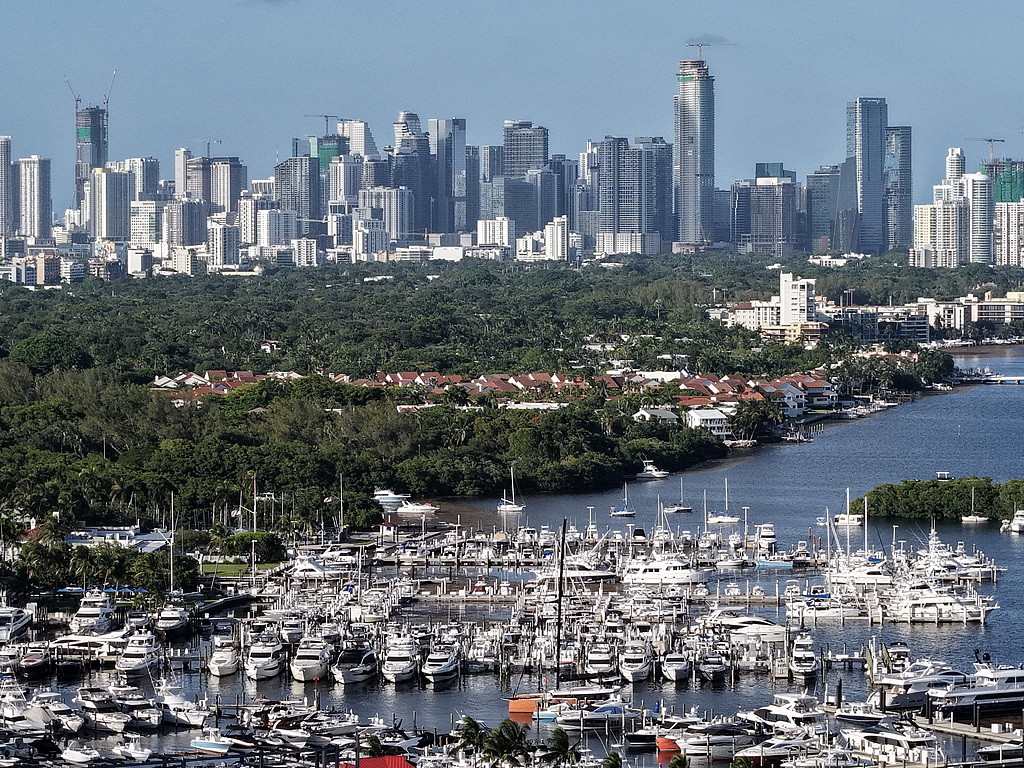
In an aerial view, boats are docked at Dinner Key Marina as the city skyline is seen in the background on July 21, 2026 in Miami, Florida. (Photo: VCG)
The US Trade Representative Jamieson Greer announced on July 23 a sweeping 301 tariff of 10-12.5% on around 60 economies, replacing the Section 122 tariff that expires on July 24. This seamless tariff relay proves again that the Trump administration relies heavily on tariffs as a core economic tool. As Section 122 was the continuation of reciprocal tariffs by other means, the new 301 tariff is also a continuation of the Section 122 tariff by other means.
The 301 tariff is a total farce. The US 1974 Trade Expansion Act Section 301 authorizes the USTR to probe into a certain trading partner to find if any discriminatory trade policy is pursued at the cost of American business or families. The probe normally focuses on a certain product or trade practice, normally lasting for 4-6 months, and goes through public hearings before a final decision is made.
The findings and conclusions of the current 301 probes have been pre-set. As Washington needs this new tariff to replace the Section 122 tariff, the USTR has just gone through the legal procedures. The public hearings are in general of little use. In 2018, when the USTR held public hearings over tariffs on Chinese goods, 94% of the participants opposed them. However, it did not change the final USTR "finding."
The US 301 investigation and tariff are a blunt violation and challenge to WTO multilateral trading rules, which stipulate that tariffs are to be set through negotiations.
Over the past year and a half, the Trump Administration has deployed tariffs through two tools. Phase one: "reciprocal tariff", killed on February 20, 2026; Phase two, Section 122 tariff, expires on July 24, 2026. Now we have Phase Three, Section 301 tariff, to be effective for years. Each relay is the continuation of the unilateral tariff tool by other means.
On the other hand, facts have proved repeatedly that the US unilateral global tariff is a paper tiger.
Workers assemble scaffolding around the North Portico of the White House on Monday July 6, 2026. (Photo: VCG)
The unilateral tariff could not cut down the US's trade deficits drastically. For May 2026, the US trade deficit rose again to $105.89 billion, annualized at $1.27 trillion, higher than that in 2025 ($1.23 trillion). The high tariff failed to stop imports rising, with May imports up 21.5% year on year, much faster than export growth (16.3%). Nor has it brought manufacturing back to America. Fed data shows that the manufacturing production index stood at 97.9 in May, up only 1.4% over a year ago, and still lower than 2017 (100.0, the base year).
It has also only accelerated inflation at home, with CPI up 4.2% year on year in May, only retreating to 3.5% in June, thanks to the oil price fall following the easing of Middle East tensions, not to tariffs. The June CPI data remains well above the Fed's rate-cut threshold of 2%. The reigniting of inflation cuts into the earnings of American businesses and the real income of households.
Completely different from a century ago, the current Trump tariffs, with levels even higher, have been little felt in the world economy and trade.
In fact, the trend continued into the first half of 2026. An outstanding example is China, with its exports worldwide up 17.6% year on year, three times faster than its growth in 2025. The EU also saw its exports up 5.0% and imports up 9.3% year on year in April. Japan had its exports up 19.7% and imports up 10.7% year on year during H1, 2026.
All the above actual performances have proved that the US is no longer a hegemonic player in the world economy and trade.
The US's unilateralism and global tariffs are actually leading to the opposite of what Washington has anticipated. The global multilateral trading system is, by and large, still working. 73% of international trade flows are still following WTO rules, and the US is increasingly sidelined in the world trade landscape.

Shoppers browse food products and fresh produce at a supermarket in Reykjavik, Iceland, on May 30, 2026. (Photo: VCG)
There is a clear tendency of realignment in world trade arrangements and trade flows, with the US increasingly sidelined. Canada has announced it a target of doubling its exports to non-US markets in 10 years and is in close talks with the EU for a free trade arrangement. The EU is intensifying its efforts for trade agreements with over 70 trading partners, ranging from North America to the Asia-Pacific, Africa and Latin America. It has signed an agreement with Mercosur and enhanced cooperation with the Free Trade Union of Africa. EU and CPTPP are in talks for a super trade alliance, the largest in the world. In the Asia-Pacific, China, ASEAN and RCEP economies are enhancing trade cooperation significantly.
China elevated its free trade agreement with ASEAN to version 3.0, and bilateral trade increased by 22.9% year on year during H1 2026. Its trade with RCEP members increased by 21.5%.
The intra-RCEP trade exceeded $6 trillion in 2025, larger than intra-EU trade and nearly twice as large as the US's global imports. Asia, Europe and Africa combined account for 70% of world trade while the US's imports only accounted for 13.2% of world trade in 2025, down from 13.6% in 2024.
It is estimated that the global multilateral trade mechanism with the WTO at its center, the extensive non-US trade arrangements across the world, and trade flows therefrom will continue to grow, no matter how Washington's tariff tools develop.
The trend is inevitable, and the 301 tariffs only sideline the US further.