


BEIJING, July 24 (Xinhua) - China's tax authorities have issued detailed rules that address long-standing ambiguities in the taxation of offshore trusts, bringing the existing legal provisions into more effective operation.
Chinese resident individuals are required to declare and pay individual income tax (IIT) on income derived from transferring assets into offshore trusts, as well as income generated during the lifetime of such trusts, according to a joint announcement issued on Friday by the Ministry of Finance and the State Taxation Administration.
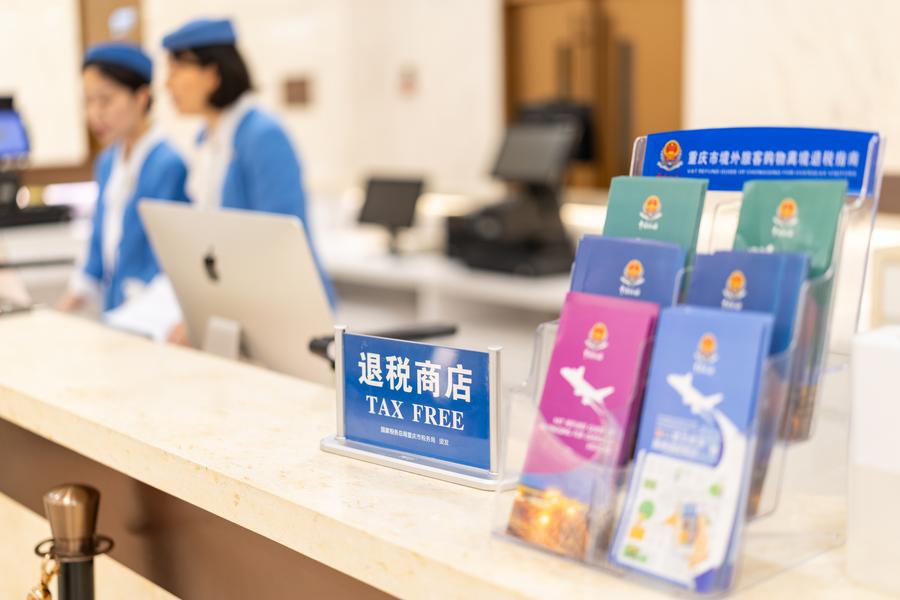
This photo shows a tax free shop in Southwest China's Chongqing Municipality, May 2, 2025. (File photo:Xinhua)
The announcement specifies the IIT reporting requirements for offshore trusts across their establishment, operation, and termination stages. Gains from transferring assets into a trust are taxed as "income from transfer of property," while income generated during the trust's lifetime is taxed either as "income from transfer of property" or as "interest, dividends and bonuses," depending on the nature of the returns, with both categories subject to a 20 percent rate.
For trusts that have been under operation for more than three years, tax liabilities incurred at the establishment stage will be exempt from retroactive collection. However, income accrued during the trust's lifetime must be reported regardless of the establishment date. A three-month grace period is provided for voluntary disclosure, during which late-payment penalties are waived.
Under China's individual income tax law, resident individuals shall pay IIT on income derived from both domestic and overseas sources. This aligns with the standard practices of major countries, experts said.
Shi Zhengwen, director of the Center for Research in Fiscal and Tax Law at China University of Political Science and Law, said that the announcement does not introduce new legislation, but detailed rules for more effective law enforcement.
"In the past, enforcement was hindered by information asymmetry and vague rules. With stronger international tax cooperation and improved data-sharing mechanisms, the conditions for effective collection have now matured," Shi said.
Tax experts noted that China's latest move on offshore trust taxation enhances tax certainty and transparency, helps stabilize taxpayer expectations, and contributes to greater social equity.