


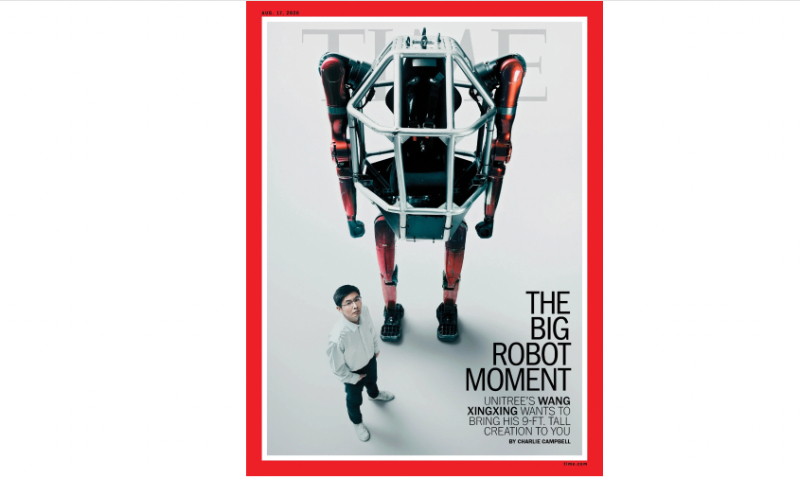
TIME magazine cover features Unitree Robotics' founder CEO and its giant mecha robot (Photo: Scresshot of a post by Unitree Robotics)
Unitree Robotics founder and CEO Wang Xingxing has made history by appearing on the cover of TIME magazine alongside the company's groundbreaking human-piloted mecha robot GD01, under the headline "The big robot moment." It has been eight years since a Chinese entrepreneur last graced the cover of the TIME.
The striking cover image features the nearly 2.7-meter-tall GD01 dominating the frame, with Wang standing beside it. The magazine highlighted Wang's remarkable contribution to turning science fiction into reality, stating that he has "done more than arguably anyone else to bring this science fiction closer to reality."
Sam Jacobs, the editor-in-chief at Time magazine, wrote on his linkedin account on Friday that "the ambitions for this company and this space continue to grow."
The GD01 featured on the cover is Unitree's world-first production ready manned mecha, unveiled on May 12. Priced from 3.9 million yuan ($650,000) and weighing about 500 kilograms with a person inside, the giant robot features a cockpit inside its torso for human piloting.
According to Unitree, the robot can transform and serve as a civilian transport vehicle. Standing roughly 1.6 times the height of an average adult, it seamlessly switches between bipedal and quadrupedal modes. The bipedal mode is suited for city streets, while the quadrupedal mode handles stairs, slopes, and rough terrain, the company told the Global Times previously.
According to TIME, Wang revealed that beyond mixed martial arts, he took a dash of inspiration from film director James Cameron: "We actually drew some references from a similar robot featured in Avatar."
From quadruped robotic dogs to advanced humanoids like the G1 and H2, and now the GD01, Unitree's robots have gained worldwide fame after dazzling performances at China's Spring Festival Galas and this year's America's Got Talent audition.
The video entitled "Unitree's robots leave Simon Cowell SPEECHLESS!" was viewed 4.6 million times in one month, as showed on the YouTube account of America's Got Talent.
Unitree Robotics said on Friday that "it has been exactly eight years since the last time that a Chinese entrepreneur graced the cover of the TIME magazine."
In January 2018, Baidu founder Robin Li Yanhong graced the cover of TIME magazine's Asia edition, headlined "Baidu's Robin Li is Helping China Win the 21st Century." Dubbed "The Innovator," Li became the first Chinese internet entrepreneur to earn this distinction.
Eight years on, from Baidu's AI breakthroughs to Unitree's embodied intelligence, Chinese tech firms have transitioned from catching up to leading the way.
Unitree is currently among global leaders of robots by shipping volume. According to an Omdia report, global humanoid robot shipments reached around 13,000 units in 2025. Chinese companies dominated the market, with AgiBot (also known as Zhiyuan Robotics) ranking first with 5,168 units, taking 39 percent of global share), followed by Unitree Robotics' 4,200 units and UBTECH's 1,000 units.
Morgan Stanley predicted that the number of humanoid robots worldwide could reach 13 million by 2035, and could increase to 1 billion by 2050, with the industry's scale reaching $5 trillion.
In a wide-ranging interview with TIME, Wang expressed optimism about the future. He predicted that "in 10 years, every household may have a small robot that can do your laundry, grill your steak, and even provide basic care if you fall ill."
He believes the industry is "two to 10 years away from a 'ChatGPT moment' for humanoids."
During an exclusive interview with the People's Daily in August 2025, Wang said, "Robot AI is progressing fast. For example, six months ago, I wouldn't have believed our robots could compete in martial arts matches - I thought it'd take at least one to two years - but it has happened in just a few months. Predicting industry growth is tough; notable progress might come in three to five years," he said.
The main hurdle is that the AI level of robots isn't advanced enough to break the critical threshold, which is also a global issue now. Breakthroughs in AI can happen anytime, as sudden technological leaps are common. Problems unsolvable now might suddenly be resolved some day in the future, said Wang.