


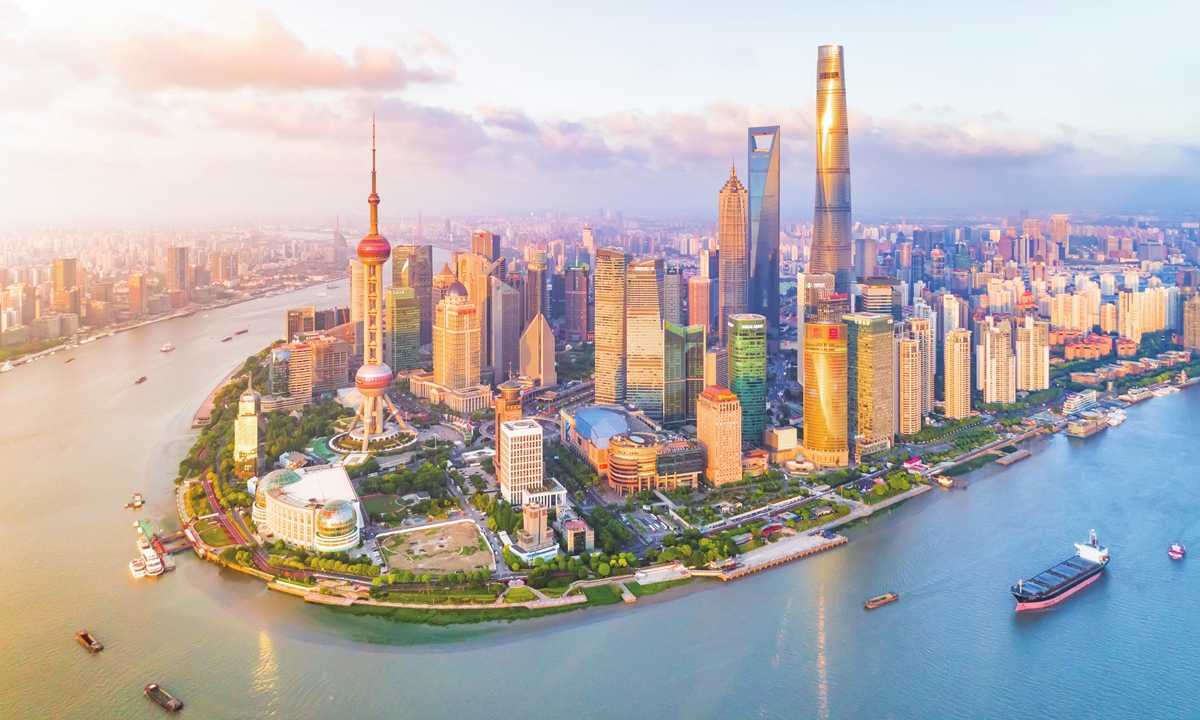
A view of Shanghai (Photo: VCG)
China's economic performance in the first half of the year cannot be contextualized through a two-quarter snapshot. The results are more than numbers when they tell a tale. From the political-economic perspective, the results would display the multi-year growth trajectory.
In the first quarter of this year, China's growth accelerated to 5.0 per cent year-on-year, up 0.5 percentage points from the fourth quarter last year and the fastest pace in three quarters, against a market consensus of 4.8 percent. Between January and June, China's GDP grew by 4.7 percent, which still falls within the Chinese government's annual growth target between 4.5 and 5 percent.
What makes this more than a statistical blip is the source of the acceleration, which is driven by structurally different factors: a genuine export upgrade into AI-linked capital goods, electric vehicles (EVs), renewable energy equipment, and high-tech manufacturing. The shift in the composition of growth, from an exhausted old engine toward a new, higher-value-added one, as is evident in China's case, has the potential to genuinely bend the multi-year curve.
The IMF's July 8 update is worth reading carefully. The two major developments, the downgrade in global growth and the upgrade in China's growth projection are not unrelated realms. They offer one interpretation of how unevenly the current shock is being absorbed. Global growth for 2026 was trimmed to 3.0 per cent, the second downgrade this year following an April cut, driven primarily by the Middle East war and the roughly 25 percent rise in energy prices it has produced. China's forecast moved the other way, up 0.2 percentage points to 4.6 percent, alongside a 0.1-point upgrade for 2027 to 4.1 per cent.
That distinction matters for how the international confidence framing should be interpreted. What the IMF is confirming, with independent verification, is the same structural point that China's own data has been signaling through the first half of this year: that the export upgrade into high-tech manufacturing is real and internationally recognized, rather than a temporary statistical artefact.
China is a stabilizing anchor for the global technology and capital goods supply chain, where AI-linked demand is functioning as a genuine offset to the energy shock elsewhere. It is not currently functioning as a demand anchor for the global economy in the way it did during the 2009 or 2015 stimulus cycles, when Chinese domestic demand pulled commodity exporters and manufacturing partners along with it. Examples like that of China show that a country can be an anchor for supply chain resilience.
Against this backdrop, some in the West hype up a "China Shock 2.0," which I think is purely political bias. Germany's auto sector, South Korea's semiconductor industry and Japan's precision machinery have all run persistent, large export surpluses relative to domestic consumption without being labelled as suffering from "overcapacity" in trade discourse, and the distinction between calling a surplus "competitiveness" in these countries and "dumping" in China rests on a political judgment about origin.
Chinese high-tech export growth is producing real consumer and climate benefits globally, largely as the counter-narrative describes. In actuality, the "China Shock 2.0" narrative can be assessed against the fact that cross-country data have found that industries with the highest penetration of Chinese imports showed the sharpest slowdowns in producer price inflation across dozens of surveyed economies, a genuine deflationary benefit for import-dependent consumers and downstream manufacturers.

Aravind Yelery (Photo: Courtesy of Aravind Yelery)
The 15th Five-Year Plan, adopted by the National People's Congress in March 2026 following the October 2025 plenum recommendations, sets two overarching targets: a self-reliance agenda aimed at reducing exposure to strategic technologies, and a genuine opening agenda aimed at specific sectors where Beijing wants continued foreign participation. The opportunity for multinationals sits almost entirely in the second track. China intends to expand market access specifically in services, with pilot programs widening in value-added telecommunications, biotechnology, and wholly foreign-owned hospitals, alongside continued opening in education and culture.
The plan also explicitly commits to adjusting tariffs and incentives to encourage imports of advanced technology, high-quality agricultural products, and productive services, which signals China wants foreign capital and know-how in various sectors. The plan creates a genuine and expanding lane for foreign firms in services, healthcare, green technology, and AI application industries.
This article is compiled based on an interview by the Global Times with Aravind Yelery, associate professor of Centre for East Asian Studies at Jawaharlal Nehru University in New Delhi.