


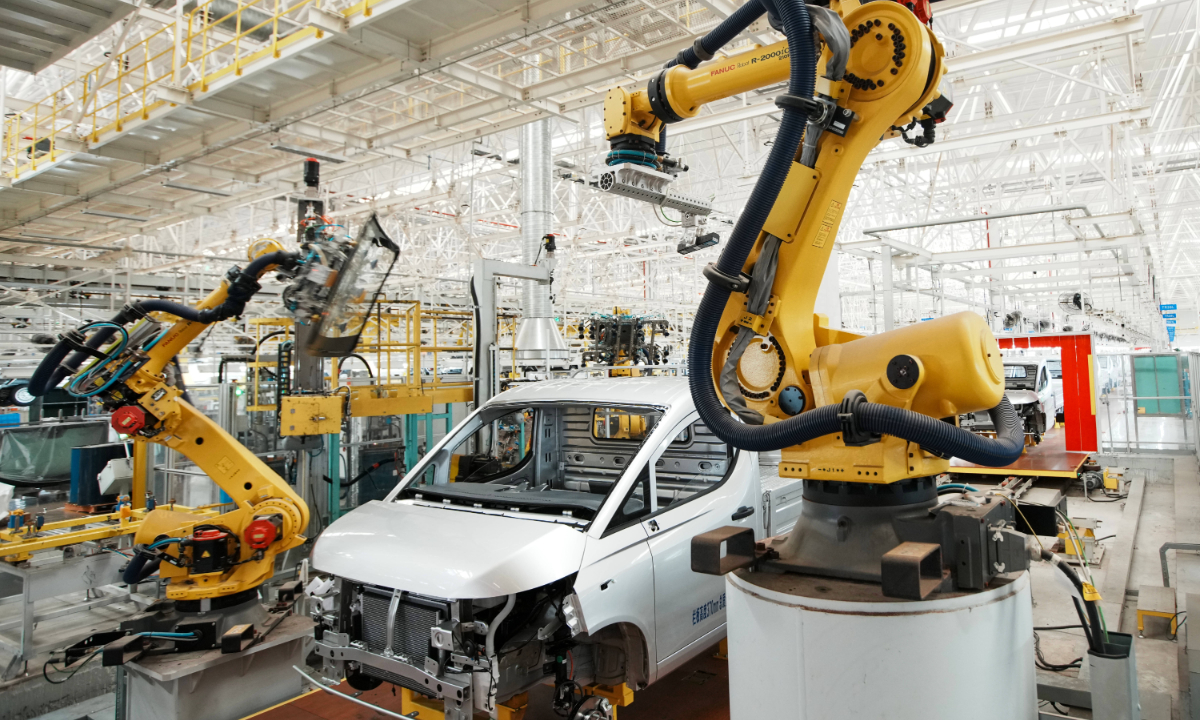
Robots assemble a new energy passenger vehicle at Liuzhou Wuling Automobile Industry Co in Liuzhou, South China's Guangxi Zhuang Autonomous Region, on July 18, 2026. (Photo: VCG)
According to a Sunday report by CCTV News, China’s passenger vehicle sector has achieved full carbon footprint coverage for the first time. Experts said the milestone marks a new stage in the large-scale and systematic development of China’s automotive carbon data management system, while helping automakers better meet overseas compliance requirements and support their global expansion.
The report cited the latest data from the China Automotive Industry Chain Carbon Publicity Platform, showing that as of July 2026, the platform had collected carbon footprint data for more than 12,100 passenger vehicle models from 92 automakers, covering all domestic passenger vehicle models and major imported models.
In the past, China’s automotive industry faced challenges in low-carbon management, including inconsistent standards, fragmented data and incomplete traceability. Through the carbon disclosure platform, the industry has established a carbon data chain spanning the entire lifecycle from upstream raw materials to vehicle use, which helps drive systematic emissions reductions across the entire industrial chain, according to the report.
Building on the platform’s lifecycle carbon data, China will establish a standardized and measurable framework to assess low-carbon development.
Carbon footprint management evaluates emissions across a vehicle’s entire lifecycle, covering manufacturing, use and end-of-life recycling, and provides a comprehensive assessment of its environmental impact, Zhang Xiang, secretary-general of the International Intelligent Vehicle Engineering Association, told the Global Times on Sunday. As global markets increasingly adopt carbon management requirements, a complete carbon footprint system has become essential for automakers seeking international competitiveness, Zhang said.
He said China’s establishment of a carbon disclosure platform for the automotive industry responds to the global trend of carbon management and will help Chinese automakers, especially new energy vehicle producers, meet overseas compliance requirements and prepare for potential carbon tariffs. China’s practices in carbon footprint management could also provide a reference for other countries developing similar systems.
Zhang noted that setting industry standards represents a higher level of competition among companies. As China’s auto sector moves from manufacturing strength toward technological and standard-setting advantages, a stronger carbon footprint management framework will further enhance the industry’s global influence and competitiveness.
Beyond setting industry standards, carbon footprint assessment is also a key tool for tracking emissions and driving carbon reduction across the automotive supply chain, Chinese expert said.
On July 9, the nation issued an action plan for carbon peaking during the 15th Five-Year Plan period (2026-2030), outlining a roadmap for the country’s carbon peak efforts over the next five years.
According to the plan, China will accelerate the low-carbon transformation of transportation by advancing the transition toward cleaner energy use and continuing to increase the number of new energy vehicles.
The plan also calls for improving the carbon emissions accounting system, including establishing a scientific and standardized mechanism for updating greenhouse gas emission factors, accelerating the development of national greenhouse gas emission factor and carbon footprint databases, and strengthening carbon measurement capabilities and their application.
Carbon footprint accounting and management are essential for energy conservation and emissions reduction, enabling companies to identify and optimize resource use and emissions levels, while uncovering opportunities for further carbon cuts, a Chinese expert said.