


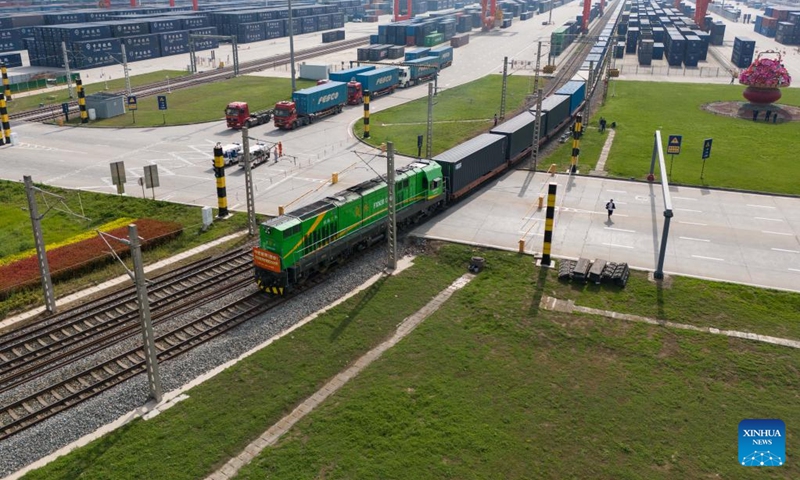
An aerial drone photo taken on April 24, 2026 shows a China-Europe freight train departing from the Xi'an International Port Station in Xi'an, northwest China's Shaanxi Province. The Xi'an International Port Station has handled over 2,000 China-Europe freight train trips this year. The total freight volume transported has exceeded 2.1 million tonnes in this period. (Photo: Xinhua)
China-Europe freight train services have completed more than 130,000 trips carrying goods worth over $520 billion over the past decade, an official said at a press conference in Beijing on Tuesday, as the rail link increasingly serves as a buffer against volatility in global shipping.
Annual trips grew from 1,702 in 2016 to 20,022 in 2025, an average annual growth rate of more than 30 percent, said Liang Linchong, director-general of the Department of Regional Opening-up of the National Development and Reform Commission (NDRC) at the press conference on Tuesday. The service now completes in a single month what it took the whole of 2016 to achieve.
Whenever sea routes between Asia and Europe are disrupted or international supply chains come under shock, the freight trains become an important option for companies at home and abroad, Liang said. New paths have been opened via the trans-Caspian corridor, through Türkiye into Europe, and via Russia's St. Petersburg port to Germany.
The shift was on display in June. When a record-breaking heatwave pushed temperatures above 40 C across Europe and Chinese-made air conditioners sold out across the continent. Manufacturers including Midea and Gree switched their restocking channel from ocean shipping to rail, compressing delivery times from about 40 days to roughly 15, Liang said.
Other users have reported similar gains. Solar manufacturer Longi ships photovoltaic products to Europe in 15 days by rail, more than 20 days faster than by sea, lifting its capital turnover rate by 30 percent. A timber importer in Ganzhou, East China's Jiangxi Province, cut transport time by nearly 70 percent and logistics costs by 18 percent by sourcing from Europe via the trains.
Customs clearance is now completed within 30 minutes following the rollout of a digital port system and an express rail clearance model. Fixed-timetable trains, which run to set schedules like passenger services, have cut journey times by more than a third. The Xi'an-Duisburg route, once a 15-day journey, can now be completed in 11 days, according to the press conference.
The loaded container rate, a measure of how full the trains run, has stayed at 100 percent for 46 consecutive months as of June 2026, while outbound and return trips have moved close to a 1:1 balance, Liang said, indicating steadier two-way demand.
Route diversification has accelerated. Volume on the southern corridor, which runs through the Trans-Caspian International Transport Route, surged more than 90 percent year-on-year in the first half of 2026. The corridor carried 456 trips in 2025, up 20 percent from 381 in 2024. The network now covers 96 routes reaching 236 cities in 26 European countries, with goods spanning 53 major categories and more than 50,000 varieties.
European cities have been reshaped along the way. Malaszewicze, a small border town in Poland, has become a significant logistics hub in the EU because of the trains, while Duisburg in Germany has transformed from a traditional industrial city into a major European logistics center, Liang said.
Looking ahead to China's 15th Five-Year Plan (2026-30) period, the NDRC will focus on improving transport organization, expanding resilient multi-modal corridors, strengthening safety governance and deepening innovation, Liang said.
"The China-Europe freight train services is an important public good benefiting countries along the routes," he said, adding that more countries and companies are welcome to take part.