


Consumption growth has slowed somewhat in China. In June, total retail sales of consumer goods reached 4.269.1 trillion yuan, up 1.0 percent year-on-year, compared with a decline of 0.6 percent, in the previous month. Investment declined, with national fixed-asset investment, excluding rural households, falling 5.7 percent year on year.
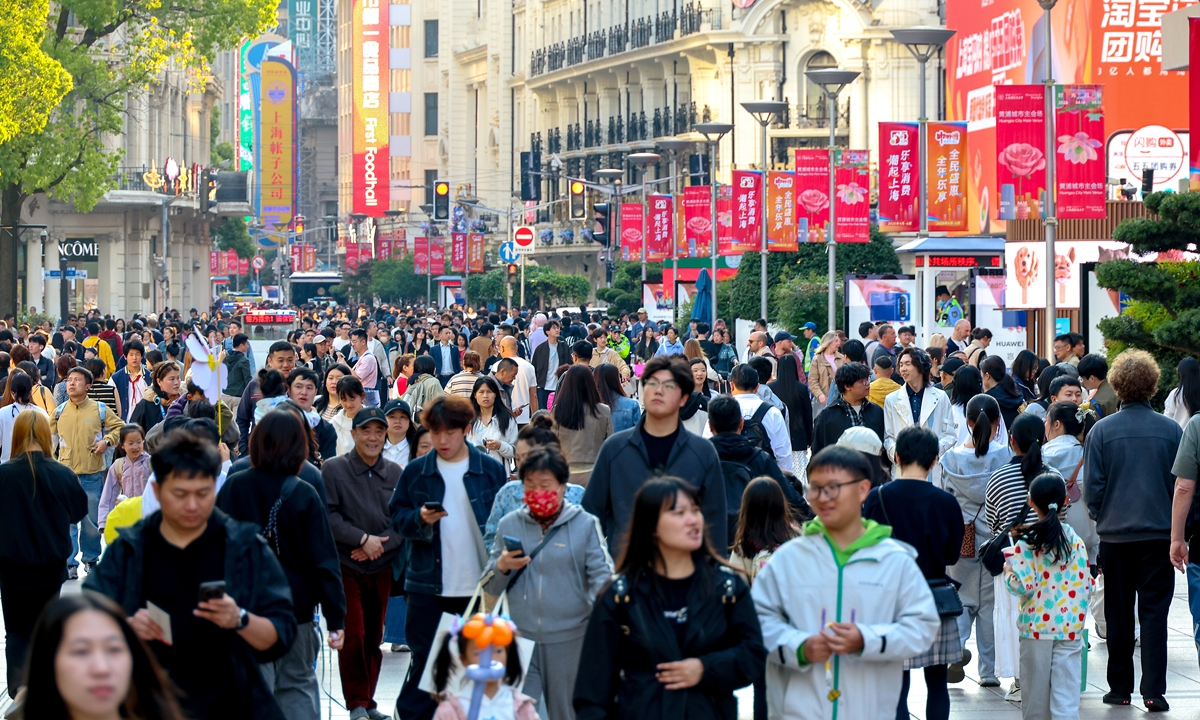
Crowds of tourists are seen on a Shanghai pedestrian street during the 2026 "Shopping in China" International Consumption Season (Shanghai Station) and the 7th Shanghai May 5 Shopping Festival on April 30, 2026. (Photo: VCG)
Is China's domestic demand "faltering"? After the release of China's semi-annual economic report for 2026, some observers have seized on short-term fluctuations in individual indicators to hype pessimistic narratives such as "weak domestic demand" and "peak China."
To truly understand China's domestic demand, one must look beyond the "shape" of short-term fluctuations and grasp the "momentum" of long-term improvement. It is equally important to acknowledge the real pressures of aggregate adjustment while recognizing the bright spots of structural upgrading.
Fluctuations during an economic transition are normal. The fundamentals of China's domestic demand — a solid foundation, vast potential and strong momentum — remain unchanged. The "weak domestic demand" narrative is simply untenable.
In the consumption sector, although growth has fluctuated, the trend toward upgrading has become increasingly clear. In the first half of the year, total retail sales of consumer goods and services grew 2.7 percent year on year, of which retail sales of goods increased by 1.1 percent. Judged solely by the headline growth rate, the figure is indeed not particularly impressive. But looking beyond the headline figure to the underlying structure, one can detect a strong pulse of consumption upgrading.
In terms of service consumption, the vitality of everyday life is generating "new growth drivers." Retail sales of services grew by 5.3 percent year on year, outpacing the growth of retail sales of goods by 4.2 percentage points. Service consumption in areas such as tourism, consulting, leasing, culture, sports, and leisure recorded double-digit growth, becoming the main engine driving consumption growth.
In terms of goods consumption, sales of upgraded products have been robust. Retail sales of communication equipment by units above a designated size grew by 14.4 percent; retail sales of highly-energy-efficient household appliances increased by more than 30 percent; retail sales of smart wearable devices such as smart glasses more than doubled; and the penetration rate of new-energy passenger vehicles has exceeded 60 percent for three consecutive months.
In terms of the urban-rural structure, rural consumption potential continues to be unleashed. The growth rate of rural retail sales of consumer goods outpaced that of urban areas by 1.3 percentage points, and the share of retail sales accounted for by county and township markets continued to rise, while lower-tier markets remained vibrant.
In terms of retail formats and business models, new models are giving rise to new growth poles. Retail sales through livestream e-commerce exceeded 1 trillion yuan, up 6.5 percent. Retail sales by new retail formats, such as warehouse club stores and unattended convenience stores, up more than 25 percent; the value of instant-retail transaction grew by more than 20 percent.
These figures fully demonstrate that Chinese consumption is not "weak"; rather, it is undergoing a profound structural transformation. With per capita GDP approaching the level of high-income countries, Chinese household consumption is rapidly shifting from subsistence and basic consumption toward development-oriented and higher-quality consumption, and shifting from a goods-dominated model toward a more balanced mix of goods and services.
Some people simply compare China's household consumption rate with that of developed countries and conclude that "Chinese household consumption is insufficient." Such a conclusion is untenable.
Shaped by historical traditions and national conditions, Chinese household consumption has developed into a pattern with distinct characteristics. At the same time, China's consumption rate is affected by multiple factors such as price differences and household saving habits. The Fourth Plenary Session of the 20th Central Committee of the Communist Party of China listed "a notable increase in the household consumption rate" as one of the main targets for China's economic and social development during the 15th Five-Year Plan (2026-30) period. Since the beginning of this year, all regions and departments have thoroughly implemented various policies to expand domestic demand and boost consumption, supporting the continued expansion of the overall scale of the consumer market, a steady rise in the household consumption rate, and continued improvements in living standards.
Short-term fluctuations are an inevitable part of the transition. China's vast market of more than 1.4 billion people, the strong demand of the world's largest middle-income group, combined with the long-term trend of consumption upgrading, mean that the resilience and growth potential of China's consumer market should not be underestimated. With steady growth in residents' income and a continued increase in the supply high-quality goods and services, consumption's contribution to economic growth will continue to strengthen. The room for expansion and upgrading embedded in this process is precisely a major opportunity for the long-term sound development of the Chinese economy.
Turning to the investment sector, although total fixed-asset investment has faced pressure, structural optimization has produced notable results.
In the first half of the year, affected by factors such as the deep adjustment of the real estate market, national fixed-asset investment (excluding rural households) fell by 5.7 percent year on year, which some have used as grounds for talking down investment. However, if real estate development investment is excluded, the decline narrows to 2.7 percent. More importantly, the diverging trends within the investment structure clearly shows the direction of transformation and upgrading.
Investment in sectors associated with new quality productive forces continued to grow, with the role of innovation becoming more prominent. In the first half of the year, investment in high-tech manufacturing grew by 3.2 percent year on year, among which investment in electronic circuit manufacturing increased by 55.6 percent, lithium-ion battery manufacturing by 24.4 percent, electronic specialty materials manufacturing by 10.0 percent, and integrated circuit manufacturing by 8.8 percent. Investment in high-tech services grew by 7.5 percent year on year, with the rapid development in frontier fields such as artificial intelligence driving a 15.5 percent increase in investment in information services, while investment in R&D and design services continued to accelerate.
Infrastructure investment also showed signs of strength. Investment in internet and related services grew by 39.9 percent, and investment in water transport and power supply both maintained growth rates close to 20 percent, laying a solid foundation for stabilizing growth, improving livelihoods, and supporting broader economic and social stability.
It is not difficult to see that, although total investment has declined, the structure, quality, and efficiency of investment are improving. In areas representing future directions such as technological innovation, industrial upgrading, and new infrastructure, investment remains strong continues to show solid growth momentum, the technological sophistication and innovation content of investment continue to rise.
As a major developing country, China has vast scope for effective investment, ranging from new industrialization and urbanization, to major strategic projects, large-scale equipment upgrades, consumer goods trade-in programs and the development of the "Six Networks" - water networks, new-type power grids, computing power networks, next-generation communication networks, urban underground pipeline networks and logistics networks - from industrial upgrading to addressing weaknesses in people's livelihoods, China's still has vast scope for effective investment. The current structural adjustment is precisely accumulating momentum for higher-quality investment growth.
A long-term perspective is essential in assessing China's domestic demand, short-term fluctuations should not obscure a broader perspective. At present, consumption is upgrading amid transformation, and investment is optimizing amid adjustment — this is a necessary process through which China's domestic demand can build long-term momentum.
Despite short-term fluctuations, China's strategic commitment to expanding domestic demand remains unwavering, and its confidence in development remains unchanged. Going forward, as various policies to expand domestic demand continue to take effect, the vitality of China's vast domestic market will continue to be unleashed, the Chinese economy will grow stronger, and domestic demand's role as the primary driver of economic growth will become even more prominent. Those pessimistic narratives that ignore facts and deliberately exaggerate short-term fluctuations will once again be disproved by China's steadily improving development performance.
(This was compiled and translated by the Global Times English edition based on an article published in the "Chisu Jinsheng" economic commentary column of the People's Daily on July 25, 2026.)