


Lima (People's Daily) - July 26 marks Peru's National Pisco Day, sparking celebrations nationwide.
In Lima's artistic Barranco district, crowds packed the Pisco Expo. Dozens of wineries displayed crystal-clear pisco, filling the air with its signature aroma.
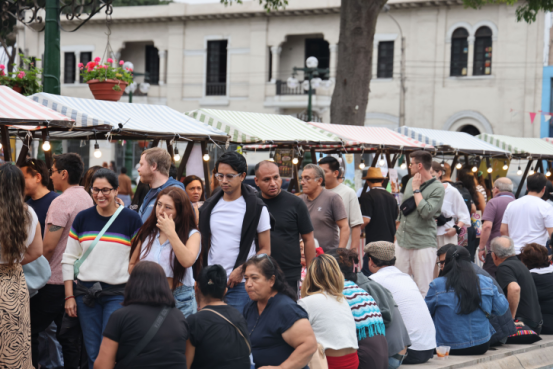
Visitors gather at the Pisco Expo in Lima's Barranco district on July 26. (Photos: Shi Yuanhao/People's Daily)
Visitors from around the world raised glasses, sampling local cuisine and enjoying traditional folk performances.
"Pisco is more than a spirit—it embodies the history, culture and identity of Peru's regions," Sharon Vivar Ponte, Deputy Tourism Manager for Lima, told People's Daily.
Ponte noted that pisco is officially recognized as part of Peru's National Cultural Heritage.
She added that as the capital, Lima unites cultures from across Peru, using international events to introduce global visitors to pisco's heritage.
In recent years, Peru's push to promote pisco has turned the centuries-old spirit into a key driver for agriculture, tourism and culture.
People's Daily visited several pisco wineries to explore its production, cultural roots and growing economic impact.
Livelihoods and female empowerment
"This is an alambique, where fermented grape juice is distilled," said Carmen Robatty de Moquillaza, General Manager of Finca 314 Winery and President of the Pisco Committee at the Peruvian Exporters Association (ADEX), pointing to a copper, gourd-shaped still.
Located 300 kilometers south of Lima in Ica, Finca 314 sits in one of Peru's five official pisco-producing regions.
Blessed with intense sunshine and drastic day-to-night temperature swings, Ica offers ideal conditions for wine grapes.
Under Peru's designation of origin, only spirits produced in Lima, Ica, Arequipa, Moquegua and Tacna can legally be labeled "Pisco."
Historian Erik Peña, co-author of The Origins of Pisco, its UNESCO Inscription and New Data, said records date pisco back to 1583.
The spirit blends European grape cultivation and distillation techniques with the native environment and cultures of the Andes.
Peña noted that for nearly five centuries, Spaniards, Greeks, Africans, Chinese, Indigenous peoples and Peruvians created a history of cultural fusion—with pisco at its heart.
"Behind pisco lies an entire community, legacy and tradition," Peña said, seen today in heritage grapes, cuisine, dances and local craftsmanship.
Finca 314's history dates back to 1821.
"Women have continuously managed our winery for five generations," Carmen said. Beginning with her husband's great-grandmother, the family has grown its own grapes and controlled every step of production.
Her daughter, Claudia de Moquillaza, joined the family business several years ago to manage operations and expand the market.
While preserving traditional techniques, Claudia has pushed international sales, exporting to Brazil, Europe and beyond.
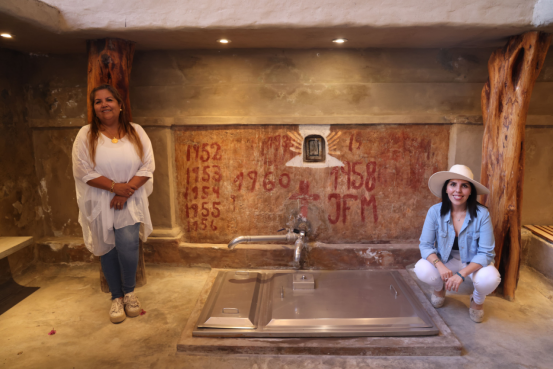
Carmen and Claudia de Moquillaza pose in front of generations-old equipment at Finca 314 Pisco Winery.
According to Peru's Ministry of Production, the pisco supply chain comprises over 500 companies—97 percent of which are micro and small enterprises.
The sector generates roughly 16,000 direct and indirect jobs across the five producing regions.
"Every harvest season, we partner with local farming communities to hire around 100 workers for harvesting and sorting—the vast majority being women," Claudia said.
She added that about 70 percent of Peru's pisco wineries are female-led or rely on women in key leadership positions.
"Women also make up most of the harvest and fermentation workforce," Claudia noted. "The industry helps boost household incomes and achieve real empowerment."

Traditional pisco distillation equipment on display at Finca 314 Pisco Winery.
As brand recognition grows, supporting sectors like logistics, packaging and catering have expanded, creating more local jobs.
"Only when the entire industry grows can pisco go further," Carmen said, noting the spirit offers stable incomes that allow workers to stay in their hometowns.
From winery to tourist destination
Shaded by massive mango trees, heavy lemon branches and walnut trees, Finca 314 stands out against Ica's desert landscape.
Claudia said the estate offers customized tours, immersive pisco tastings and event rentals for weddings.

Lush greenery frames Finca 314, a certified stop on Peru's Pisco Route.
Since 2011, Peru's Ministry of Foreign Trade and Tourism has promoted the "Pisco Route," combining heritage, winemaking traditions and gastronomy.
Finca 314 is a certified destination on the route.
Former Minister of Foreign Trade and Tourism Berthin Gómez Vela recently reaffirmed commitment to the initiative, noting it boosts regional economies, creates jobs and supports thousands of wine-producing families.
Established in 1540, Tacama Winery is another highlight along the route and one of South America's oldest vineyards.
Unlike the artisanal scale at Finca 314, Tacama features large-scale mechanized production.
Its modern bottling line produces 1.5 million bottles of wine and 250,000 bottles of pisco annually, alongside a booming tourism department.
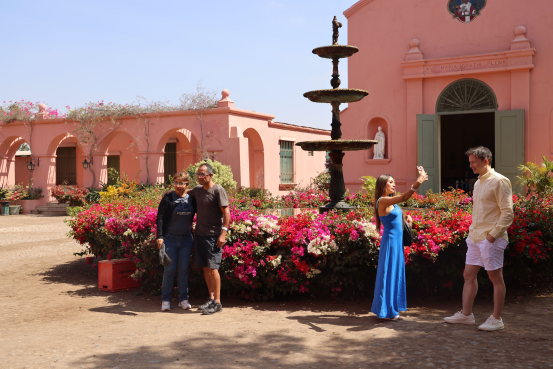
Visitors tour Tacama Winery, a flagship destination along Peru's Pisco Route.
"Tourism has become one of our most vital business units," said Armando Rojas, Administrator and Head Sommelier at Tacama.
Since launching formal tours in 2015, visitor numbers have steadily grown.
"We average 3,000 to 4,000 visitors monthly. During Peru's Independence Day holiday, we expect nearly 10,000 guests over five or six days," Rojas said.
Guests explore centuries-old cellars, learn about pisco's designation of origin, sample guided tastings with sommeliers and watch traditional Marinera dance performances.
Rojas noted heavy investment in training guides, restaurant staff and sommeliers.
"Many foreign visitors knew little about Peruvian pisco before arriving. Tourism helps them recognize our high quality," he said.

Visitors watch a traditional Marinera dance performance at Tacama Winery.
"Ten years ago, our tourism team had 35 people. Today, it's nearly 100," Rojas added, noting how visitor growth has driven upgrades to local roads, hotels, and restaurants.
Carmen agrees that visitors to Ica buy more than a bottle—they experience local history.
"When guests see how grapes are grown and distilled, they understand the real value behind the product," she said.
Reaching global markets
Tacama's pisco—including its popular Demonio de los Andes label—is widely available on Chinese e-commerce platforms.
Rojas noted Tacama has exported to China for years, calling it a strategic market poised for continued growth.
While the US, Spain and the Netherlands remain top export markets, shipments to China are rising.
In the first half of this year, China accounted for 2.5 percent of Peru's pisco export value, up nearly 25 percent year-on-year.
ADEX stated that surging demand from China and Brazil offers crucial diversification for exporters.
Deeper trade ties between China and Peru also support growth.
"The upgraded China-Peru Free Trade Agreement and the opening of Chancay Port are major positives for future exports," Carmen said.
Having attended numerous international trade expos, Carmen sees massive potential in Asia, particularly China.
"Entering China means entering the global stage. It is the strategic market that will drive pisco's internationalization," she said.
At Tacama, Chinese tourist arrivals are also climbing.
"Years ago, we rarely saw Asian tourists. Now we host two or three Chinese tour groups monthly," Rojas said.
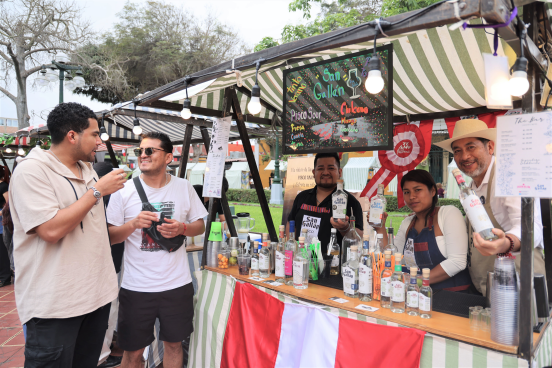
Producers showcase their pisco at the Pisco Expo in Lima's Barranco district.
"What moves consumers is the land, the people and the culture behind the drink," Carmen said.
As China-Peru cooperation deepens, Peru's national spirit is set to reach more Chinese consumers—one glass at a time.