


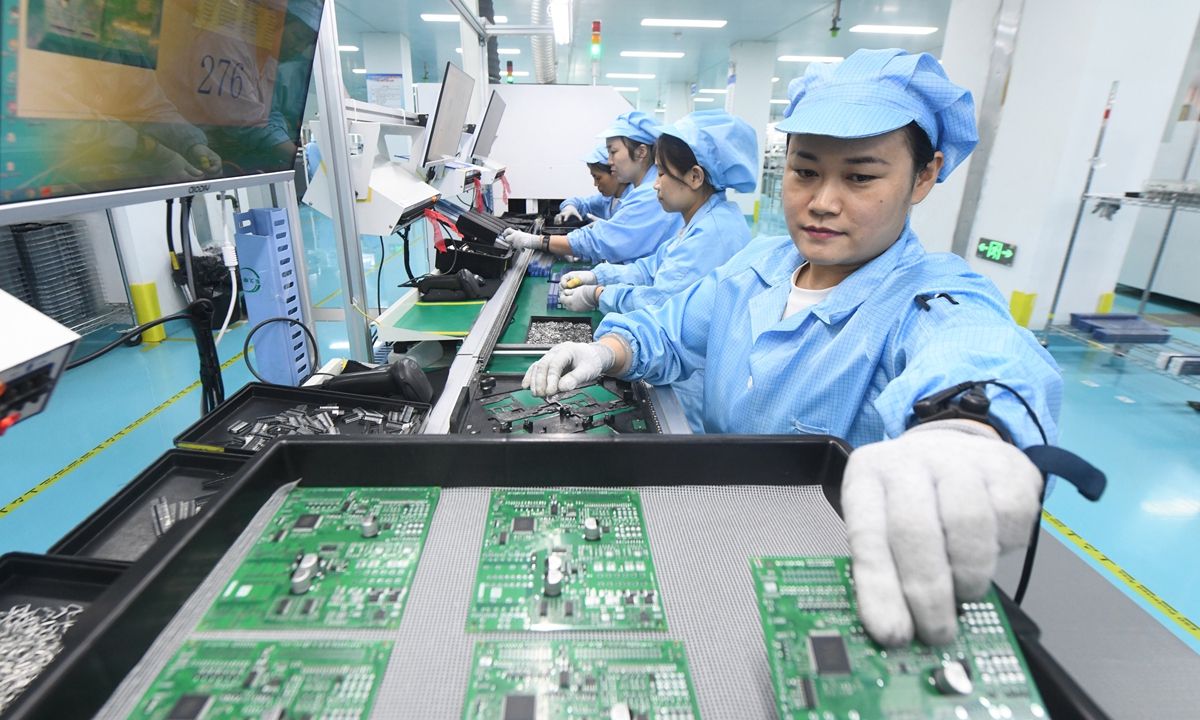
Workers produce electronic components for exports at a factory in Xinle, North China's Hebei Province, on June 16, 2026. (Photo: VCG)
In psychology, there is a concept known as "attribution theory": People tend to attribute their successes to internal factors, such as their own efforts, while attributing their failures or problems to external factors.
This tendency is especially pronounced among trade protectionists. When some countries' industries fall behind, become outdated or suffer from domestic deindustrialization, they shift the blame onto others, claiming that China is at fault.
In response to these phenomena - politicizing trade issues, hyping up the "overcapacity" problem in China, and escalating restrictions on the country - the Chinese Ministry of Commerce officially released a document titled "China's Position on the So-called Excess Capacity Issue."
The 12,000-word document essentially uproots the "overcapacity theory" in one fell swoop.
What does overcapacity mean? Does large production capacity necessarily mean overcapacity?
Simply put, overcapacity occurs when supply exceeds demand. However, market supply and demand are in constant flux. For example, refrigerators sell very well in summer but less so in winter. We cannot conclude that production is insufficient based solely on summer demand, nor can we conclude that there is overcapacity based solely on winter demand.
The document clarifies that excess capacity is a dynamic phenomenon in the market economy. Capacity supply and demand in the world economy go through the dynamic cycle of "balance - imbalance - rebalance", without lasting capacity balance. Whether there is surplus capacity depends on supply and demand with dynamic adjustments in the life cycle of the industry. Supply-demand balance is relative, while imbalance is universal.
As a complex concept, excess capacity should be approached from the perspective of macroeconomic scenarios instead of a narrow focus on the absolute level of capacity and a limited perspective confined to a particular time or region. There are no globally accepted criteria for determining the reasonable range of capacity utilization, as it differs across economies. Data from relevant institutions indicate that the median capacity utilization rate for advanced and fast-growing economies mostly falls in the 75-80 percent range, whereas that for less developed countries usually stands between 50 percent and 64 percent.
As the "world's factory" and "world's market," China's industrial capacity utilization rate is generally within a reasonable range. In 2025, China's industrial capacity utilization rate for enterprises above a designated size reached 74.4 percent, with high-tech manufacturing, high-end equipment manufacturing, and strategic emerging industries utilizing capacity more fully. The capacity utilization rate in some traditional raw material industries was temporarily lower, mainly due to adaptive adjustments brought about by structural reforms and green transformation.
Xu Yingming, director of the Institute of International Market Studies at the Ministry of Commerce's Research Institute, said that judging a country's capacity utilization rate is generally done by comparing it with its long-term equilibrium or average value. The long-term average capacity utilization rate in the US from 1967 to 2007 was 81.4 percent, while the average from 2008 to 2021 was 76.1 percent, a decrease of 5.3 percentage points.
In contrast, in the past three years, China's average capacity utilization rate in key sub-sectors such as general equipment manufacturing and electrical machinery and equipment manufacturing has remained within a relatively healthy range, basically close to the average capacity utilization rate since 2006.
Regardless of whether trade protectionists are genuinely confused or feigning ignorance, the document provides an objective analysis of the relationship between industrial subsidies, trade surpluses, economic imbalances, market competition, and "overcapacity," offering a solid and factual reality check.
For example, there is no necessary link between industrial subsidies and overcapacity. Multiple reports from the UN Conference on Trade and Development indicate that the number of global industrial policies has grown rapidly in the past five years, with providing research and development subsidies, tax incentives, and low-interest loans to emerging industries becoming international practices. Reasonable industrial subsidy policies help correct market failures, promote technological innovation, environmental protection, poverty reduction, and balanced development, and do not cause "overcapacity."
A large trade surplus does not necessarily mean overcapacity. Eighty percent of US-produced chips are exported, and about two-thirds of Boeing's commercial aircraft are sold to customers outside North America; the EU's 2025 trade surpluses in automobiles, pharmaceuticals, and cosmetics reached $92.2 billion, $214.6 billion, and $11.6 billion respectively. China does not deliberately pursue a trade surplus. In the first half of the year, China's merchandise imports grew 22.1 percent, significantly faster than exports. Foreign-invested enterprises contributed 16 percent of China's trade surplus in 2025 and reaped substantial returns. "The surplus is in China, but the benefits are shared by all parties."
The claim that "insufficient domestic demand in China leads to excess capacity" is also inaccurate. According to World Bank purchasing power parity calculations, China's total retail sales in 2025 were equivalent to 1.7 times those of the US, making it the world's largest consumer market for goods. China ranks No.1 globally in physical goods consumption, and per capita annual consumption of some industrial products is approaching the levels of developed countries.
In fact, market competition itself is the most effective mechanism to prevent disorderly expansion of production capacity; otherwise, unsold goods, losses, and market elimination will occur. The number of market entities in China has exceeded 200 million, creating a highly competitive market environment. A survey by the US-China Business Council shows that 92 percent of surveyed US companies were profitable in China in 2025, and a survey by the European Union Chamber of Commerce in China shows that 75 percent of companies believe their production efficiency in China is higher than in other parts of the world.
Cui Fan, a professor at the University of International Business and Economics, said that the document's discussion of four pairs of relationships clarified some vague and erroneous understandings prevalent internationally regarding the issue of production capacity. For example, if issues such as climate change are left entirely to the market to resolve, it may not meet the urgent need for low-carbon emission reduction. Only a combination of an effective market and a capable government can better address these challenges.
Data from the International Renewable Energy Agency shows that over the past 10 years, the average cost per kilowatt-hour for global wind power and solar power has cumulatively decreased by over 60 percent and 80 percent respectively, largely thanks to Chinese innovation, Chinese manufacturing, and Chinese production capacity.
The purpose of uprooting the "excess capacity theory" is not to engage in verbal battles, but to clarify doubts and promote win-win cooperation. As the document states, mutually beneficial and pragmatic cooperation on industrial and supply chains that makes the pie of global development bigger serves the common interest of all countries.
In recent years, China has continuously expanded its opening-up, reduced import tariffs, expanded the opening-up of service trade, and implemented a strategy to expand domestic demand, Cui said. For some products with rapid export growth that are prone to trade friction, China has proactively reduced or canceled its export tax rebates to maintain export order. The decline in industrial competitiveness in some economies is not due to "excess capacity" in China. China has been actively expanding imports, promoting balanced import and export development, and providing more market opportunities for its trading partners.
The data speaks for itself: China has ranked second globally in imports for 17 consecutive years and is a major export destination for nearly 80 countries. It has also implemented zero-tariff on 63 countries, making it the first major economy in the world to achieve full coverage of zero-tariff coverage for all African countries with which it has diplomatic relations, as well as all least developed countries that maintain diplomatic ties with it. China is the only country in the world to host the China International Import Expo. Having successfully held eight sessions, the expo has achieved a cumulative intended transaction volume exceeding $580 billion. During the 14th Five-Year Plan (2021-25) period, the cumulative import volume surpassed 90 trillion yuan ($13.3 trillion).
These facts point to an irrefutable conclusion: China is not only an increasingly powerful "world factory," but also a vibrant "world market." China's modern industrial development is not a "China shock 2.0" for the world, but rather a "China opportunity 2.0."
(Source: Global Times)