


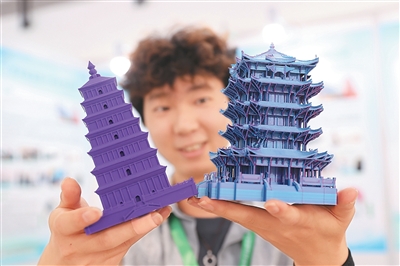
A staff member displays artworks 3D-printed from recycled materials at the 24th China International Environmental Protection Exhibition and Conference and the eighth Conference on the Innovative Development of the Environmental Protection Industry in Beijing, June 2, 2026. (Photo/Chen Xiaogen)
The word "handcrafted" often conjures up images of small, playful gadgets. But in China's tech scene, the term has also come to cover lightweight digital content, like AI-generated videos and apps, made quickly by a single person or small team.
Now, as AI and 3D printing technologies mature, the same DIY spirit is now making its way into industrial-grade production, enabling small teams to build industrial equipment like robots and drones in just days.
Tan Liwei, a user experience engineer at Chinese tech giant Huawei in Shenzhen, south China's Guangdong Province, decided to build a smart plant accessory in 2025 after noticing that while most households grow houseplants, few know how to keep them healthy. He came up with the idea of translating soil-monitoring data into facial expressions on a small screen, such as a frown when the plant needs water or a hand shielding its forehead from too much light.
Half a year later, he brought working prototypes to the 2026 Consumer Electronics Show (CES) in Las Vegas, drawing coverage from more than 70 global media outlets and garnering over 10 million views online. The product is now headed for mass production, with preorders launching in September.
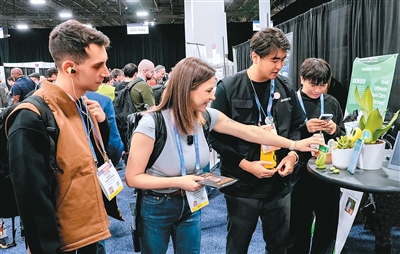
Tan Liwei (second from right) attends the 2026 Consumer Electronics Show (CES) in Las Vegas. (Photo courtesy of the interviewee)
In Wenxin subdistrict, West Lake district, Hangzhou, east China's Zhejiang Province, Zhejiang University Ph.D. holder Zhang Dong is building an eldercare robot that can fetch water and fruit for seniors. His workshop, which started in a garage five years ago, has since moved into a space provided by the local subdistrict government.
Two decades ago, as a graduate student, Zhang spent more than three years with a team of six or seven building a machine-vision sorter for red dates. Now, with the help of AI and 3D printing, and not counting time spent sourcing parts online, designing and printing a structural part takes just three days, while developing the software system takes another three.
Similar stories are multiplying: college students at Huazhong University of Science and Technology in Wuhan, central China's Hubei Province, pooled living expenses of 10,000 yuan ($1,476) to build a humanoid robot later sold to a company for 400,000 yuan; high schoolers in Shenzhen built a drone from foam board and water bottles.
Liu Lianlian, a researcher at the Anhui Academy of Social Sciences, said "handcrafted" hardware now incorporates technologies such as 3D printing, AI, programmable logic controllers and modular components. This gives products the functionality, interactivity and commercial potential needed for real-world applications in fields like education, exhibitions, cultural tourism and consumer markets.
Turning a prototype into a mass-produced product once stopped many entrepreneurs cold.
For Tan, the path across that gap was clear. Once market demand was validated, he decided to outsource circuit design and wiring, mold-making, printed circuit board (PCB) printing and final assembly to a large original design manufacturer in Shenzhen, freeing his core team of six or seven to focus on algorithms and product development.
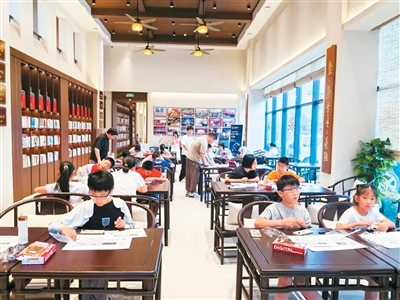
Zhang Dong and his team move their "garage lab" into a community center, launching a science outreach program for youth. (Photo courtesy of the interviewee)
Tan said sourcing a PCB prototype that might take Silicon Valley teams three to five months to complete takes just a week in the Guangdong-Hong Kong-Macao Greater Bay Area.
Agile manufacturing clusters, like Shenzhen's Huaqiangbei, Asia's largest electronics market, offer design, rapid prototyping, flexible manufacturing and logistics under one roof, allowing small-batch and even single-item orders.
Platforms are also lowering the barriers to hardware entrepreneurship. The Shenzhen InnoX Academy, founded in 2021 by Hong Kong University of Science and Technology professor Li Zexiang, has built a resource pool of more than 1,600 suppliers covering the full range of smart hardware manufacturing, including 3D printing, and has been used by more than 200 tech companies.
"More and more service providers now offer one-stop solutions covering everything from design and prototyping to soldering and debugging, and there are more channels than ever for connecting with small-batch orders," Zhang said. "That shows the system supporting the commercialization of creative ideas is already fairly well developed."
JLC is a leading example of this kind of one-stop service. The Shenzhen-based provider of electronics and machinery manufacturing services uses a "group-buying model" to bundle large numbers of small orders into single production runs, cutting the cost of a single PCB prototype run from several hundred yuan to just tens of yuan and shortening delivery times from weeks to as little as 12 hours. In 2025, the company's revenue exceeded 10.23 billion yuan, with more than 21 million orders processed over the year, serving nearly 10 million engineers and makers.
"Backed by China's comprehensive supply chain advantages, as long as something 'handcrafted' wins market recognition, mass production is no longer the bottleneck," Zhang said.