


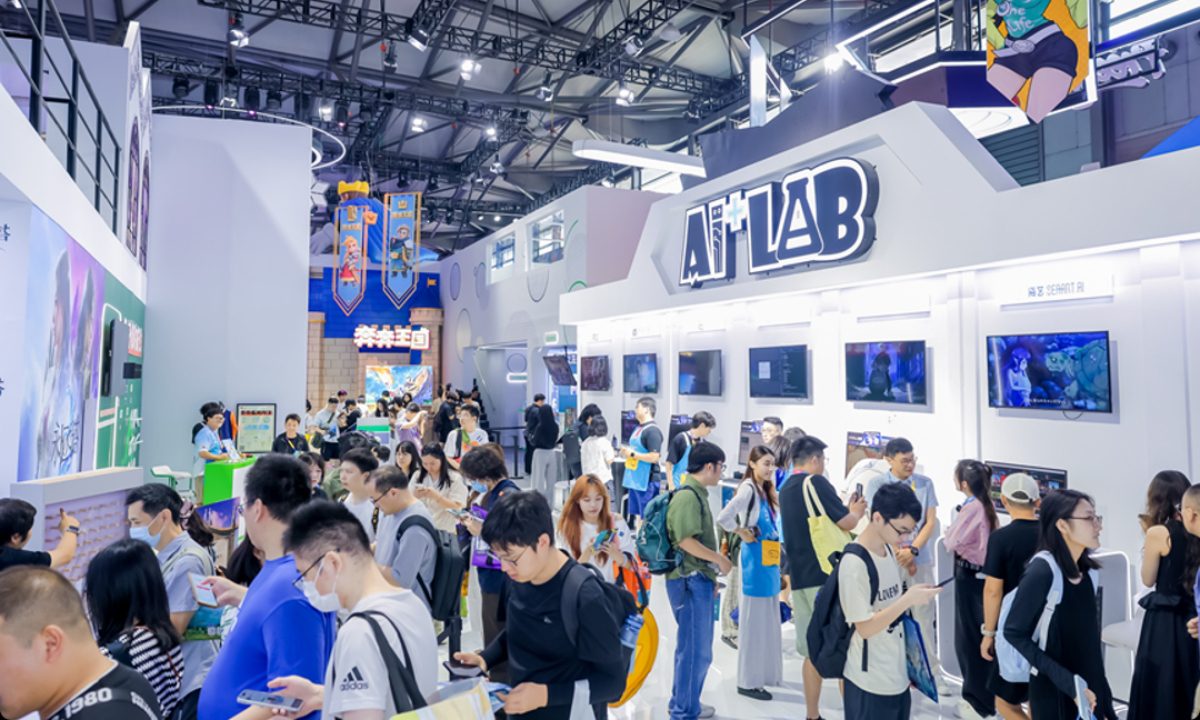
Visitors at ChinaJoy on July 31, 2026 (Photo: courtesy of Century Huatong)
AI becomes the highlight of the 23rd ChinaJoy held in Shanghai during the weekend, where nearly 900 exhibitors from 39 countries and regions showcased a full spectrum of AI-enabled gaming solutions under the theme of "Level Up with AI."
From AI-driven game development workflows to humanoid robots grooving to live music, cutting-edge AI technologies have been woven into game creation, production and operation. The immersive on-site exhibits offer visitors a first-hand glimpse into the vigorous rollout of AI across China's gaming industry, with an official industry report putting AI penetration at 86.36 percent in the Chinese market.
Century Huatong's exhibition booth stood out with full-scale AI features. Equipped with a welcoming humanoid robot and an original AI-produced theme song, the booth displayed the company's core game IPs and offered immersive experiences, attracting large crowds on the opening day.
In addition, Century Huatong has set up an AI+LAB zone to exhibit entries of its 2nd Digiloong Cup Global AI Innovation Competition. Launched in April, the contest covers AI games, applications and agents and received nearly 100 submissions.
Century Huatong has long built up its AI ecosystem for games development. AI tools have improved its art production efficiency by 60-80 percent and shortened content development cycles, the Global Times learned from the company.
Another ChinaJoy exhibitor, X.D. Network launched its in-house AI game development tool TapTap Maker in early 2026. Creators only need to submit text prompts, and the AI will generate code, visuals and audio to build playable games. The tool allows people without coding skills to make games independently and helps professionals streamline prototype testing.
The company told the Global Times that 4,699 works have been produced on the platform in six months, mostly by first-time developers, demonstrating how AI has lowered the barriers for amateur game creation.
This year's ChinaJoy introduced the new Vision Future cutting-edge tech zone, spotlighting humanoid robots, smart wearables, spatial computing and integrated software-hardware AI applications.
Dozens of leading tech firms including Unitree and LimX Dynamics showcased their achievements that reflect AI's shift from auxiliary tools to end-to-end applications. Qualcomm displayed edge-AI devices such as AI-enabled smartphones, laptops, earbuds and smart glasses, alongside multiple AI-powered robots, the Global Times learned from the organizer.
Official statistics show China's game market generated total sales revenue of 188.45 billion yuan in the first half of 2026, marking a year-on-year growth of 12.17 percent. Chinese gaming companies' overseas sales hit $12.372 billion, surging by 30.22 percent year-on-year.
Double-digit growth across both domestic and overseas markets has positioned AI as a major engine driving games sector transformation, according to a report released by Game Publishing Committee of the China Audio-Video and Digital Publishing Association (CADPA) during ChinaJoy.
According to CADPA, AI penetration in China's game industry stands at 86.36 percent. The survey covering 22 representative firms including Tencent Games, NetEase Games and Huya found AI has been broadly adopted across four core stages of game development -- planning, art, programming and testing, boosting efficiency in artwork creation, automated testing and intelligent NPC production with the most noticeable improvement in asset generation for art, though its use remains largely auxiliary and has not yet overhauled the human-led development model.
Chinese research institute Gamma Data estimates that mature large-scale AI adoption will unlock a market potential worth 53.3 billion to 84.6 billion yuan for China's game industry.