


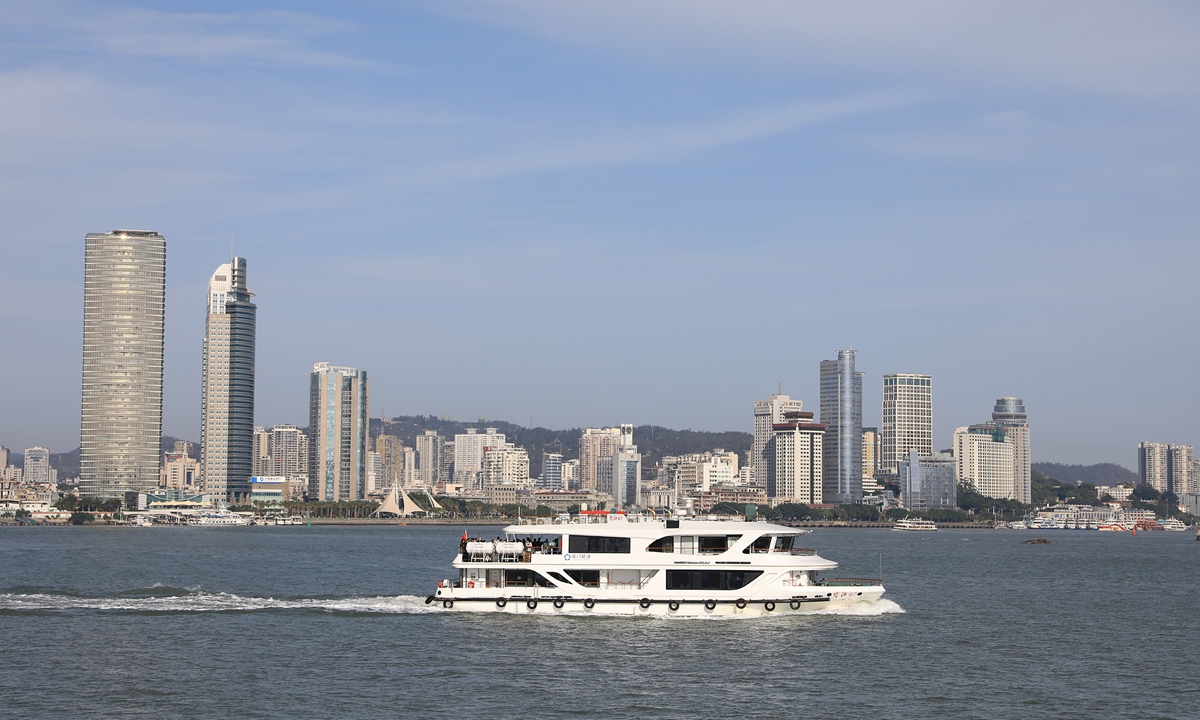
A cruise boat sails against the skyline of Xiamen in East China's Fujian Province. (File photo: VCG)
Christmas may still be months away, but inside a German chocolate factory in Xiamen, East China's Fujian Province, the holiday season has already begun.
On the production line, workers carefully arrange festive-shaped chocolates, which then go through a series of steps including molding, cooling, wrapping and packing before being shipped across the ocean to overseas markets such as the US and Australia.
Located in Haoliwen Industrial Park in Xiamen's Haicang district, the factory is operated by WAWI Chocolate (Xiamen) Co., Ltd., a German-invested company that was among the first foreign companies to settle in the coastal city in the 1990s. Over the past three decades, its workforce has grown from around six employees to 450-500, while its global reach has expanded significantly, with annual exports rising from 15 containers at the beginning to about 300 to 350 containers today.
The story of this chocolate factory goes beyond chocolate itself. It reflects the broader transformation of Xiamen. Once a coastal city with a modest port handling only tens of thousands of containers annually in the early 1990s, the Port of Xiamen has developed into a global shipping hub, with container throughput exceeding 12.5 million twenty‑foot equivalent units (TEUs) last year, placing it among the world's major ports.
Behind these figures is a city that has undergone profound economic transformation over the past decades. Xiamen's GDP reached 898 billion yuan ($132.62 billion) last year, a record high that reflects its evolution from a smaller coastal economy into a modern industrial and innovation base. The city has also gained recognition for its livability, ranking among leading Chinese cities in the China City Livability Index Analysis Report.
During a recent visit to Xiamen, Global Times reporters observed how openness and sustainable development have become two defining forces behind the city's transformation, shaping not only its industries but also its communities and urban landscape.
Open to the worldInside this German chocolate factory, Baerbel Lellbach, managing director of WAWI Chocolate (Xiamen) Co, has spent more than three decades witnessing both the growth of the company and the transformation of Xiamen.
When she first arrived from Germany as an intern, she never expected that she would spend so many years in the coastal city.
At that time, Xiamen was "more of a jungle," she recalled, with large areas of greenery but few commercial facilities, making even a simple shopping trip inconvenient.
What kept her here was the city's unique charm and the people she met. During her early days in China, she was deeply touched by the warmth and hospitality she experienced while traveling and living here.
The city has also become a long-term home for the company she represents. According to Lellbach, one of the key reasons WAWI Chocolate has been able to stay in the city for so many years is its strong manufacturing foundation, skilled workforce and well-established supply chains, among other factors.
Beyond attracting foreign businesses, Xiamen's openness has also created opportunities for international residents.
For Luigi d'Apolito, a 47-year-old Italian teacher, Xiamen has become a place where his passion for cars has found new possibilities.
When Global Times reporters met him, he was in a laboratory testing self-developed components for an electric racing car with his students, preparing for a competition in November.
As an associate professor at the School of Mechanical and Automotive Engineering of Xiamen University of Technology, d'Apolito comes to the lab almost every day during the summer break.
"China's new-energy vehicle (NEV) industry is developing very fast, and I am excited to be part of it," he said.
After first arriving in China in 2010, d'Apolito noticed the potential of the emerging NEV sector. He joined Xiamen University of Technology in 2012, where he has since been involved in teaching and research related to automotive engineering.
For d'Apolito, Xiamen has provided a front-row seat to this transformation. Through projects with his students, he has developed electric racing cars that compete in global competitions, with support from local NEV companies whose industrial needs also provide direction for their research.
"This sense of participation makes me excited," he said. "When I came to Xiamen, I felt that I would live here for a long time."
Beyond professional opportunities, d'Apolito said the city's comfortable environment, improving public services and support for international talent have helped him gradually become part of the community.
"You feel that you are not only working here, but becoming part of a larger community," he said.
For Bong Antivola, a Filipino who has lived in Xiamen for 20 years, the city's transformation has been a journey he has experienced firsthand.
"I have spent one third of my life living in Xiamen," he said.
As the foreign investment director of Yingke Matrix, which helps foreign companies invest and establish operations in China, Antivola has long been involved in China's overseas economic exchanges and witnessed growing interest among overseas businesses in the Chinese market.
Work opportunities first brought him to Xiamen, but it was the city itself that made him stay.
He recalled that when he first arrived, what impressed him most was how different Xiamen was from many other major cities. The city was more convenient, comfortable and filled with green spaces, he said.
Over the years, Xiamen has continued to improve its services for international residents. Digital payment, online services and multilingual public facilities have made daily life smoother for people from different cultural backgrounds.
The city has been working to build a more internationally competitive investment environment aligned with global rules. By 2025, around 140 foreign-invested companies backed by Fortune Global 500 companies had established operations in Xiamen, while the city continued to improve foreign investment facilitation by implementing the negative list for foreign investment access.
"The city keeps evolving rapidly, but one thing that never changes about Xiamen is its natural beauty. It remains a garden island city... Local businesses are still thriving even amid global economic headwinds, and Xiamen is still a rapidly growing, progressive city," said Antivola.
A touch of green, blueStanding by the sea on Xiamen's Gulangyu Island is a symbolic dolphin sculpture, a familiar landmark known by locals as the "Gulangyu Welcome." It serves as a reminder of Xiamen's efforts to protect the Chinese white dolphin, a national first-class protected animal that has long called the city's waters home.
While pursuing openness and development, Xiamen has remained committed to ecological protection. Liu Wei, deputy director of the Xiamen Chinese White Dolphin Nature Reserve Affairs Center, told the Global Times that "the population of Chinese white dolphins in Xiamen Bay has remained stable for many years, with a healthy age structure featuring multiple generations living together."
Behind this achievement lies years of sustained conservation efforts. In the 1950s and 1960s, Chinese white dolphins were relatively abundant in Xiamen's waters. However, as urban development accelerated and marine activities expanded, port construction, channel projects and increased vessel traffic placed growing pressure on their habitat. By the 1990s, when systematic monitoring began, the dolphin population in Xiamen had already declined significantly, according to Liu.
In 2000, the Xiamen Chinese White Dolphin Nature Reserve was upgraded to a national-level nature reserve, marking a shift from responding to problems after they occurred to comprehensive management throughout the development process.
Today, when advancing projects such as port construction and cross-sea infrastructure, early assessments are conducted to evaluate potential impacts on marine ecosystems. For projects involving areas where Chinese white dolphins are active, avoiding disturbance is prioritized during the planning stage.
"Nowadays, protection of Chinese white dolphins is considered from the very beginning of marine projects, starting at the planning and site selection stages," Liu said. One recent example is the ongoing Xiamen-Kinmen Bridge project has adjusted its route and optimized bridge designs to preserve space for dolphin activity.
Environmental protection in Xiamen is not limited to the sea. It also reflects in the city's efforts to restore its urban ecosystems.
Located near Xiamen Bay, Yundang Lake is a vivid example of this transformation.
In the 1980s, years of untreated industrial and domestic wastewater discharge left the lake heavily polluted, earning it the nickname "Xiamen's smelly ditch" among local residents.
The turning point came in 1988, when Xiamen launched a comprehensive restoration project. Over nearly four decades, the city has continued to improve the lake's environment by building sewage networks, restoring water circulation and using tidal exchanges to maintain ecological vitality.
Today, the lake has become home to 98 recorded bird species and more than 60 aquatic species, with the island at the center serving as an important habitat for egrets, said Zhong Pengze, a staff member at the Xiamen Yundang Lake Protection Center.
Ecological restoration is not only about improving the environment, but also about rebuilding the relationship between people and nature.
Zhong told the Global Times an interesting story about the lake's restoration process. During the process, some residents suggested trimming an old tree whose low-hanging branches affected pedestrian access along the lake. After inspection, they decided to preserve the tree, saying its age and unique shape had become part of the city's landscape.
"Bowing to the tree is also bowing to nature," Zhong explained.
During the 14th Five-Year Plan period (2021-25), Xiamen made significant strides in ecological conservation. The city was designated a National Demonstration Zone for Ecological Civilization, ranked first nationwide in waste sorting, maintained air quality among the best in China, and was recognized as a global "City of Biodiversity Charm," according to Fujian Daily.
In the 15th Five-Year Plan (2026-30), China pledged to steadily expand institutional opening-up, and Xiamen, as an important gateway for opening-up, is entering a new stage of high-quality development.
The effort to balance between development and nature have become part of Xiamen's appeal to international residents.
"The longer I stay here, the more I like this city," Lellbach told the Global Times.