


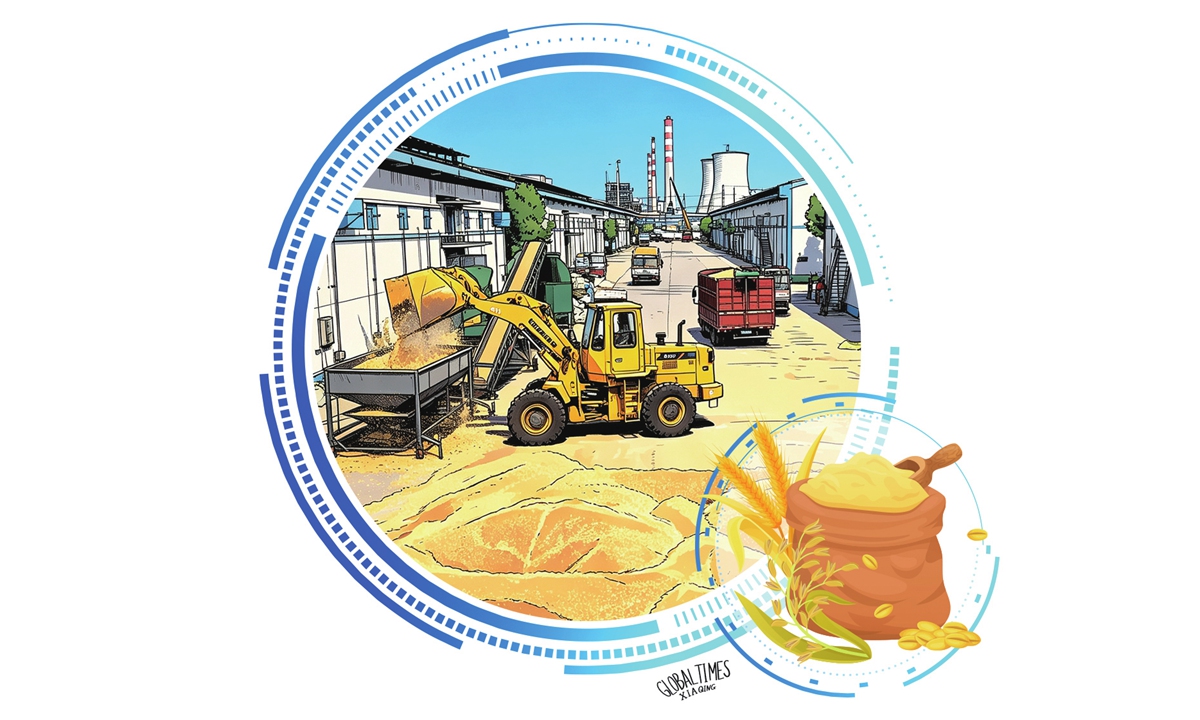
Illustration: Xia Qing/GT
Temperatures in parts of East China's Shandong Province recently exceeded 40 C. In a grain storage facility in Jiyang, a district of Jinan in Shandong, the average temperature of stored grain remained at about 20 C. An internal air circulation system made this possible, helping preserve grain quality through the summer heat.
This is not a story about technology in the abstract. It is about a practical challenge: how to keep grain properly stored as temperatures rise. Such examples point to a broader economic question facing the world: how to accelerate the conversion of technological advances into market-ready products.
In the northern hemisphere, many regions have recently experienced record-breaking temperatures. The El Nino affects not only temperatures but also global rainfall patterns, potentially adding to weather-related uncertainty for economies around the world.
The economic effects could be felt across a range of sectors, from agriculture and energy systems to infrastructure and supply chains. In agriculture, analysis from the United Nations World Food Programme suggests that the strengthening El Nino is set to significantly worsen food insecurity in some of the world's most vulnerable countries into 2027.
Setting aside the climate issue for a moment, reducing the El Nino's economic effects becomes a practical consideration, with technology offering one possible approach.
In this area, China provides a useful point of reference. This is not to say that the country has faced climate-related problems in recent years. Rather, rapid technological advances in China have produced a wide range of practical applications, some of which could help strengthen economic resilience amid the current phase of global climate volatility.
Agriculture is one area where technological progress has translated into practical applications. Summer grain storage is one such case. According to CCTV.com, temperature monitoring systems installed inside grain storage facilities allow operators to track changes in grain temperatures in real time. When temperatures in the upper layers reach a preset control level, internal circulation ventilation is activated to reduce heat and humidity inside the facility. Such applications can help improve the reliability of large-scale grain storage during hot summer months.
This summer, heatwaves have affected parts of the world. For some households, the question has been whether to install air conditioning. A similar question applies to grain storage facilities: should more warehouses be equipped with temperature-control systems?
Grain storage, however, is only one small part of a broader adjustment that may be taking place across the economy. Rising temperatures can create demand for adaptation technologies, from air conditioning to automation that helps industries operate more efficiently as environmental conditions change. The potential applications span sectors such as cold-chain logistics, agriculture, manufacturing and even robotics.
Reducing the economic costs of climate volatility will require more than technological breakthroughs. The greater challenge is turning those advances into products that can be produced at scale, traded across borders and deployed where they are needed. For developing economies in particular, access to affordable technologies will be an important part of adapting to changing environmental conditions.
China's development offers a useful illustration. Technological progress has been accompanied by a strong ability to turn innovations into commercial products at scale. As these products reach different markets, they could help countries address the economic pressures associated with climate volatility.
Climate-related challenges do not stop at national borders, and neither should the technologies needed to address them. Expanding technology trade would allow more economies to benefit from innovations developed elsewhere. This will require not only continued technological progress, but also a more open environment for global technology trade and investment.
Amid rising temperatures, the demand for air conditioning may only be the beginning. The next stage of technology trade should bring more adaptation technologies into agriculture, manufacturing and services, helping economies build greater resilience amid a more uncertain environment.